Sort reusable paper offcuts by the next useful size
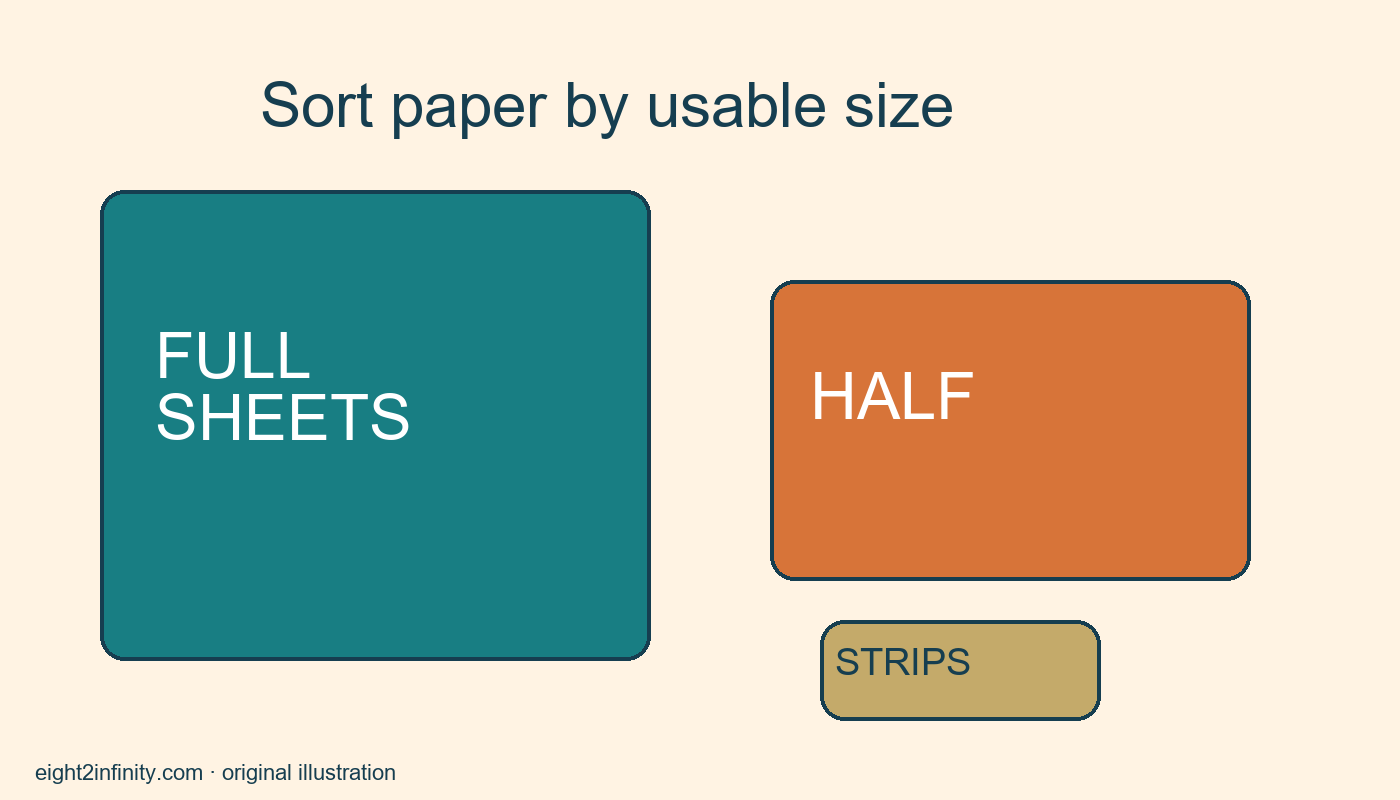
Sort reusable paper offcuts into a few sizes you can actually use, rather than saving every scrap in one mixed pile. A practical starting point is full sheets, half sheets, and narrow strips. Keep only clean paper suitable for an identified task, such as drafting, labels, or paper crafts. This is an original household sorting method based on the broad idea of reducing waste through reuse, not a promise that every paper type belongs in the same recycling stream.
Choose the uses before making piles
List two or three real uses for spare paper. Perhaps you sketch room layouts on full sheets, write short shopping lists on half sheets, and mark notebook pages with strips. Those uses define the size groups. If you never use narrow strips, do not create a large strip collection just because the pieces look potentially useful. A category should have an expected destination, not merely a reassuring label.
Start with a small stack of ordinary clean paper. Exclude anything with personal information you do not want exposed. A printed address or account detail remains visible on the reverse even when the blank side seems useful. Also set aside paper that is dirty, sticky, or otherwise unsuitable for your planned task. Follow your local disposal or recycling requirements for items you cannot reuse. This article does not provide a universal materials-acceptance rule.
Make three visible groups
Lay out the full sheets first. Then form a second group of approximately half-sheet pieces that fit your usual note area. Put long narrow pieces in a third group only if you have a use for them. Exact dimensions are unnecessary unless a project requires them. The purpose is quick retrieval: you should be able to reach for a useful writing surface without searching through dozens of mismatched fragments.
For an invented example, suppose the starting stack contains four full blank-backed sheets, six half sheets, eight strips, and five tiny irregular corners. You plan to use full sheets for diagrams, half sheets for lists, and only two strips as page markers. Keep those useful amounts accessible. Review the remaining strips and corners honestly instead of treating every retained piece as an automatic success. A smaller usable supply can be more helpful than a larger inaccessible one.
Store the groups without hiding their purpose
An existing folder can hold the full sheets, while a shallow envelope can hold the half sheets. Keep strips flat in a small labeled sleeve if they otherwise slide around. Do not add heavy clips that make it annoying to take a single note sheet. The storage should fit the retrieval motion: open, take one piece, and close. If obtaining paper requires emptying the whole container, simplify the arrangement.
Use labels that describe both size and purpose when that adds clarity. Half sheets for quick lists is more informative than Miscellaneous paper. Place the most frequently used group where you normally begin the task. For example, keep a small half-sheet supply near your ordinary list-writing spot rather than moving all household paper to a distant cupboard. Avoid scattering duplicate supplies throughout the home before you know how quickly you use them.
Set a physical limit
Choose a modest container and treat its capacity as a review trigger. When it becomes full, use some paper or reduce what you retain. Do not automatically find a larger box. The point is to keep paper available for use, not to build an archive of every offcut. A visible limit makes the decision concrete and prevents the collection from quietly spreading into neighboring storage.
Inspect both sides before writing a note that someone else will see. A draft diagram may be suitable for your own desk but confusing if handed to a visitor with unrelated printed text on the back. For a shared instruction or formal document, choose a clean sheet appropriate to the purpose. Reuse is one consideration; readability, privacy, and the recipient's needs also matter.
Keep cutting optional
You do not need to trim every piece into exact rectangles during the first sort. If a roughly half-sized piece already works for a short list, leave it as it is. Standardizing paper can become a separate task that takes longer than the notes it supports. Cut only when the intended use needs a particular fit, and use appropriate tools on a suitable surface. Keep sharp tools stored separately when you finish.
If you do trim a batch, test one piece in the storage envelope before cutting the rest. A nominal half sheet may still be too wide for your chosen pocket. This small check avoids producing a tidy stack that does not fit where it belongs. Similarly, make sure a strip used as a page marker does not protrude so far that it folds whenever the notebook is carried.
Review after a week of use
Notice which group shrinks and which remains untouched. Move more suitable pieces into the group you use and stop saving the category that only accumulates. Try writing three actual notes from the sorted supply before calling the system finished. Can you find the right size without moving another pile? What paper size would you stop saving if its storage space had to remain the same for the next month?