Find a right triangle area by halving a rectangle
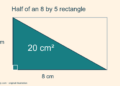
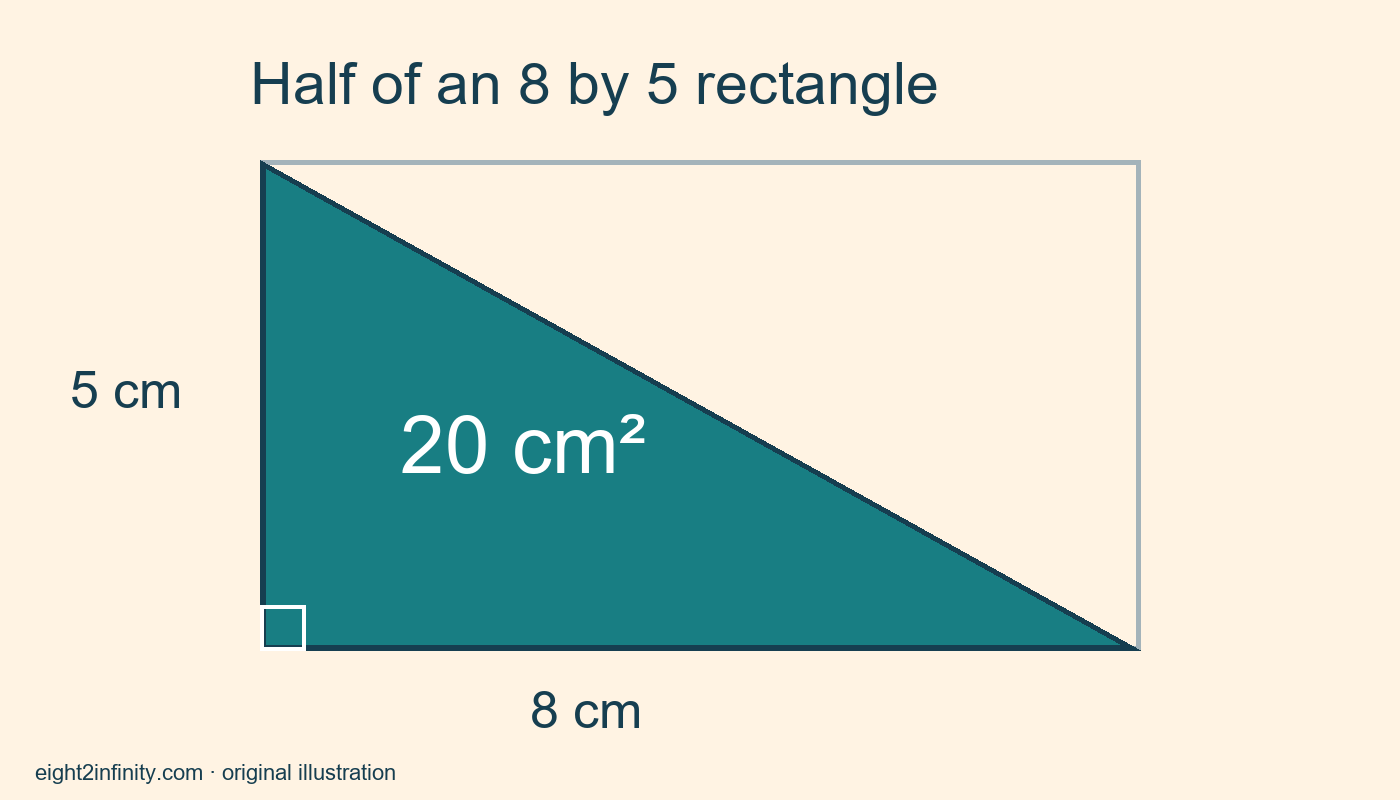
A right triangle formed by a diagonal across a rectangle has half that rectangle's area. Multiply its perpendicular base and height, then divide by two. For a triangle with an 8-centimeter base and a 5-centimeter perpendicular height, the area is 8 times 5 divided by 2, or 20 square centimeters. The height must be perpendicular to the chosen base; the sloping side is not a substitute.
Draw the enclosing rectangle
On squared paper, draw a rectangle eight squares wide and five squares high. For this model, let each square represent one square centimeter. Label the bottom edge 8 cm and a vertical edge 5 cm. Count rows and columns to verify that the rectangle contains forty unit squares. The drawing is a teaching model, so use the labels and the defined scale rather than assuming a casually drawn sketch is measured precisely.
Draw a diagonal from the upper-left corner to the lower-right corner. The diagonal divides the rectangle into two triangles. Each has one horizontal side and one vertical side meeting at a right angle. These are the perpendicular base and height for the calculation. The diagonal is their sloping side. Keep the right-angle corner visible with a small square mark so the relationship is clear.
Explain why one half appears
The two triangles fit together to make the full rectangle, without gaps or overlaps. They have matching shapes and equal areas. Since the rectangle covers forty square centimeters, each triangle covers half of forty, or twenty square centimeters. The division by two is therefore connected to a visible construction. It is not an arbitrary instruction to memorize without understanding where it comes from.
If you cut out the rectangle for a paper demonstration, draw and label it before cutting along the diagonal. Rotate one triangle to compare it with the other. Handle scissors appropriately and use an alternative drawn demonstration if cutting is unsuitable for the learner. The mathematics is the equal-area relationship; physically cutting paper is an optional way to make that relationship easier to see.
Write the calculation with units
Write Area = one half times base times perpendicular height. Substitute the values as one half times 8 cm times 5 cm. Multiplying the lengths produces square centimeters, so the result is 20 cm². Do not write 20 cm, because that is a length unit rather than an area unit. The tiny squared symbol expresses that the measurement counts two-dimensional square units.
You can perform the arithmetic in more than one order. Eight times five is forty, then half is twenty. Alternatively, half of eight is four, and four times five is twenty. Both calculations describe the same area. Keep the explanation linked to the rectangle so the convenient arithmetic does not become a disconnected trick. If you halve both eight and five, you will reduce the area by too much.
Avoid substituting the sloping side
The diagonal is longer than either rectangle side, but its length is unnecessary for this area calculation. Using it as the height with the horizontal base would be incorrect because it does not meet that base at a right angle. Height is a perpendicular distance, not whichever side looks tall on the page. Rotating the drawing does not change which two sides meet at the right angle.
Try turning the paper a quarter turn. The rectangle still has the same area, and each triangle still occupies half. You may choose the other perpendicular side as the base, swapping the labels base and height. Five times eight divided by two remains twenty. This shows why the result depends on perpendicular dimensions rather than the direction the triangle appears to point.
Compare two deliberate changes
Draw another right triangle with an 8-centimeter base and a 10-centimeter perpendicular height. Its area is forty square centimeters, double the original area because only the height doubled. Then consider a triangle with a 4-centimeter base and the original 5-centimeter height. Its area is ten square centimeters, half the original. Predicting these changes helps you check whether a numerical answer is reasonable.
Do not infer the same relationships from a drawing alone if its dimensions are unspecified. A sketch may be intentionally not to scale. Use the stated measurements and make sure they use compatible length units before multiplying. If one dimension is in meters and the other in centimeters, convert to a common unit first. That keeps the final square unit meaningful and prevents a misleading mixed-unit product.
Check area against the whole
For the original rectangle, a triangle area greater than forty square centimeters cannot be right because the triangle lies inside that forty-square-centimeter rectangle. An answer of forty suggests you forgot to halve. An answer of ten may suggest you halved both dimensions. These checks do not replace the formula, but they connect common mistakes to the picture that explains the task.
Finally, draw a 6-centimeter by 4-centimeter rectangle and divide it diagonally. Predict each triangle's area, then verify that two copies total the rectangle's area. Each should be twelve square centimeters. Label the base, perpendicular height, and right angle on your drawing. How would you explain to another learner why the sloping side is not needed, even though it is one of the triangle's three edges?