Find a missing rectangle side from its perimeter
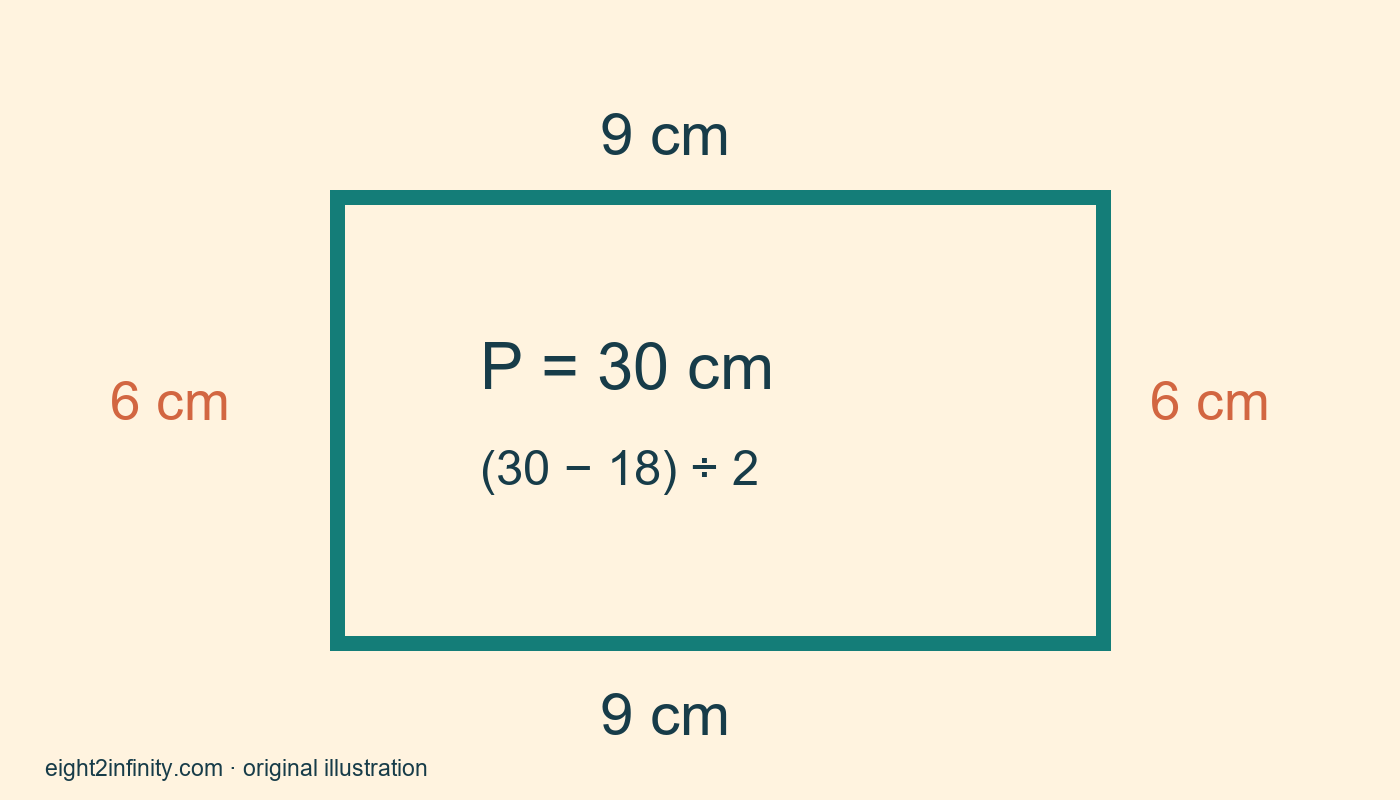
To find a rectangle’s missing side length from its perimeter and the other side, subtract the two known equal sides from the perimeter, then divide the remainder by two. For a rectangle with perimeter 30 centimeters and length 9 centimeters, the two lengths total 18 centimeters. The remaining 12 centimeters belong to the two equal widths, so each width is 6 centimeters. Check by adding all four sides: 9 plus 6 plus 9 plus 6 equals 30.
This original lesson uses the standard rectangle perimeter relationship described in OpenStax mathematics material. It concerns an ordinary rectangle with opposite sides equal. It does not apply unchanged to an irregular four-sided shape. Draw a labeled sketch before writing a formula so the quantities have meaning. The picture need not be to scale, but the equal sides and units must be shown accurately. Keep area separate: perimeter measures the boundary, while area measures the surface inside it.
Draw what is known
Sketch a rectangle and label the top and bottom 9 cm. Label the left and right sides with a question mark. Write Perimeter 30 cm outside the shape. The perimeter is the total distance around all four edges. It is not another edge you should add to the drawing. Trace the boundary with a finger or pencil and say the four side lengths in order: 9, unknown, 9, unknown. This makes the repeated pair of widths visible before any algebra is introduced.
Add the two known lengths: 9 plus 9 equals 18. Subtract that total from the perimeter: 30 minus 18 equals 12. Now point to the two unknown sides. Together they account for those remaining 12 centimeters. Divide 12 by 2 to get 6. Label both unknown sides 6 cm. Do not put 12 on each side, because that would use the remaining distance twice and create a different perimeter. The division step distributes the remainder between two equal edges.
Verify with the complete boundary
Add 9 plus 6 plus 9 plus 6. The result is 30 centimeters, which agrees with the given perimeter. Verification should use the original information rather than repeat only the last division. If you accidentally found a width of 12, the boundary sum would be 42 and reveal the mistake. A check is useful because an arithmetic answer can look plausible even when it assigns a total for two sides to one side.
Next calculate the area only to distinguish the measures: 9 times 6 equals 54 square centimeters. This is not a second answer to the perimeter question. The units explain the difference. Centimeters describe lengths along the boundary; square centimeters describe the surface inside. Writing 54 cm for the area or 6 square centimeters for the width mixes the quantities. Encourage the learner to say what each number measures before deciding which unit belongs beside it.
Connect the reasoning to a formula
If P is perimeter, L is length, and W is width, then P equals 2L plus 2W. Rearranging gives W equals the quantity P minus 2L, divided by 2. Use parentheses when writing this as a calculator instruction so the whole remaining boundary is divided by two. For the example, enter the quantity 30 minus 18, then divide by 2. Do not divide only the 18 by 2 before subtracting it from 30.
Another valid route is to halve the perimeter first. Half of 30 is 15, representing one length plus one width. Subtract the known length 9 to get width 6. Compare the two methods with the drawing: one removes both known sides before splitting, and the other groups the boundary into two identical length-and-width pairs. The methods agree because they describe the same rectangle. Choose the explanation the learner can connect to the sketch rather than requiring memorization without meaning.
Notice impossible or incomplete information
Suppose the perimeter were 16 centimeters while the length stayed 9 centimeters. The two lengths alone would total 18, already exceeding the stated perimeter. A negative result for the width would signal inconsistent information for an ordinary rectangle. Do not report a negative physical width as a valid solution. Recheck the problem, units, and transcription. A meaningful answer must fit the geometry as well as the arithmetic operations.
If only the perimeter is known, there is no single width. A rectangle with perimeter 30 can have sides 9 and 6, or 10 and 5, among other positive possibilities. The second side or another constraint is needed to identify one rectangle. This is a useful opportunity to explain that a formula cannot create missing information. Ask what the problem actually gives before inserting guessed numbers merely to make a calculation possible.
Practice with a new rectangle
Try a rectangle with perimeter 44 meters and length 13 meters. The two known lengths total 26 meters, leaving 18 meters for the two widths. Each width is 9 meters. Check 13 plus 9 plus 13 plus 9 equals 44. Then try perimeter 26 centimeters and length 8 centimeters. The width is 5 centimeters. Sketch both and label every side. Keep the units consistent within each problem rather than mixing meters and centimeters without conversion.
For a final exercise, create a rectangle with a width you choose, calculate its perimeter, and hide the width from a partner. Can they recover it and verify the boundary sum? Ask them to explain why the remaining perimeter must be divided by two. The useful learning outcome is the connection between paired opposite sides and the total boundary. A correct number matters, but a drawing, a unit, and a check make the reasoning reproducible and expose common mistakes.