Map a Busy Drawer Before Buying Organizers
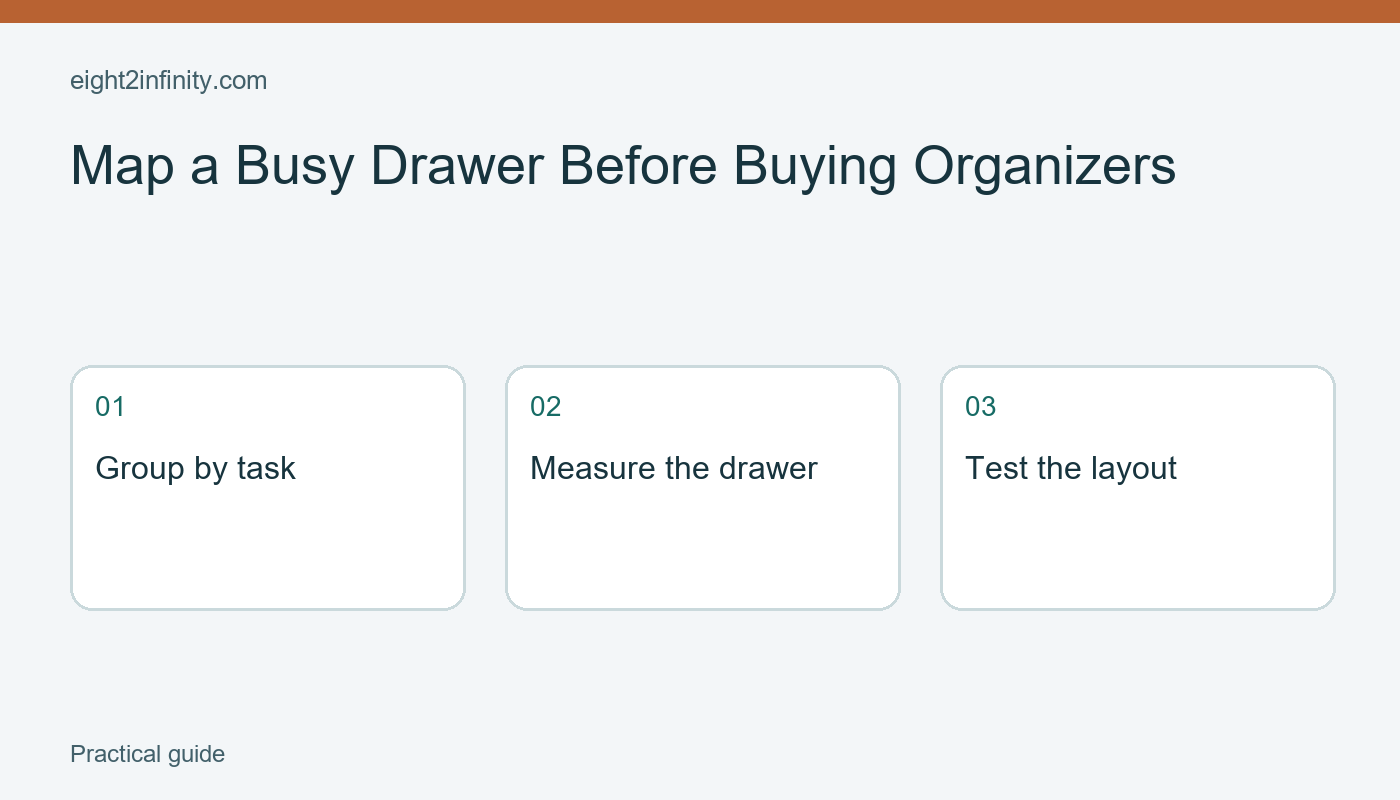
Before buying drawer dividers, group the items by task, measure the usable drawer space, and sketch where each group should live. Test the arrangement with containers you already have. This gives you evidence about the sizes and categories you need, instead of buying a matching set first and trying to make your belongings fit it afterward.
This is an original organizing exercise for a small household stationery drawer. It can also work for another low-risk category, such as craft supplies, if you adapt the groups to how you use them. Keep sharp tools, medicines, cleaning products, and small items that pose risks to children outside the scope of this general example. Their storage requirements deserve separate attention.
Define what the drawer should help you do
Write one sentence describing the drawer's job. For example, this drawer holds supplies for addressing letters, taking short notes, and fastening paper. That description gives you a test for each item. A spare phone charger may be useful, but it does not automatically belong in a paper-supplies drawer. You can choose another home for it without deciding to throw it away.
Gather a piece of paper, a pencil, a ruler, and a temporary container for items that belong elsewhere. Work on a clear surface and return any sensitive papers to their appropriate storage. Avoid spreading the contents across a walkway or leaving the drawer unusable overnight. A smaller section is a reasonable starting point if you do not have time for the entire drawer.
Use your existing household inventory as a reference if you have one. It may reveal that an apparent spare is part of a set kept somewhere else. The inventory is a clue, not a reason to keep every object in the current drawer. Our room-by-room home inventory guide describes how to record belongings without turning the exercise into a detailed catalogue of everything at once.
Sort by action rather than appearance
Place envelopes, stamps, and address labels in a mailing group. Put pens and a small notepad in a note-taking group. Put paper clips and suitable fasteners together. These are examples, not universal categories. A person who mails letters rarely may need a smaller mailing zone than someone who prepares several envelopes each week.
Count the bulky or awkward pieces in each group. Six pens need a different space from forty. A long ruler may need a full-width channel. Keep the actual objects nearby while drawing the plan, because a neat sketch can conceal a practical problem such as a lid that cannot open or a container too narrow for the item it is supposed to hold.
Make separate decisions about duplicates and broken items. Try pens on scrap paper before returning them to a ready-to-use group. Avoid keeping every dry pen merely because the new layout has room. Equally, do not discard a useful spare solely to match an arbitrary online photograph. The goal is a drawer that supports your tasks, with decisions you understand.
Measure the usable space
Measure the inside width, depth, and available height. Note rails, rounded corners, or hardware that reduce the space available to containers. A tray that fits the outer dimensions can still prevent the drawer from closing. Write the measurements on the sketch and include the unit. Mixing centimetres and inches on an unlabeled note can lead to a purchase that looks almost right but does not fit.
Draw a rectangle for the drawer and mark the planned groups. Put frequently used supplies where your hand reaches naturally. Give an awkward long object its place before dividing the remaining space. If a group is used only occasionally, it may belong at the back. These are hypotheses to test during the trial, rather than fixed rules about how every household should arrange a drawer.
Use small boxes or existing trays to test the boundaries. Check that the drawer opens and closes without items catching. Avoid attaching permanent dividers during this first trial. Temporary boundaries let you discover whether a group needs more room, whether two tasks belong together, or whether a container is simply annoying to lift every time you need a pen.
Test the plan during ordinary use
Use the drawer for several days and note any moment when an item is hard to retrieve or difficult to put away. A successful arrangement needs to work in both directions. If the drawer looks orderly only immediately after a sorting session, the return path may be too complicated. Reduce the number of compartments or move a category closer to its point of use.
After the trial, buy dividers only if a specific missing size or function remains. Bring the measurements and the group sizes with you. Compare the proposed organizer with the tested layout rather than assuming a product photo represents your needs. Reusing a suitable box is also a complete solution when it works and remains convenient to clean and inspect.
Try one drawer this week
Choose a drawer with ordinary paper supplies. Write its job, sort three task groups, record its internal measurements, and sketch a temporary layout. After three days, change one awkward feature and repeat the test. Which group needs the largest space, and does its space reflect how often you actually use it rather than how attractive the objects look together?