Make a Simple Home Library Location Index
A small home-library index needs only a book title, author, and shelf location to help you find a volume later. Give each shelf a stable label, record the books you most often search for, and update the location when you move one. Start with a useful subset rather than spending days cataloguing every book before the index becomes helpful.
This is an original practical filing method, not a requirement to follow a professional library standard. It suits a household where books are spread across several rooms and the main problem is locating a particular title. You can keep the index on paper or in a simple digital file. The best tool is one you can consult and update without making the system feel like another project.
Name locations before listing titles
Choose short location labels that describe places rather than individual books. For example, Study A1 could mean the top shelf of the first study bookcase. Living B2 could mean the second shelf of a different bookcase. Write down the naming rule so another person can interpret it without asking you. Keep the labels readable and avoid adhesive that might damage furniture.
Make a small location key with the room, bookcase, and shelf order. Decide whether you count shelves from top to bottom. A consistent rule matters more than the particular letters you choose. If the household has only one bookcase, simple labels such as Shelf 1 and Shelf 2 may be enough. Do not build a complicated coding scheme for a collection that does not need it.
Keep labels stable when individual books move. If a shelf named Gardening later holds cookbooks, a location-based label still works. A category-based label would need to change along with the contents. This is why the location and the subject should be separate fields if you decide to record both. One tells you where the book is; the other describes what it is about.
Record enough detail to distinguish editions
For each selected book, copy the title and author from the book itself. Add the shelf label. If two editions share a title, include an edition note or publication year when it helps distinguish them. Do not rely on a cover colour as the only identifier, because editions can have similar jackets and a book's appearance may change when the jacket is removed.
Imagine three fictional entries: Balcony Growing by Lena Park at Study A1, The Small Repair Notebook by Sam Reed at Hall C2, and Everyday Sketching by Mina Cole at Living B2. These examples show the pattern without representing real publications. A person reading the index should be able to identify both the title to seek and the physical location to inspect.
Leave optional fields optional. You may want a subject, a note about a loan, or a broad condition description. You probably do not need a detailed summary of every chapter. Each extra field creates work during entry and maintenance. Add a field because it answers a question you actually have, rather than because a catalogue template happens to include it.
Build the first useful version in one session
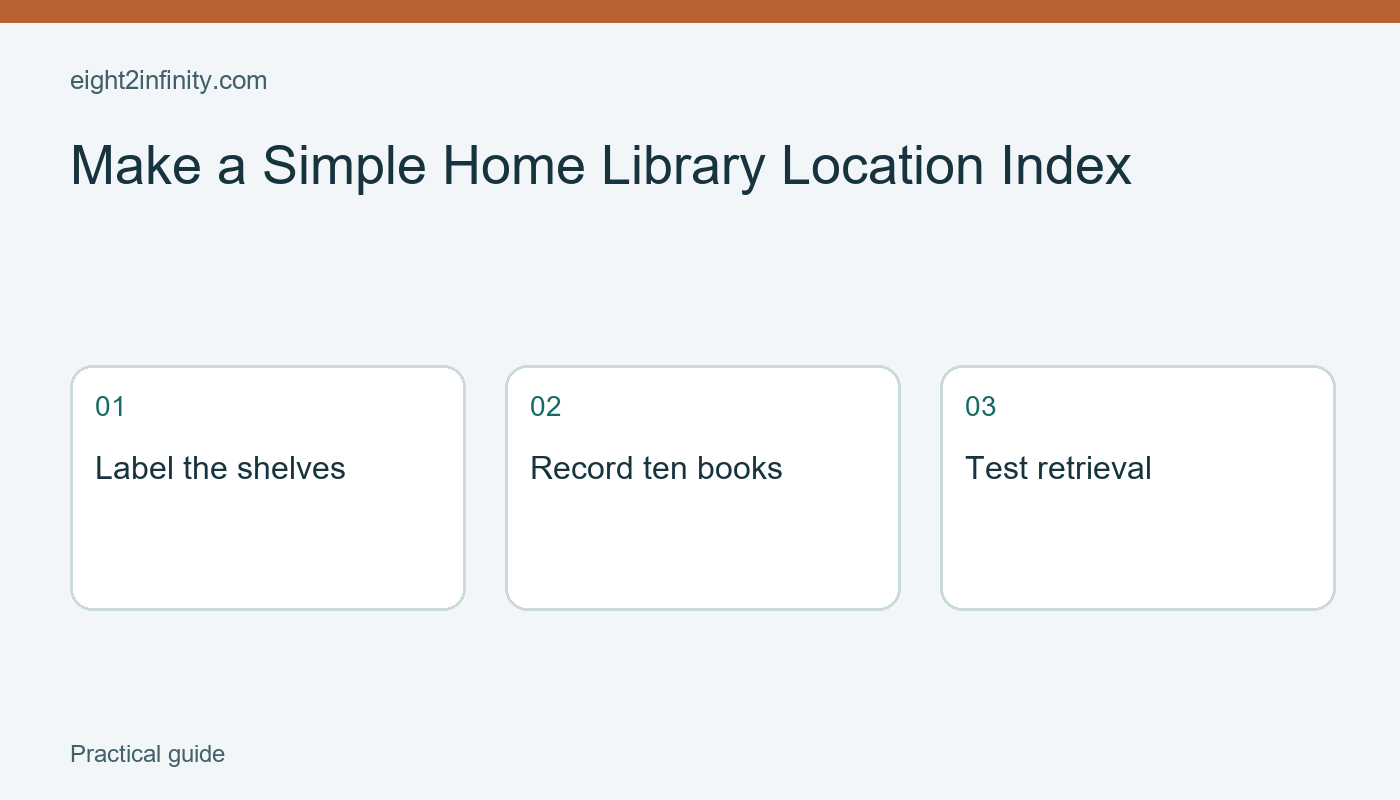
Choose one shelf or ten books you frequently look for. Record them, then stop entering data and test the index. Ask someone to locate two titles using only the entries and location key. If the instructions are confusing, revise the labels now. A small tested index is easier to improve than a large one built around an unclear location rule.
If you use a digital spreadsheet, keep one book per row and use a clear header row. A plain text document can work for a short list, while paper may be easier in a room without a nearby device. Avoid entering sensitive household details into an unfamiliar service merely to obtain decorative catalogue features. The basic method does not require a new account or public sharing.
For a larger collection, enter titles carefully enough that a search for a distinctive word will find them. If a title begins with The, decide whether to keep it as printed and use search, or adopt a consistent sorting convention. Either choice can work. Changing conventions halfway through is more likely to cause confusion than choosing a modest system at the start.
Keep the index aligned with the shelves
When moving a book, update its location at the same time. If you lend it, record a minimal note that suits your household and respect the other person's privacy. A temporary marker on the shelf can help you remember where it belongs. When the book returns, remove the loan note and verify its location instead of assuming it went back to the original place.
If you pass a book on permanently, remove or archive its entry so the index does not send you searching for something you no longer own. EPA's waste-reduction guidance encourages reuse of suitable belongings, including books. Check the recipient's current acceptance rules before donating. The catalogue itself is an organizing aid and does not assign a market value or establish ownership for insurance purposes.
Test your first ten entries
Record ten books, locate three of them from the index, move one, and update its shelf label. Our room-by-room home inventory guide offers a broader way to record belongings if you need that later. For now, which missing detail most often makes a book hard to find: the title, the edition, the room, or the shelf?