Match removable cushion covers with a simple size record
Match spare removable cushion covers by recording their actual labeled size, the cushion they belong to, and the place where they are stored. Give similar covers a short identifier so a folded stack does not require repeated unfolding. Keep uncertain matches marked as uncertain, and follow each cover's care label rather than assuming that similar fabrics can be treated alike.
This is an original household indexing method for covers already in your home. EPA guidance supports caring for and reusing suitable belongings generally; it does not establish cushion sizing rules or washing instructions. The record helps with retrieval and identification. It does not prove that a cover fits a particular insert, and it should never replace a manufacturer's care information.
Start with one small group
Choose the spare covers for one room. Leave fitted covers on cushions unless there is a separate reason to remove them. Put the spare group on a clean surface and check for labels, closures, and identifying details. Separate anything awaiting cleaning or repair. A storage index should describe ready items accurately rather than making every folded object appear immediately usable.
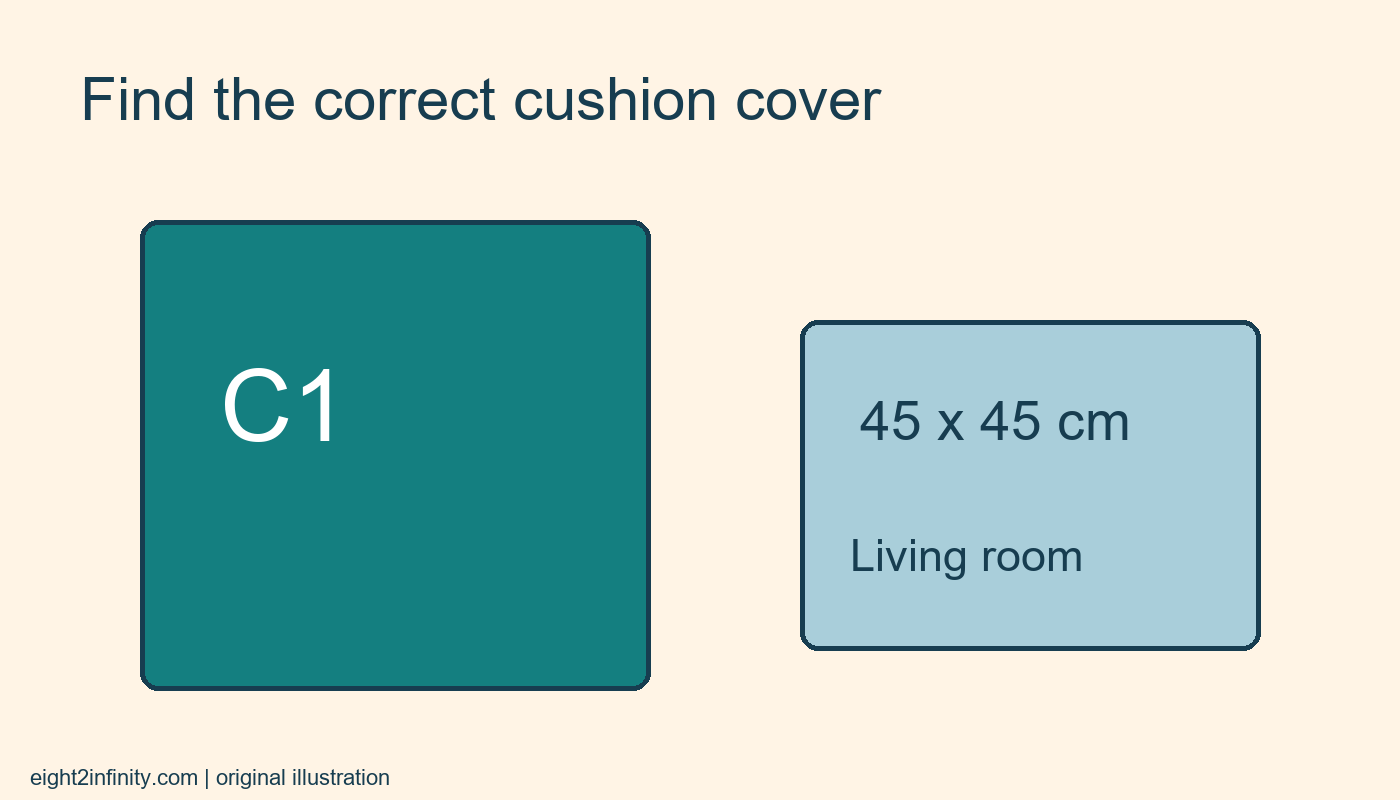
For a fictional example, use two covers labeled forty-five by forty-five centimeters and one labeled thirty by fifty centimeters. The square covers belong to the living room; the rectangular one belongs to the reading chair. These dimensions are examples, not universal cushion standards. Your own labels or product records are more reliable than a guess based on the appearance of a folded piece.
Record size with a clear basis
Copy a labeled size exactly, including the unit. If there is no label, note that fact. You can measure a cover laid flat without stretching, but identify that number as a flat measurement rather than a manufacturer's nominal size. Seams, fabric stretch, construction, and the intended insert can affect the fit. Do not convert a rough measurement into a guaranteed size claim.
Keep the two measurement types separate in the record. For example, Labeled forty-five by forty-five centimeters is different from Flat measurement about forty-four by forty-four centimeters. When the purpose is simply finding the correct cover you already own, a known cushion match may be more useful than a newly measured number. Write both only when the distinction will help future retrieval.
Assign identifiers that connect objects
Use short identifiers such as C1, C2, and C3 for this small group. Write them on removable storage labels or paper bands, not directly on visible fabric. The record might say C1, blue square cover, living-room left cushion, labeled forty-five by forty-five centimeters. Include a distinctive feature such as a concealed zipper only when it helps distinguish a genuinely similar item.
If two covers are identical and interchangeable, record them as a pair instead of inventing a meaningless difference. If they belong to different inserts despite looking similar, preserve that distinction clearly. An identifier is useful because it connects the storage position with a known object; a code without a written key only replaces one memory problem with another.
Preserve care information
Read each care label and leave it attached. If a label is difficult to read, a clear personal photo can support the record, but do not crop away symbols or wording that change its meaning. Do not transcribe an uncertain symbol as a definite washing instruction. Follow the manufacturer or obtain clarification when the care method is unclear.
Keep covers clean and fully dry before long-term storage according to their care requirements. Do not seal a damp item in a container to make the shelf look finished. If one cover requires attention, put it in a separate clearly identified area. The storage index can say Awaiting care instead of assigning it a ready position beside the other covers.
Fold for identification and access
Fold each cover loosely enough to avoid forcing a zipper or decorative feature into a hard crease. Place the identifying paper band or label where it can be read without unfolding the fabric. A simple stack can work for a small group if the labels remain visible. With several similar covers, a vertical arrangement in a suitable box may make individual retrieval easier.
Give the storage location a plain name such as Living-room linen shelf, upper box. Record that location using words another household member understands. A code like Box B is helpful only if the box itself is labeled. Leave room to remove one cover without pulling apart the entire group. If the space is too tight, revise the storage quantity or location before compressing the fabric further.
Check the record against a real cushion
Retrieve C1 using only the record. Compare it with the intended cushion and the known size information. If a fit check is appropriate, do it gently without forcing the closure over an unsuitable insert. Return the cover with its identifier and update any mistaken description. The purpose is to catch a wrong association while the group is still small.
For practice, create three fictional entries and deliberately leave one match unconfirmed. Ask another person to identify the rectangular cover and explain which entry needs further checking. If they must unfold everything, improve the visible labels. A useful record distinguishes what is known, what is measured, and what still needs confirmation, so spare covers remain easy to reuse when the room arrangement changes.