Match reusable container lids before storing empty containers
Match a reusable container with its lid while both are empty, clean, and dry, then store the pair in a way that makes the match easy to repeat. Start with a small group rather than emptying every cupboard. A lid that merely rests on top is not necessarily the right lid, and a matched pair is not automatically suitable for heating, freezing, or carrying liquids. Check the product's own instructions for those uses.
This is a simple household sorting method for containers you already own. It can reduce the repeated search through a pile of similar-looking lids without requiring new organizers. The aim is to identify usable pairs and make unmatched pieces visible. It is not a reason to keep damaged packaging or to treat an unknown container as safe for a purpose its maker has not approved.
Work with one manageable group
Choose four or five containers from one shelf. Put them on a clear table with their lids beside them. Make sure everything is dry before nesting or enclosing it for storage. If you discover food residue, stop sorting that piece and clean it according to its instructions. A cupboard system works better when cleaning and matching are separate decisions rather than one rushed operation.
Sort first by obvious shape: round lids with round containers, rectangular lids with rectangular containers. Then compare dimensions and rim details. Two containers can have similar capacities but different closure designs. Keep any visible brand, model, or product marking available during the comparison, especially if several sets have accumulated over time. Shape is a starting clue, not proof of compatibility.
Check each pair without forcing it
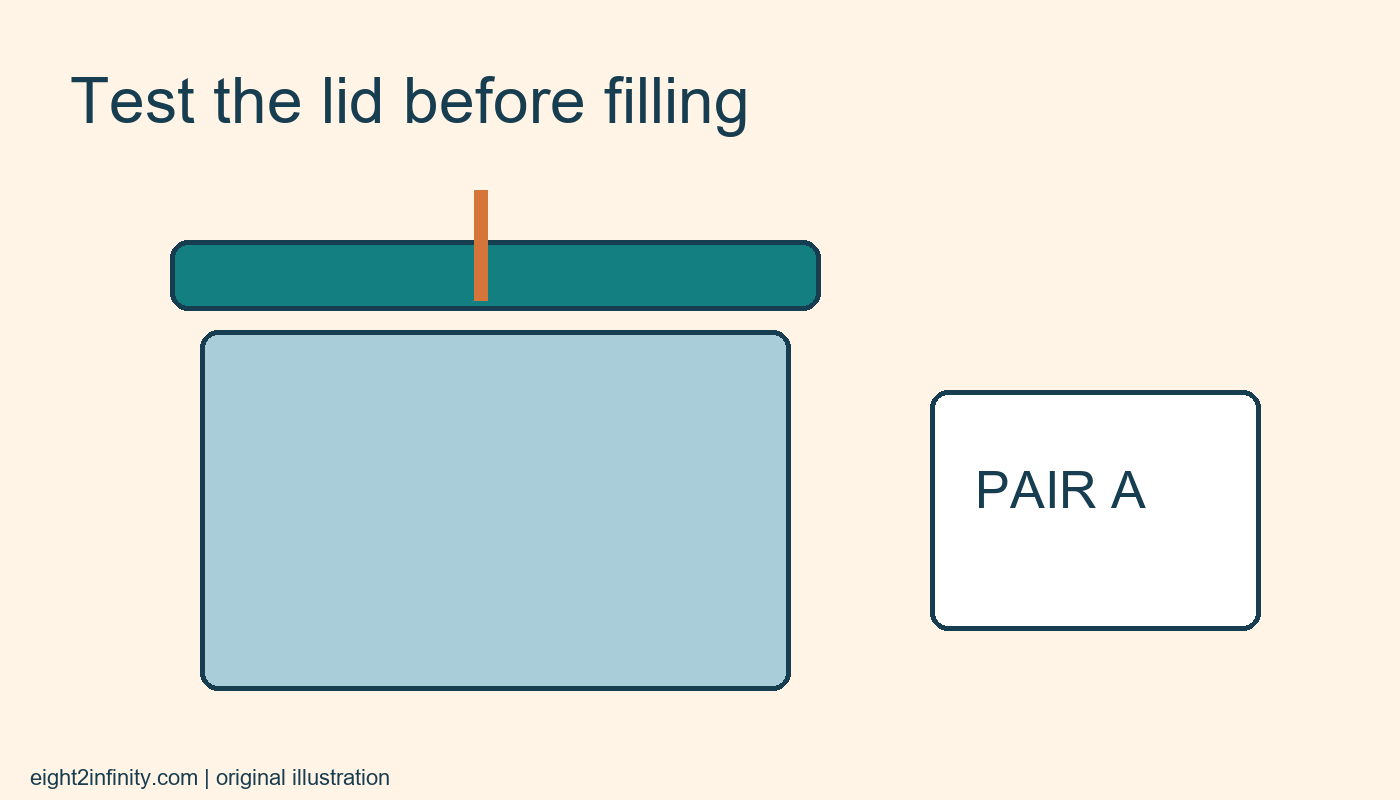
Place a likely lid on an empty container and fit it using its normal closure method. If it needs unusual force, distorts the rim, or leaves one corner lifted, set it aside and try another match. Do not cut, heat, bend, or otherwise modify a lid to make the pair work. A convenient storage match should use the product as designed.
For an original practice example, call the three containers A, B, and C on a paper sketch. A has a matching lid, B has two similar candidates, and C has none. Work through B before assigning either lid permanently. Record C as unmatched instead of quietly giving it a lid that almost fits. This makes the unresolved decision visible the next time you review the shelf.
Choose a retrieval method
If cupboard space permits, store each empty container with its matching lid placed as the manufacturer recommends for storage. If nesting saves substantial space, keep the lids in a nearby upright divider or shallow compartment. Arrange them in the same broad size order as the containers. The best layout is one you can restore after washing, not one that looks tidy only during the initial sorting session.
Use a removable exterior mark only if it is appropriate for the material and does not interfere with the lid, food-contact surface, care instructions, or product label. A paper location sketch may be enough. For example, your sketch could say Small round pair at front left and Tall rectangular pair at back right. You do not need to label every object if their differences are already obvious.
Separate storage from performance claims
A lid fitting in the cupboard does not establish a leakproof seal. It also does not establish that the pair is suitable for a microwave or dishwasher. Keep those questions tied to the manufacturer's markings and instructions. If the intended use matters and you cannot verify it, choose another known container for that use rather than guessing from appearance or from the recycling symbol alone.
Inspect the pieces for cracks, warping, damaged seals, or other changes that prevent normal use. Follow the maker's replacement guidance. If a piece no longer serves its intended purpose, decide whether there is a suitable nonfood use or whether it should leave the household. Do not imply that all plastics or all lids belong in the same local recycling stream; acceptance varies by location and material.
Resolve unmatched pieces deliberately
Keep a very small temporary space for an unmatched lid only when you have a plausible missing partner to check. Write the reason on your sorting note, such as Check picnic cupboard. Without a next place to look, an unmatched pile can become permanent. After checking that location, make a decision rather than moving the same pieces between drawers indefinitely.
A container without a lid may still have an appropriate open storage job, such as holding craft materials, if its condition and material suit that purpose. Assign the job explicitly and keep it separate from food storage if necessary. Reuse is helpful when an item meets a real need. Inventing a vague future purpose for every orphaned piece simply transfers clutter to another category.
Try a retrieval check
Put the selected pairs away, step back, and choose the medium container as if you were preparing for an ordinary task. Can you find its matching lid without taking out every other piece? If not, change the order or reduce nesting depth. Repeat the check after the next wash, because returning pieces to storage is the part of the system you will use most often.
EPA's reuse guidance supports considering useful roles for existing items, but this matching routine is an original household suggestion rather than an EPA container-safety procedure. Product instructions govern actual uses. As an exercise, organize only one shelf and note which pair caused the longest search. Was the problem an unclear match, too many nested pieces, or a storage location that made the lid difficult to see?