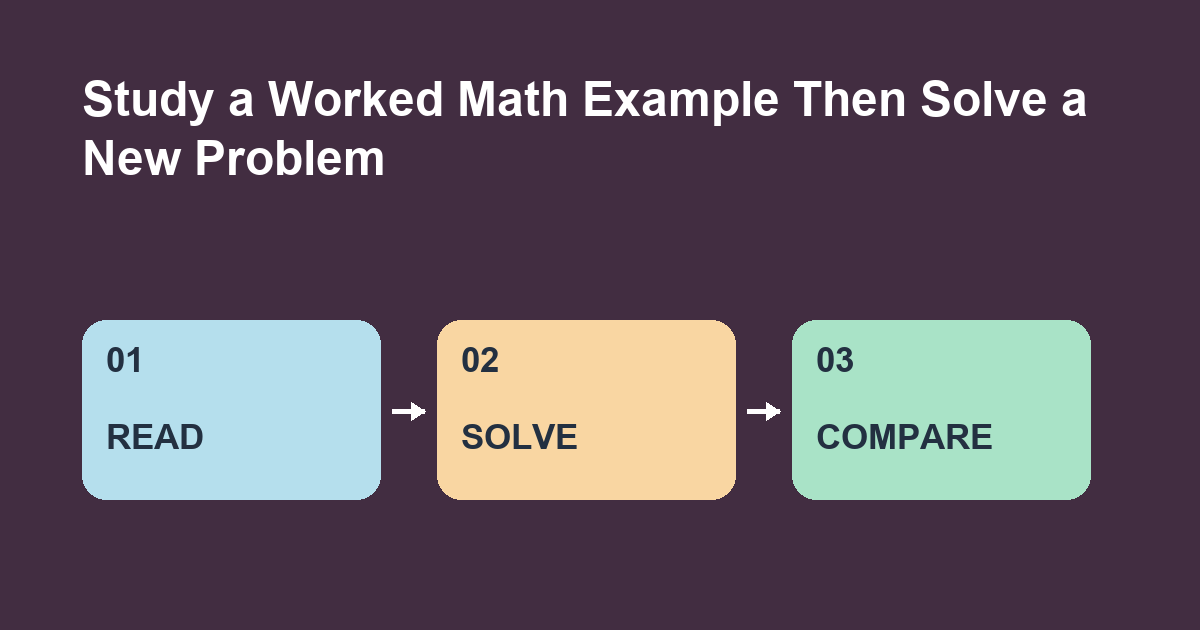
Read one solved example, explain each step, then cover it and solve a similar problem. Compare your work only after making an attempt.
Read for decisions
For 3x + 5 = 20, subtract 5 from both sides to get 3x = 15. Divide both sides by 3 to get x = 5. Substitute 5 in the original equation to check it. Explain why each operation is applied to both sides and which part of the expression it undoes.
Try a problem with different numbers
Cover the example and solve 4x + 7 = 31. Write the intermediate equation. You should get 4x = 24 and x = 6. Check that 4 times 6 plus 7 is 31. If your result differs, identify the first line where the arithmetic or equality went wrong.
Change the operation
Solve 2x – 6 = 10. The first step is addition, and the answer is x = 8. If you subtracted 6 out of habit, compare the signs and redo the first step. This alternation between solved examples and practice follows the approach described in the U.S. What Works Clearinghouse guide.
Make a challenge
Write an equation with solution x = 4 that needs addition as its first step. Can someone else solve it and explain their choice?
Explain what stays true
Think of the equals sign as a promise that both sides have the same value. If you subtract five from each side, the promise still holds. Put that sentence beside the worked line rather than memorizing a rule about moving the five. On the next problem, you can use the same reasoning even if the constant is negative.
Compare decisions before answers
Suppose you wrote 4x = 31 – 7 correctly but then calculated 31 – 7 as 25. Your choice to subtract was sound. The calculation is the part to fix. If you wrote 4x = 31 + 7 instead, revisit which operation undoes the added seven. The two mistakes call for different practice, even though both produce the wrong value of x.
Gradually remove the prompts
Try 5x + 2 = 22 with only this hint. First isolate 5x. Then try 6x – 4 = 20 without a hint. Both have x = 4, but the first steps differ. Show your intermediate line and substitute the answer into each original equation. If you can explain both starts, write a pair that looks similar but has different answers. Trade your pair with a classmate and compare the first line of each solution before checking the final values. A clear explanation should name the operation and show it on both sides.