Find a missing angle beside a straight line
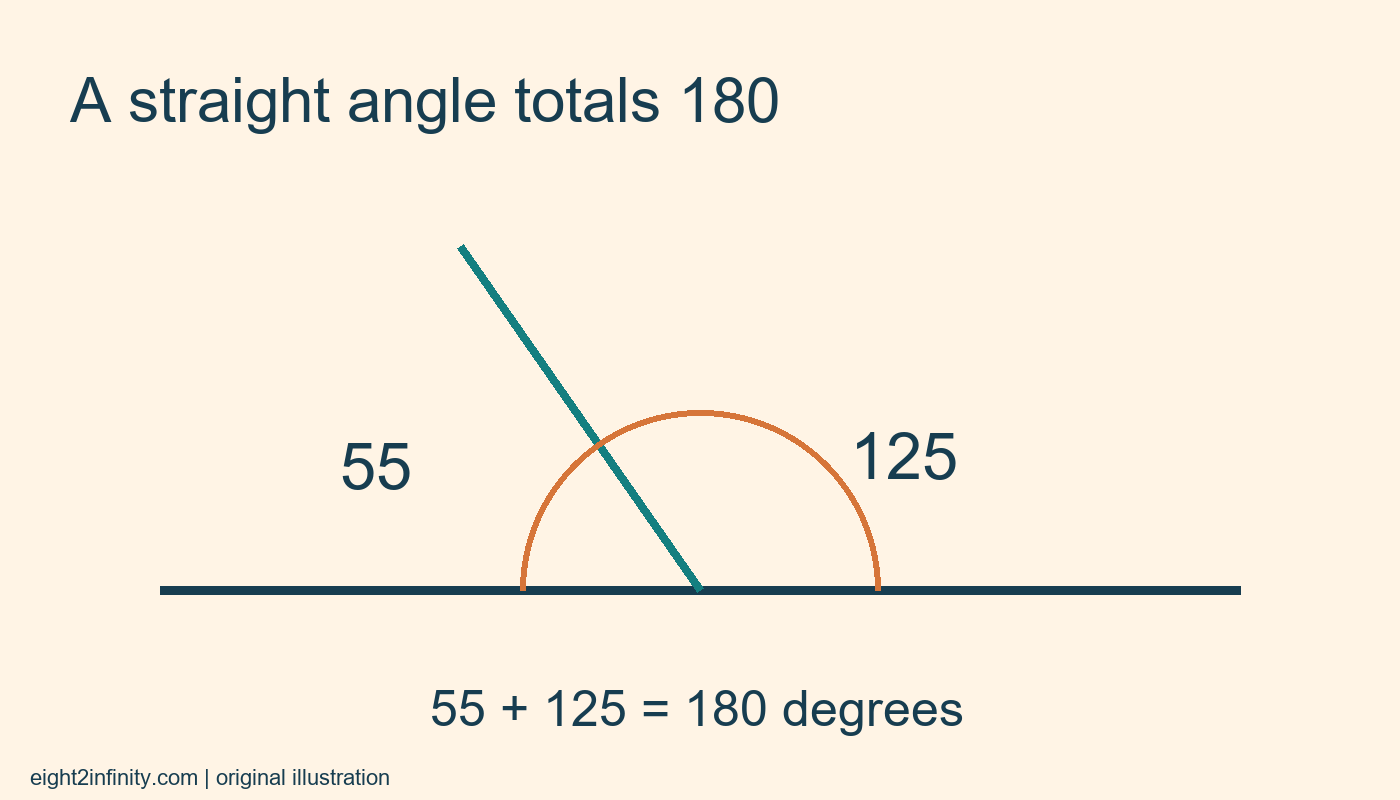
When two adjacent angles together form a straight angle, their measures add to 180 degrees. Subtract the known angle from 180 to find the missing one. If one angle is 55 degrees, the other is 125 degrees because 55 + 125 = 180. First establish that the diagram really shows a straight line; the subtraction rule depends on that relationship.
OpenStax describes straight angles and supplementary angles in its introductory geometry material. The worked examples here are original practice exercises. They use simple labeled diagrams and ordinary arithmetic. A drawing that merely looks nearly straight is not enough evidence in a mathematical problem unless the straight-line relationship is given or otherwise established. Use the stated facts rather than guessing from a sketch's appearance.
Identify the vertex and rays
Draw a horizontal straight line with a point O in its middle. Draw one ray from O upward and slightly to the left. The upper half of the straight angle is now divided into two adjacent angles. They share the vertex O and the new ray, while their other sides point in opposite directions along the straight line.
Label the smaller left angle 55 degrees and the larger right angle x. The angle labels describe openings at the shared point, not the lengths of the drawn segments. Making the upward ray longer does not change either angle's measure. This distinction prevents a common mistake: judging an angle by the amount of ink used to draw its sides.
State the relationship before calculating
Write 55 + x = 180. This equation records why subtraction is appropriate. The two angles occupy the complete straight angle without a gap or overlap. Subtract 55 from 180 to get x = 125. Include degrees in the final written answer: the missing angle is 125 degrees. The number is a measure of angle, not a length in centimeters.
Check by addition. Combining 55 and 125 gives 180, which matches the straight angle. The missing angle should also be larger than 90 degrees because the known angle is smaller than 90 and the total is 180. That estimate is not the proof, but it makes an answer such as 35 degrees obviously suspicious before you finish the full check.
Distinguish a straight angle from a right angle
A right angle measures 90 degrees. If a diagram shows a right-angle marker and two angles filling that right angle, the total is 90 instead of 180. With a known 55-degree angle in that different situation, the missing angle would be 35 degrees. The arithmetic is easy in both cases; choosing the correct total requires reading the geometry carefully.
Write the total beside the equation rather than reaching immediately for subtraction. Ask what whole opening the two parts fill. A straight line gives a half-turn, while a right angle gives a quarter-turn. The two cases are related but cannot be swapped without changing the problem. A clear diagram label matters more than whether the drawing looks aesthetically balanced.
Understand supplementary angles
Two angles whose measures add to 180 degrees are called supplementary. They do not have to be adjacent in every problem. In this exercise, adjacency and the straight line give a visible reason for the total. If a question simply states that two separate angles are supplementary, you can still use the same sum even when the drawings are placed apart.
Do not assume any pair of neighboring angles is supplementary. Two adjacent angles could total 70, 90, 180, or another amount depending on their outside rays. Locate the stated straight line, a given total, or another established fact. Naming a relationship should summarize evidence in the problem, not replace the evidence with a guess.
Try a second pair
Draw a new straight line and a ray that creates a 132-degree angle on one side. Call the other angle y. Write 132 + y = 180, then subtract to obtain y = 48 degrees. Check 132 + 48 = 180. This time the known angle is obtuse and the missing angle is acute, which fits the visual idea of completing a straight angle.
If your subtraction gives a negative answer for a simple interior angle in this exercise, recheck the known value and the selected total. You may have reversed the subtraction or used a number larger than the straight angle. Do not erase the geometry and redraw it to make a mistaken result look plausible. Diagnose the equation first, then the arithmetic.
Explain rather than only answer
A complete short explanation can say: the adjacent angles form a straight angle, so they sum to 180 degrees; subtracting 55 degrees gives 125 degrees. That statement connects the diagram, relationship, operation, and unit. A bare answer might be correct, but the explanation shows whether you used a valid property or guessed from the picture.
For practice, find the supplements of 27, 90, and 164 degrees. The answers are 153, 90, and 16 degrees. Sketch each pair and check the sums. Then write a deliberately different problem in which the whole is a right angle. What fact in your new question tells the reader to use 90? Identifying that fact is the skill that transfers to more complicated diagrams with several unknown angles.