Convert kilograms to grams while keeping the units visible
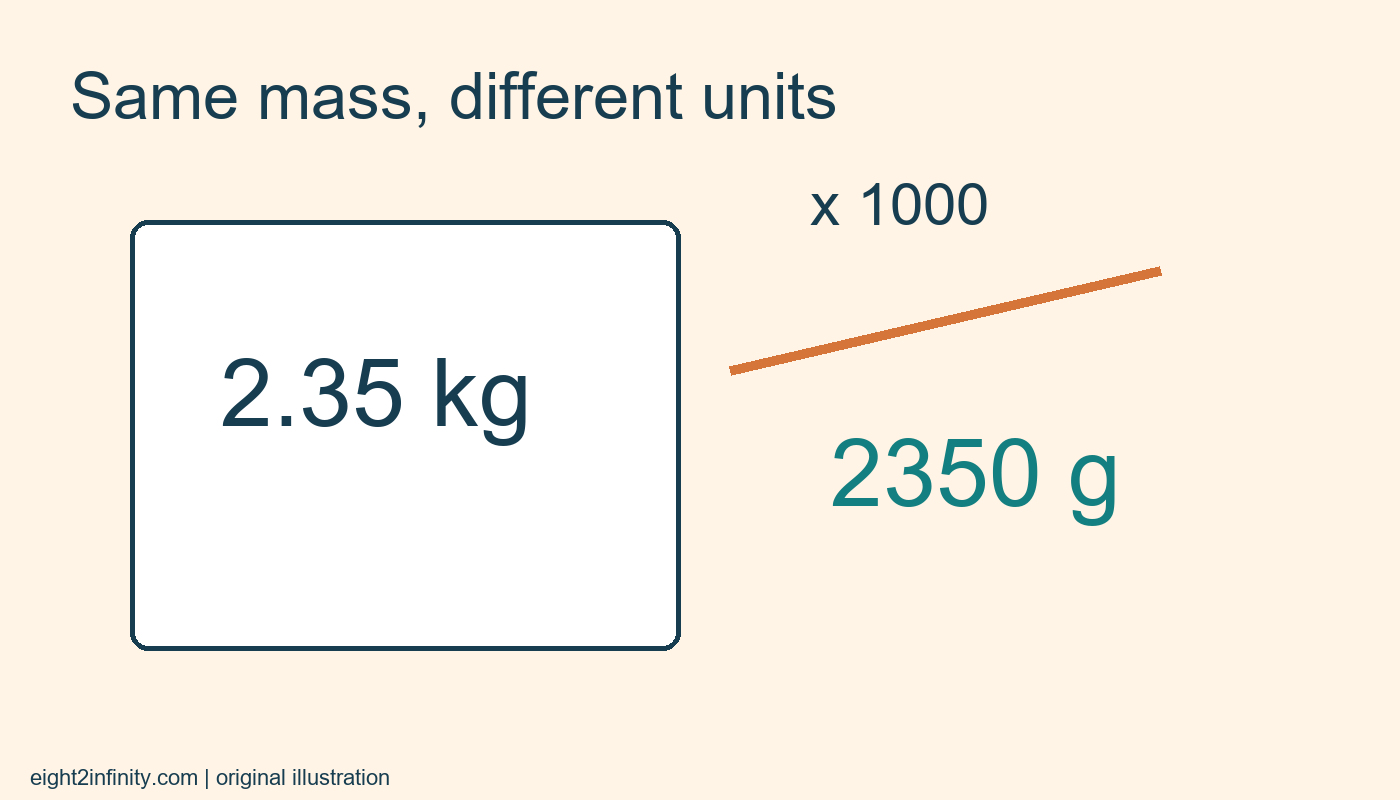
To convert kilograms to grams, multiply the number of kilograms by one thousand. A mass of 2.35 kilograms is 2350 grams. Keep the unit beside each number so the change is easy to interpret: the quantity of material stays the same while the number grows because grams are smaller units. This is a unit-conversion exercise, not a change in the object's mass.
The metric relationship is established in standard measurement references, including OpenStax's treatment of measurement systems. The examples below are original practice problems. They use kilograms and grams only; they do not convert between mass and volume. A gram and a milliliter measure different quantities, and converting between them requires information beyond the relationship discussed here.
Start with a concrete relationship
Write 1 kg = 1000 g at the top of a page. Read it aloud as one kilogram equals one thousand grams. The symbols kg and g identify the units. They are not extra digits or labels that can be discarded whenever the arithmetic becomes awkward. Keeping them visible makes it easier to see whether the final answer matches the requested unit.
Imagine a practice parcel labeled two kilograms. Its mass can also be written as two thousand grams. You have not added material to the parcel; you have described it using a smaller measuring unit. This is similar to expressing a length in meters or centimeters, but the conversion factor must come from the units actually used in the question.
Work through a decimal example
For 2.35 kg, multiply 2.35 by 1000 to obtain 2350. Write the result as 2350 g. One way to explain the arithmetic is to split 2.35 into 2 + 0.3 + 0.05. Two kilograms contribute 2000 grams, three tenths of a kilogram contribute 300 grams, and five hundredths contribute 50 grams. Adding those amounts gives 2350 grams.
This decomposition helps when a memorized instruction about moving a decimal point feels unclear. Each part represents a portion of the same mass. The explanation also gives a reasonableness check: 2.35 kilograms lies between two and three kilograms, so the result should lie between 2000 and 3000 grams. An answer of 235 grams fails that check even before you inspect the arithmetic.
Use a conversion factor
Write 2.35 kg multiplied by 1000 g per 1 kg. The kilogram units cancel, leaving grams. This method makes the direction of conversion explicit. Multiplying by 1 kg per 1000 g would leave the wrong unit arrangement for this starting quantity. You can use ordinary written fractions on paper if that makes the cancellation easier to follow.
The same factor works for a small value such as 0.08 kg. Multiplying 0.08 by 1000 gives 80, so 0.08 kg equals 80 g. Check that the answer is less than 1000 grams because the starting mass is less than one kilogram. A small starting decimal does not automatically mean the gram result must also be a decimal.
Convert back to check
To convert grams to kilograms, divide by 1000. Dividing 2350 grams by 1000 gives 2.35 kilograms, returning to the original value. This reverse calculation is a useful check when you are unsure whether you multiplied or divided in the correct direction. Write both units in the check so it is clear what each number represents.
Use the same reasoning for 125 grams: dividing by 1000 gives 0.125 kilograms. Since 125 grams is a fraction of one kilogram, a kilogram value below one is sensible. An answer of 125000 kilograms would describe a completely different scale of mass. Estimation and unit labels together catch errors that a calculator can faithfully reproduce if given the wrong operation.
Handle notation consistently
Use a decimal point consistently in this exercise. In regions where a decimal comma is standard, adapt the notation while keeping the mathematical relationship unchanged. Avoid mixing a comma used for thousands with a comma used as a decimal separator on the same page. A spaced form such as 2 350 g can help readability when a house style permits it, but consistency matters more than decoration.
Do not add precision that was never measured. Converting a label from 2.35 kg to grams changes the unit, not the quality of the measurement. If a real measurement was approximate, retain that qualification. The classroom examples here use exact stated numbers to practise arithmetic and do not establish the accuracy of any particular scale or package label.
Solve a mixed-unit practice problem
A fictional craft bundle has a mass of one kilogram plus 275 grams. Convert the kilogram to 1000 grams, then add 275 grams to obtain 1275 grams. You can also express this as 1.275 kilograms. Do not add 1 and 275 directly and label the result grams; the two original numbers were stated in different units.
Try three independent conversions: 4.6 kg, 0.009 kg, and 725 g to kilograms. The answers are 4600 g, 9 g, and 0.725 kg. For each, explain whether the numerical value should become larger or smaller before calculating. Then check by reversing the conversion. Which explanation helped you most: smaller units, decomposing the decimal, or canceling units with a conversion factor? Use that explanation to justify your next answer.