Compare negative integers by their position on a number line
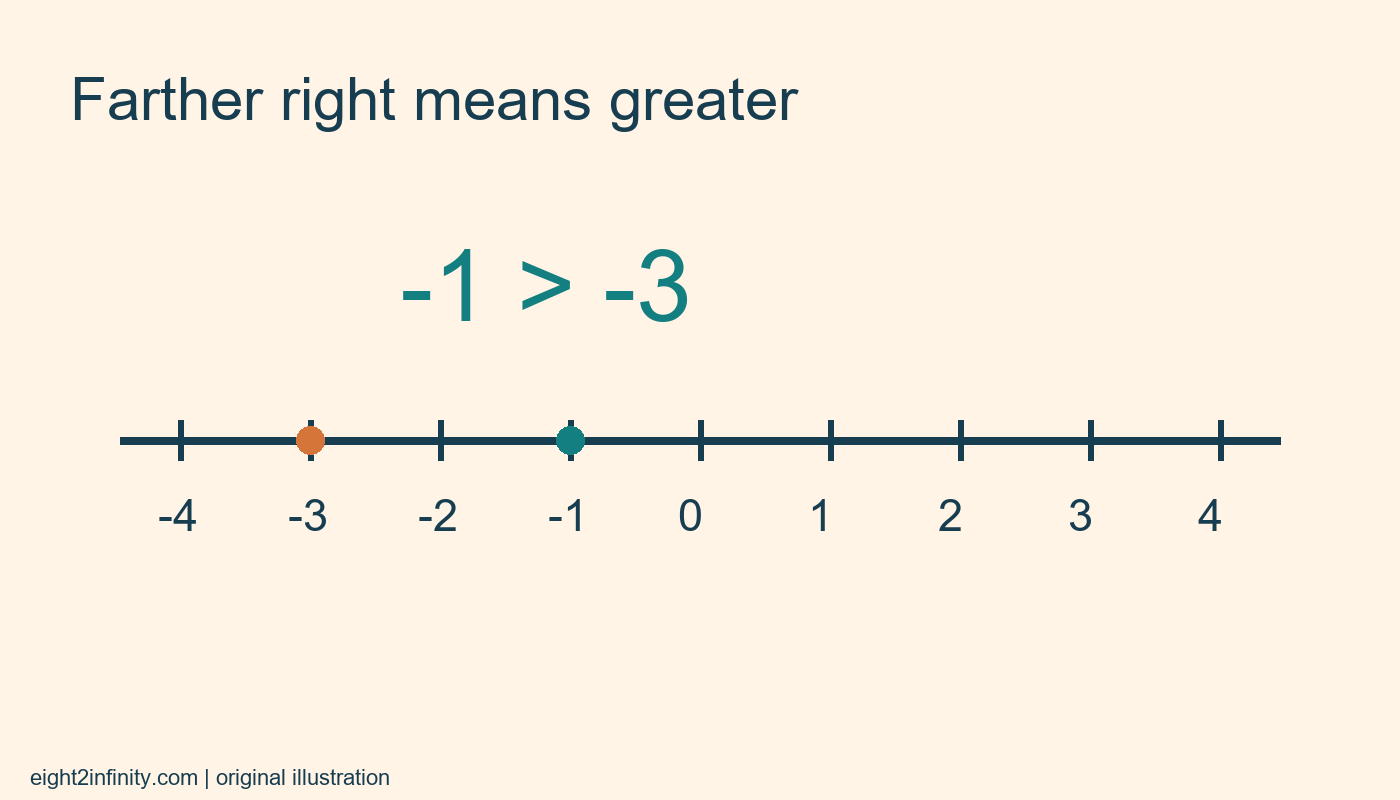
A number farther to the right on a number line is greater. That rule applies to negative integers as well as positive ones, so -1 is greater than -3. Draw equally spaced marks, label zero, and place both numbers before writing the comparison. This gives you a visible reason for the answer instead of relying on the size of the digits alone.
Negative-number comparisons can feel surprising because the digit 3 is larger than the digit 1, yet -3 is less than -1. The minus sign changes the number's position relative to zero. This lesson uses original paper exercises with small integers and a horizontal number line. It does not require a calculator, and it keeps comparison separate from the later topic of adding or subtracting negative numbers.
Draw a useful practice line
Draw a straight horizontal line on paper and mark nine equally spaced positions. Label the middle mark 0. Moving right, label 1, 2, 3, and 4. Moving left, label -1, -2, -3, and -4. Keep the minus signs clear and place each label directly under its own mark. Equal spacing matters because each neighboring mark represents a change of one unit.
Use a ruler if it helps you keep the drawing tidy, but do not spend so long decorating the line that you lose the mathematical purpose. A simple accurate sketch is enough. If two labels crowd together, redraw the line wider. You should be able to point to -3 without accidentally pointing to the mark for -2 or to a minus sign between labels.
Compare two negative values
Put a small circle around -3 and another around -1. Read the line from left to right. You meet -3 first and -1 later, so -3 is smaller and -1 is greater. Write -3 < -1 and read it aloud as Negative three is less than negative one. Then reverse the order and write -1 > -3. Both statements describe the same relationship.
The comparison symbol opens toward the greater value. If you forget which symbol to use, decide the verbal relationship first and then write it. Do not let a remembered picture of the symbol replace the reasoning. Pointing to the two locations and saying farther right is greater gives you a check that works even when the written numbers appear in an unfamiliar order.
Separate value from distance
Both -3 and 3 are three units from zero, but they are different values on opposite sides. Distance from zero alone therefore cannot tell you which of two signed numbers is greater. In the comparison between -3 and -1, -3 has the larger distance from zero while -1 has the larger value. Keep those questions separate when explaining your answer.
A useful original prompt is Which mark is closer to zero, and which mark is greater? For -4 and -2, the answer to both is -2. For -4 and 2, the closer mark is 2 and the greater mark is also 2. For -1 and 4, the closer mark is -1 while the greater mark is 4. Drawing the positions makes the distinction visible.
Include zero in the comparison
Compare -2 with 0. Zero lies to the right, so -2 < 0. Compare 0 with 3, and you have 0 < 3. Putting these together gives -2 < 0 < 3. The chain describes an order from left to right. It does not say that the gaps are equal: the distance from -2 to 0 is two units, while the distance from 0 to 3 is three.
This is a useful place to check labels carefully. If your sketch places -2 closer to the right than 0, the drawing is mislabeled. Fix the line before trusting any conclusion from it. Mathematical diagrams are tools for reasoning, but their labels still need verification. A neat-looking line with numbers in the wrong order can be more misleading than a rough but correct sketch.
Order a short list
Try ordering -2, 3, -4, 0, and 1 from least to greatest. Mark each value on your line, then read only those selected positions from left to right. The result is -4, -2, 0, 1, 3. Check that every original value appears exactly once. Sorting the negative values by their unsigned digits would incorrectly reverse the first two entries.
Now read the selected positions from right to left to produce greatest to least: 3, 1, 0, -2, -4. Changing the requested direction changes the list order, not the values themselves. Write Least to greatest above one answer and Greatest to least above the other so a reader does not have to infer which task you solved.
Explain and check your reasoning
For a final exercise, compare -4 and -1, compare -2 and 2, and order -3, 0, -1, and 4 from least to greatest. The comparisons are -4 < -1 and -2 < 2. The ordered list is -3, -1, 0, 4. Check each answer by pointing to the marks rather than merely rereading the symbols you wrote.
OpenStax's introduction to integers provides the underlying number-line and ordering concepts; the examples here are original practice prompts. If you teach this to someone else, ask them to explain why -1 is greater than -3 without saying simply that the rule reverses. Can they use position, zero, and the direction of increasing values to make the answer understandable?