Plan a short local errand loop on paper
Plan a short errand loop by listing the stops, checking their constraints, and drawing a simple route that starts and ends at the same place. Group compatible errands when it is practical, but let opening hours, accessibility, carrying needs, and your own circumstances determine the order. This paper method helps you see avoidable backtracking. It does not promise the shortest route, a particular travel time, or a measured saving in fuel or emissions.
The US Department of Energy describes combining errands as one way to drive more efficiently. The worked example below is an original planning exercise for three ordinary neighborhood stops. It can also be adapted to a walk or another travel mode when suitable, but verify the actual route and conditions independently. Do not use a rough sketch as navigation advice for an unfamiliar or unsafe area. The point is to organize decisions before leaving, not to replace current local information.
List the errands before drawing a route
For the example, start at Home and list Library return, Stationery pickup, and Parcel drop. Beside each, write what must be carried and what needs confirming. The library errand needs two borrowed books. The stationery errand needs an item description. The parcel errand needs a prepared parcel and confirmation of acceptance requirements. These are fictional tasks. Use your own verified details rather than assuming every library has a return slot or every parcel counter accepts the same items.
Cross out anything that is not ready. If the parcel label is incomplete, either finish it before leaving or postpone that errand deliberately. An unready task should not silently dictate the route. Check opening times through the relevant service’s official channel and note the date checked. A remembered closing time from a previous visit may be wrong. If a stop requires an appointment or collection notice, keep that requirement visible on the list rather than depending on memory at the door.
Draw relationships rather than a precise map
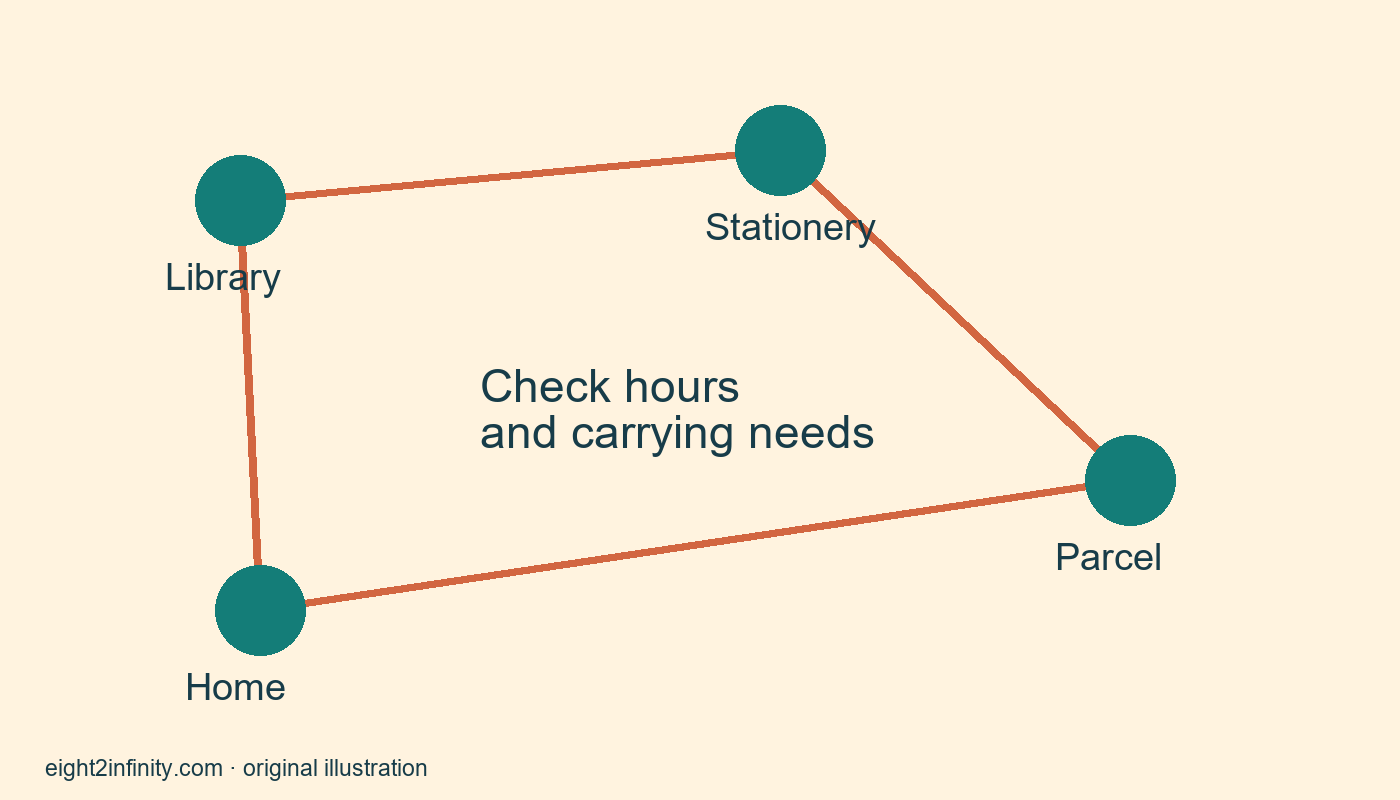
On paper draw Home at the bottom, Library to the left, Stationery above it, and Parcel counter to the right. Connect them in a loop: Home, Library, Stationery, Parcel counter, Home. This is a schematic diagram, not a measured street map. Mark any stop with a time constraint. If the parcel counter closes earlier than the others, reconsider the order using actual travel information. A geometrically neat loop is not useful if it reaches a closed service.
Next consider what you will carry between stops. Returning books first may lighten the bag in this invented example, but that advantage can be outweighed by opening hours or a different actual location. A large stationery pickup may be better collected last. Write the reason for your proposed order in one sentence. If you cannot explain the order without saying it simply looks tidy, you probably need to check a practical constraint rather than refine the drawing’s appearance.
Separate essential and optional stops
Mark the library return as essential if it is due and mark the stationery visit as optional if it can wait. This distinction gives you a fallback when time is limited. Do not let an optional browse turn the whole outing into a rushed sequence. Choose a clear condition for skipping it, such as If the library visit takes longer than expected, buy the notebook another day. The condition should be a planning aid, not an inflexible deadline that encourages unsafe travel.
Keep the loop modest. Combining every possible task into one trip can create carrying problems, delays, or an outing too demanding for the available time and energy. A smaller successful trip may be more useful than an ambitious route that repeatedly fails. If you have access or mobility needs, check those explicitly rather than assuming a nearby place is easy to enter. The paper method works best when it reflects the actual person doing the errands and the actual services involved.
Pack in the order of use
Put the first stop’s items where they can be reached without emptying the bag. Keep books protected from anything that could mark them, and keep the parcel ready for its particular service requirements. Take the short errand list or a photo of it if that is more convenient. Avoid writing sensitive account information on a loose route card. You need enough detail to complete the task, not every personal reference associated with each service.
Before leaving, read the list once from top to bottom and physically check the required items. A planned library stop is wasted if the books remain on the table. Confirm how you will get home with any collected items. This final check links the drawing to the real outing. It should take less effort than reorganizing the entire household, and you can reuse the method next time without preserving every old route card indefinitely.
Review the loop after returning
Note one useful observation, such as Stationery queue was long or Parcel counter entrance is on the other side of the building. Treat this as a dated personal observation rather than a permanent fact. Conditions and service hours can change. If the route worked, keep only the stable information worth checking again. If it did not, identify the specific cause: an unready item, a wrong opening time, an unsuitable order, or too many stops for the outing.
For an exercise, redraw the fictional loop with the parcel counter closing first and a bulky stationery order to collect. Which stop would you prioritize, which would you leave until last, and what would you verify before deciding? There may be several reasonable answers. A good answer explains the constraints and includes a fallback. The useful result is a manageable, prepared trip with a clear order, not a claim that a sketch has solved every transport or scheduling problem.