Portion drop cookie dough with a consistent scoop
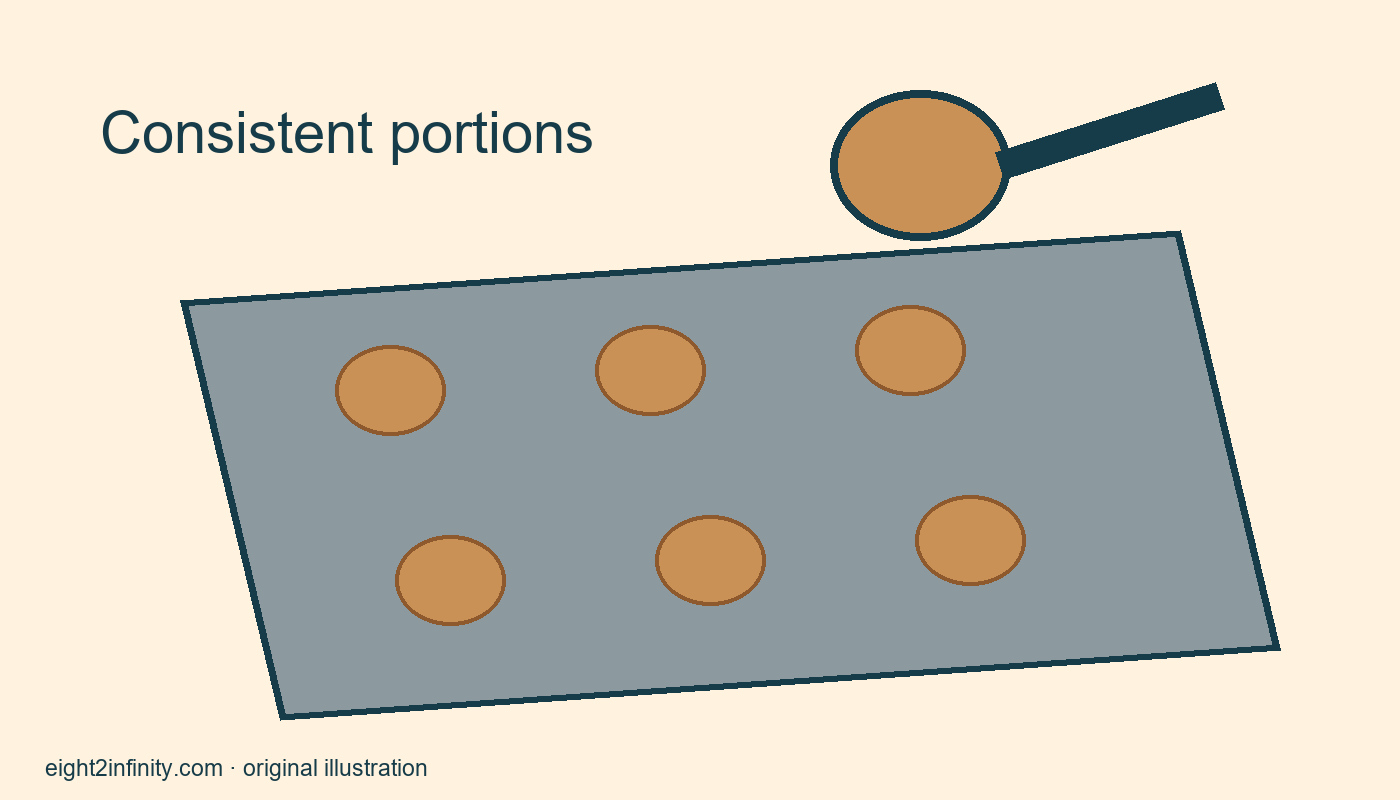
Portion drop cookie dough with the same scoop or spoon measure for each cookie, then place the portions at the spacing specified by your recipe. Similar portions make it easier to compare cookies within a batch, but a scoop does not guarantee identical shape or doneness. Follow the recipe’s instructions for dough temperature, chilling, pan preparation, baking, and cooling. The method here concerns consistency at the portioning stage rather than a universal cookie formula.
King Arthur Baking’s cookie guidance and recipes describe scooping dough and giving portions room on the baking sheet. This original exercise uses that principle without assigning one scoop size or spacing to every recipe. Some doughs spread much more than others, and a recipe may require flattened portions, rolled balls, or a particular weight. Read those instructions first. A tool that works for one drop cookie may be inappropriate for a stiff cutout dough or a filled cookie.
Set up one recipe and one measure
Choose a reliable drop cookie recipe that specifies its portion size. Prepare the dough as directed and complete any required chilling before portioning. Set out the recommended baking sheet and lining. Select a scoop or spoon that can produce the recipe’s stated portion. If your tool is a different size, recognize that you are changing the portion and may need recipe-specific guidance. Do not assume a larger scoop can use the same baking time without checking.
For the worked example, imagine a recipe that calls for twelve equal portions from a small practice batch. The number twelve is an organizational example, not a claim about the yield of a particular published recipe. Divide the work into a first row of four, a second row of four, and a third row of four only if the recipe’s required spacing fits your pan. If it does not fit, use additional batches rather than crowding the portions to preserve the drawing.
Fill the scoop in the same way
Take each portion using a similar filling action. Avoid making the first scoop lightly filled and the next heavily heaped unless the recipe explicitly calls for that variation. Release the dough onto the prepared sheet without adding loose extra pieces to random portions. Consistent handling reduces an avoidable difference between cookies. It does not remove differences caused by uneven oven heat, dough composition, or pan placement. Treat the scoop as one control within the larger recipe rather than an automatic quality guarantee.
Pause after the first four portions and compare their size visually. If one is obviously larger, adjust it before baking using suitable clean tools. Do not spend so long perfecting each portion that the dough warms far beyond the recipe’s intended handling condition. When the recipe gives weights and you have a suitable kitchen scale, checking a few portions by weight can provide another comparison. Follow the stated target rather than inventing a new weight because it matches the scoop you happen to own.
Respect the space between portions
Measure or estimate the recipe’s specified gap and check the first row before filling the rest of the sheet. The relevant distance is between the portions as the recipe describes, not a decorative grid drawn without regard to spread. Keep portions away from the pan edge as directed. If the final portion has no suitable space, put it on another prepared sheet or bake it in a later batch following the recipe’s dough holding guidance.
Crowding can make neighboring cookies meet, but simply increasing the gap does not solve every spreading problem. Dough temperature, ingredients, and recipe proportions also matter. If an early batch spreads unexpectedly, record what happened and consult the recipe’s troubleshooting guidance before changing several things at once. Do not add flour at random merely because two cookies touched. A controlled observation gives you a better basis for the next decision than an improvised correction with an unknown effect on texture.
Keep later batches comparable
Use a suitably cooled sheet for another batch when the recipe requires it. Placing dough onto a hot sheet can change how it behaves before the sheet returns to the oven. Keep the waiting dough in the condition specified by the recipe. Use the same portioning tool and filling action for later batches so you are not changing the cookie size halfway through. If a different sheet must be used, note that difference when comparing the results.
Bake according to the recipe’s instructions and look for its stated doneness cues. Do not use equal scoop size as proof that every cookie is finished at exactly the same moment. Oven conditions and position can still cause variation. Follow the cooling directions before judging texture or moving delicate cookies. Keep raw dough separate from ready-to-eat food and do not taste raw dough. Portion consistency is a useful baking habit, but it does not replace ordinary food handling or recipe instructions.
Record one useful observation
After cooling, compare the largest and smallest-looking cookies. Were they similarly portioned before baking, or did you change the scoop fill? Note the tool, the recipe’s portion target, and any obvious handling difference. Avoid claiming a precise improvement from one informal batch. You are learning how to repeat an action, not conducting a controlled laboratory trial. A concise note can still help you make the next batch more consistent without turning a pleasant baking task into an elaborate data collection project.
For a reader exercise, portion four cookies as consistently as you can and inspect them before baking. Can you identify a heaped portion or an undersized one using the same reference measure? Correct only the clear mismatch, then follow the recipe through baking and cooling. Which part of the process was easiest to repeat, and which needed more attention? The useful outcome is a deliberate portioning routine with appropriate spacing and recipe-specific checks, rather than a promise that one scoop size works for every cookie.
Sources and related reading
Check the Butter and Sugar Creaming Step Before Adding Flour