Index recipe cards with a dish name and one alternate entry
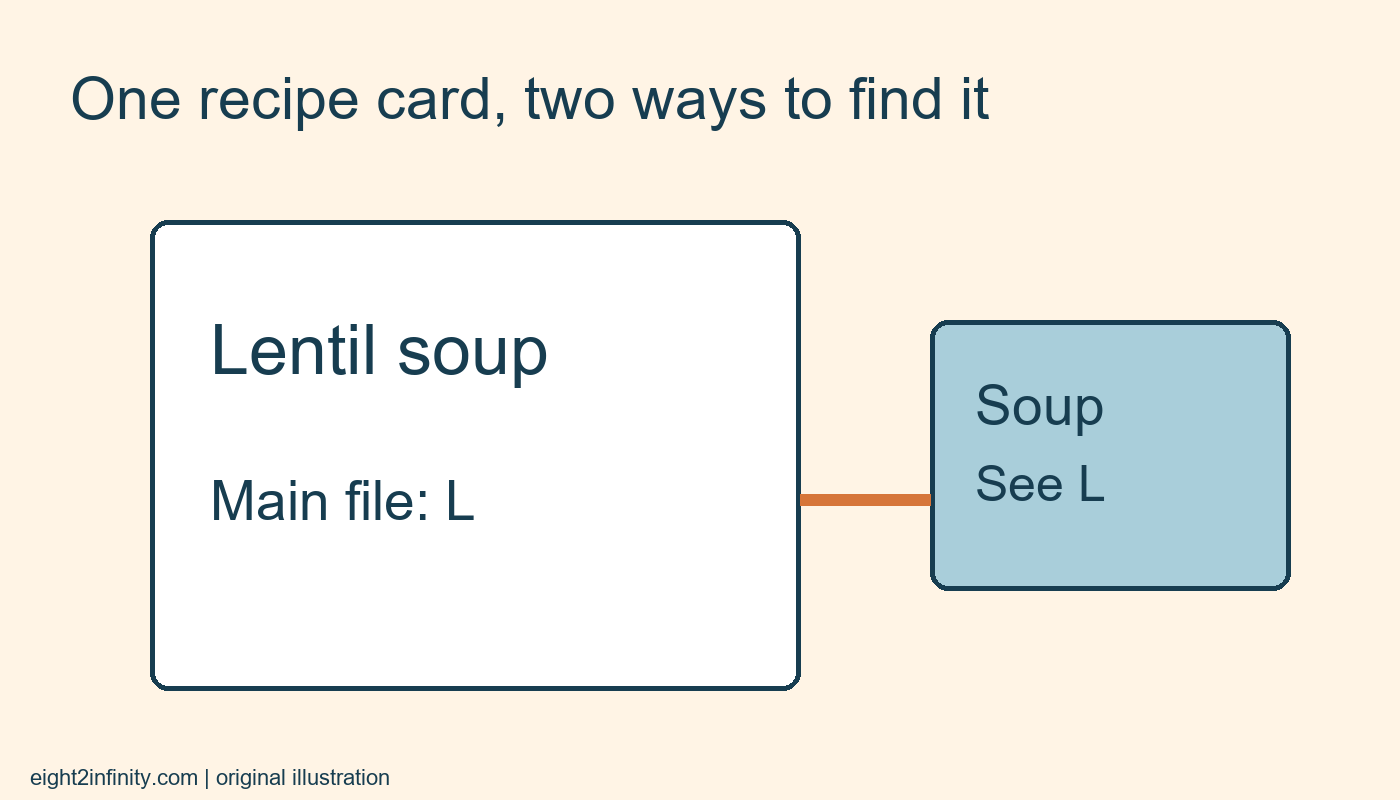
Give each physical recipe card one main filing location, then add a short cross-reference for the other name you are likely to search. For example, file a card under Lentil soup and add a note under Soup that points to it. This avoids copying the whole recipe into several sections, where later corrections could diverge. Start with a small stack and use the names your household actually remembers.
The problem is often retrieval rather than the number of cards. One person thinks of an ingredient, another remembers a dish, and a third remembers the occasion when it was served. A compact index can connect those memories without forcing every recipe into a complicated classification scheme. This method organizes cards you already own; it does not establish that a recipe is tested, complete, or suitable for a particular diet.
Choose a single main location
Gather ten cards from one drawer or box. Read the dish name on each and decide whether it is distinctive enough to recognize. A card labeled Grandma's favorite may need a descriptive addition such as apple cake, while retaining the family name as context. Do not rewrite ingredients or instructions during this sorting pass. Keep organizational edits separate from recipe changes so you can review each deliberately.
Select a simple main order, such as alphabetical by dish name. If your household already uses a successful category system, keep it rather than rebuilding everything for the sake of the exercise. The important rule is that every physical card has one primary home. Write that rule on an index card at the front so another person can return a card without guessing your intentions.
Record the minimum useful index
On a separate sheet, write the dish name and its location. For the practice stack, use Lentil soup under L, Oat biscuits under O, and Apple tray cake under A. If your box has several sections, include the section name as well. An index should tell you where to reach, not merely repeat information already visible on the card.
Avoid inventing a code system unless the physical storage requires one. A location such as Main box, L divider is usually easier to interpret than R027 when there are only ten cards. Codes can be useful for a large collection, but they need maintenance. Start with language that remains understandable when you have not used the box for several weeks.
Add one realistic alternate entry
Think about the first word you would use when asking for each recipe. For Lentil soup, that might be Soup. Write Soup: see Lentil soup, L divider. For Apple tray cake, the alternate might be Tray bake. One well-chosen cross-reference is more useful than a long list of speculative tags that no one will consult. Add additional references only when real searches reveal a need.
Keep the cross-reference brief. Do not copy the quantities, oven setting, or method onto the index. Those details belong on the main recipe card, where corrections can be made once. An alternate entry that contains a partial recipe can become dangerous confusion if someone treats it as complete. The index should direct the reader to the full card and nothing more.
Preserve source and version details
If the card came from a book, magazine, or family member, retain any existing attribution. When you have two genuinely different versions, distinguish them by a meaningful qualifier such as Apple cake with oil and Apple cake with butter. Do not merge them just because the titles sound alike. Differences in quantities and method need recipe review, not merely a filing decision.
A dated note such as revised sugar amount on 12 May can help explain a change, but do not claim a version was tested if you have no record of that. An index can include a neutral note such as handwritten correction present. The organization system should preserve uncertainty rather than turning a neatly filed card into an implied endorsement of every instruction it contains.
Deal with incomplete cards
If a card lacks a vital quantity or ends halfway through the method, place it in a clearly labeled Needs checking section. Record that location in the index. Do not fill gaps from memory while sorting, especially for instructions where exact amounts or temperatures matter. A visible unresolved note is more useful than a plausible completion that someone later assumes came from the original source.
Keep the checking section small and actionable. For example, write Find original magazine page next to one incomplete recipe. If you cannot locate the missing information, decide whether to retain the card as a memory or remove it from the active cooking collection. A sentimental card can have a place without being presented as a usable kitchen instruction.
Test with an ordinary search
Ask someone to find a soup recipe without telling them its exact title. Watch whether they consult the alternate entry and reach the correct card. Then have them put it back. If retrieval succeeds but return fails, the main filing rule may be unclear. Improve the divider labels before adding more index detail. A system has to support both directions of movement.
EPA's broad reuse guidance is relevant to keeping useful existing materials in service; this indexing method is an original suggestion, not an EPA recipe-management procedure. As your exercise, index ten cards and record one unsuccessful search. Which alternate word would have helped, and can you add it without copying the recipe or giving the same card two competing physical homes?