Sort fabric offcuts by the rectangle you can actually cut
Sort clean fabric offcuts by their usable dimensions and a plausible next project, rather than keeping every irregular piece in one compressed bag. Lay each piece flat, identify a useful rectangle within it, and record that size on a removable paper label. This gives you a practical answer when you need a patch, small craft panel, or practice piece. It is an original organization method, not a sewing pattern or a guarantee that an unknown fabric suits a particular garment.
Define what belongs in the session
Start with a small group of clean, dry scraps from projects you recognize. Keep unfinished garments, sentimental textiles, and materials needing special care outside the first sorting pass. You are deciding how to retrieve ordinary offcuts, not resolving every textile decision in the house. Use a clear table and a ruler. If a piece has loose pins or needles from earlier work, remove and store them safely before folding or reaching into the pile again.
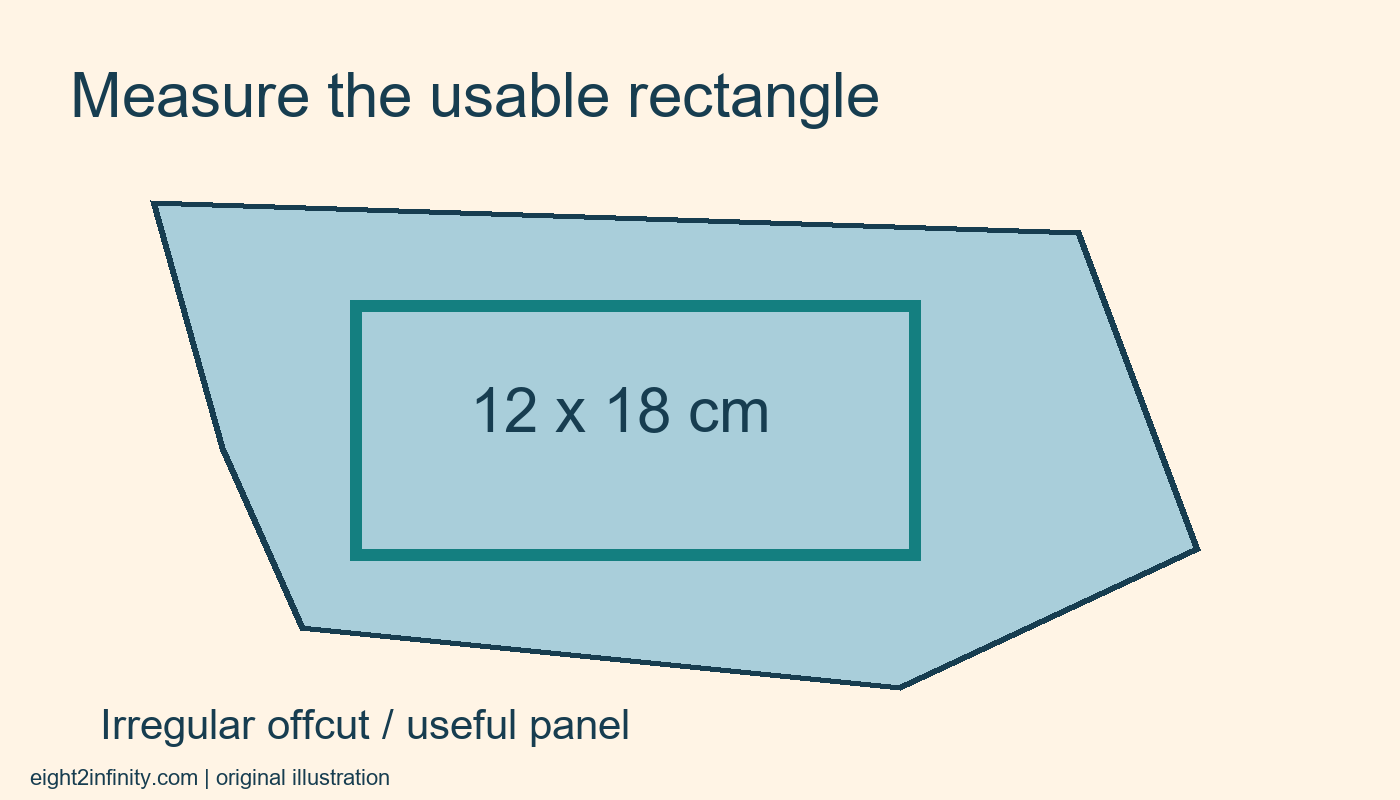
Look for damage, marks, thick seams, or cutouts that reduce usable space. An irregular piece measuring 30 cm at its widest point may not contain a clean 30 cm square. Do not label its bounding size as though the entire shape were available. A practical label might say Contains one 12 by 18 cm rectangle, with the rest described as narrow strips. That wording prevents a future project from being planned around fabric that cannot actually be cut from the scrap.
Identify a useful rectangle
Lay the piece flat without stretching it and imagine the rectangle you could cut while respecting the fabric's direction where that matters. Measure both dimensions. If there is a directional print, include a simple note such as flowers face along the 18 cm side. If you know the fabric type and care instructions from the original project, keep that information. If you do not know, write Unknown rather than guessing from touch or appearance and presenting the guess as established fact.
You do not need to cut the rectangle immediately. Leaving the piece intact preserves options. The recorded dimensions are a retrieval clue for a later project. For example, a 12 by 18 cm usable area may be worth checking for a craft panel, while a long narrow strip may be useful for practicing seams. Neither description proves that the material is appropriate for a heat-resistant item, children's product, or load-bearing repair. Those applications need suitable known materials and instructions of their own.
Use a few meaningful groups
Create three groups that reflect your actual work, such as Small panels, Long strips, and Practice pieces. Add only a few size subdivisions if the volume justifies them. Sorting by color alone looks attractive but does not tell you whether a piece is large enough. Sorting by project can also fail if the projects are only vague possibilities. A dimensional group is useful because it answers a concrete question before you unfold everything.
Attach labels with a loose paper band or place folded pieces in labeled envelopes or containers. Avoid adhesives directly on fabric when residue or damage is possible. Do not hide a tiny scrap inside a larger folded piece without noting it, because it may fall out and be lost during selection. Keep the folded shapes shallow enough that you can scan them. A tightly packed container can turn a helpful system into another pile that has to be emptied before any choice is possible.
Apply a realistic keeping rule
Choose a space limit before deciding that every piece is potentially useful. For example, keep one small box of practice pieces and one folder of larger panels. When those spaces fill, compare the new offcut with what is already there. A plain usable rectangle may be more versatile than several tiny irregular pieces in a color you rarely use. This is a personal workflow choice, not a universal minimum size that everyone should follow.
If a scrap has no likely role, look for an appropriate local textile reuse or disposal option. Acceptance rules vary, especially for tiny pieces, mixed fibers, or damaged materials. The EPA encourages reuse generally, but local programs determine what they accept. Do not put loose scraps into a donation bag under the assumption that every charity processes them. Check the receiving organization's instructions first, and keep useful material clean and separate from anything contaminated or unsuitable.
Test retrieval with a pretend project
Write a sample requirement such as One panel at least 10 by 15 cm with no directional print requirement. Use your labels to find candidates before unfolding them. Then check the chosen piece physically and account for any seam allowance required by the actual pattern. A scrap matching the finished dimensions may be too small once allowances are included. The organization label describes available material, not the complete cutting requirement of a future project.
After using a piece, update or remove its label. Do not return a smaller remainder under the old dimensions. Try the method with six offcuts and note which labels helped most. Did you need fiber information, pattern direction, or only the usable rectangle? Keep the fields that answer real retrieval questions. The system is working when you can select a suitable candidate quickly and still verify it against the project's instructions, without treating the index as a substitute for measuring again.