Store spare buttons with a garment identification note
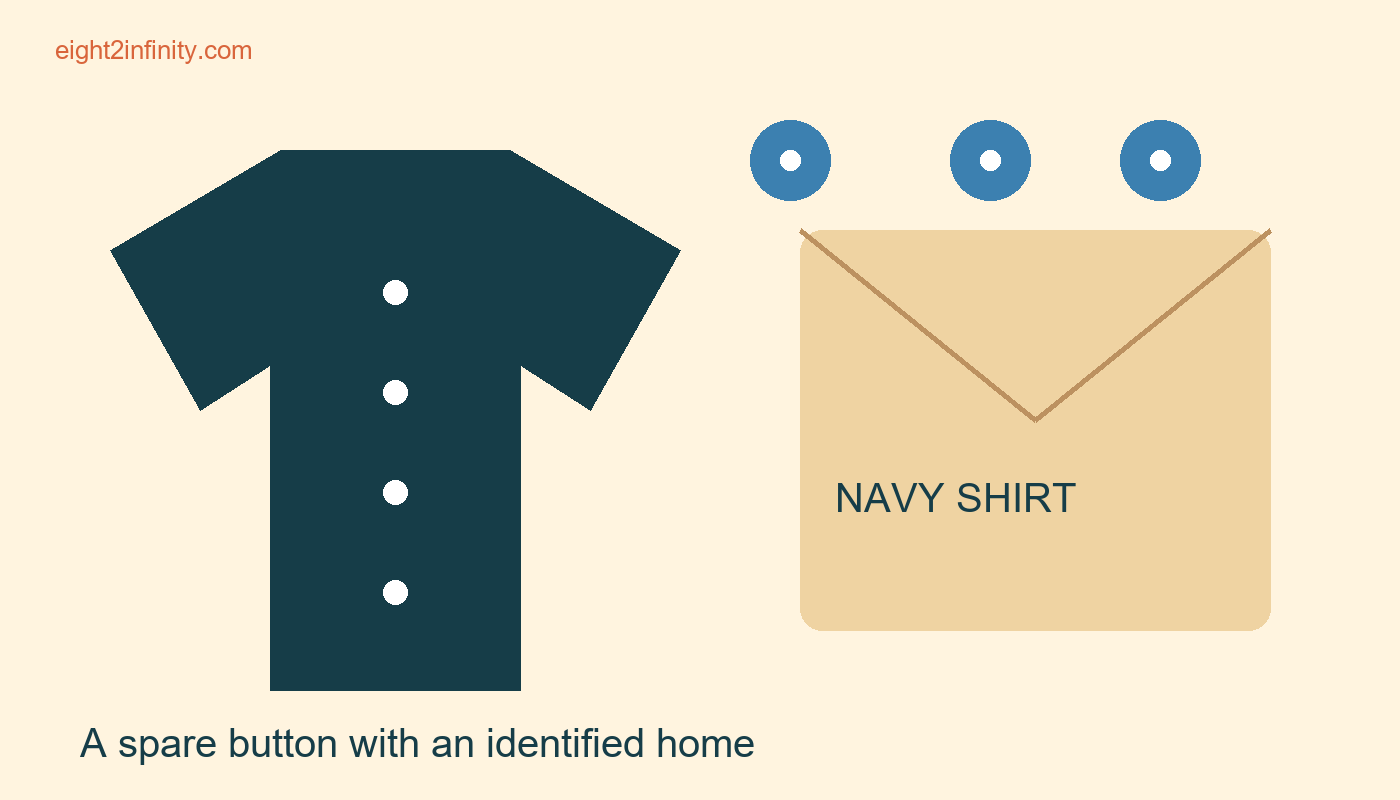
Keep a spare button in a small labeled envelope with enough information to identify the garment it belongs to. Write the garment type, color, and a distinctive feature, then store the envelope in one known sewing supply location. For example, Navy shirt with narrow white collar stripe is more useful than Blue button. This simple organization method helps you find the right spare when a garment needs attention without promising that every button can repair every fastening.
Identify the garment before separating the spare
When a new garment arrives with a spare button, match it to the garment while the connection is still obvious. Check the supplied packet and compare the button with the existing fastenings. Some garments have several button sizes, such as small collar buttons and larger front buttons. Record which kind the spare appears to match. Do not assume the biggest button in a mixed sewing box belongs to the shirt you happen to be wearing.
If the spare is already loose and you cannot identify its garment, label it Unmatched rather than inventing a connection. Keep unmatched buttons in a separate small container. The point is to preserve useful information, not to make every item look fully documented. An honest unknown is easier to resolve later than a confident label that sends someone searching through the wrong clothes. Handle small buttons away from children or pets who might swallow them.
Write a useful envelope label
Use a small envelope or another suitable container you already own. Write Navy shirt, narrow white collar stripe on the front. Add a brand or size only if it helps distinguish the garment and you want that information in the sewing kit. Avoid a label that depends entirely on where the shirt hangs today. Wardrobe locations change, but the garment's physical features are more likely to remain recognizable when you need the button months later.
For a second example, imagine two gray cardigans. One has smooth dark buttons and one has pale textured buttons. A label saying Gray cardigan is insufficient. Add the sleeve style, button appearance, or another stable distinguishing feature. You can include a small printed photograph you took yourself, but it is optional. A short clear description often provides enough context without creating another digital archive to maintain.
Keep the contents and note together
Place the spare button inside and close the envelope in a way that will not let a small object escape. If the packet contains more than one size, separate or describe them clearly rather than letting them become indistinguishable. Do not tape adhesive directly over a decorative button surface unless you know it is appropriate. The container should hold the button securely while making it easy to inspect without damaging it.
Store the envelopes upright in a small box or section of the sewing kit. Choose a capacity you can review in one sitting. Sorting by garment type, such as shirts and outerwear, may help if the collection is large, but a handful of envelopes needs no elaborate filing scheme. Put the newest envelope into the same location immediately. A well labeled packet in a random drawer is still hard to find when a repair is needed.
Do a retrieval check
Choose one garment and try to locate its spare using only the envelope descriptions. Open the likely packet and compare size, color, holes, and appearance with the existing button before beginning any repair. Matching appearance is an identification check, not a guarantee about material or durability. If the fastening has a special construction or you are unsure how to attach it, follow garment guidance or ask someone with suitable repair skills.
The Environmental Protection Agency includes clothing repair within its broader waste reduction advice. This envelope method is an original way to support that habit by keeping a useful part findable. It does not establish that repairing every garment is practical or that a specific spare is suitable. Make the repair decision based on the actual garment, its condition, and your ability to complete the work appropriately.
Maintain the collection when clothes change
When a garment is donated or passed to someone else, consider sending its identified spare with it. Secure the packet so it is not lost and make its purpose clear. If the garment leaves without the spare, review whether the button has another genuine use. Do not keep a growing collection of garment specific envelopes simply because they were once neatly labeled. The label's value depends on there still being a useful relationship to preserve.
After using a spare, update the envelope quantity or remove the empty packet. If you keep an empty envelope as a reminder to find a replacement, mark that purpose prominently. Otherwise someone may expect a button that is no longer there. Review unmatched buttons separately and keep only a manageable selection you expect to use. Your sewing kit should support repairs rather than become a museum of every fastening that has ever entered the house.
Try the method on three garments
Select three garments that already have identifiable spare buttons. Write a description for each, store the packets together, and ask another person to match one packet back to its garment. Which description was ambiguous? Improve it with one physical detail rather than a longer story. When a button eventually needs replacement, the useful test is whether the right spare can be found and checked quickly, not whether the envelopes all look identical.