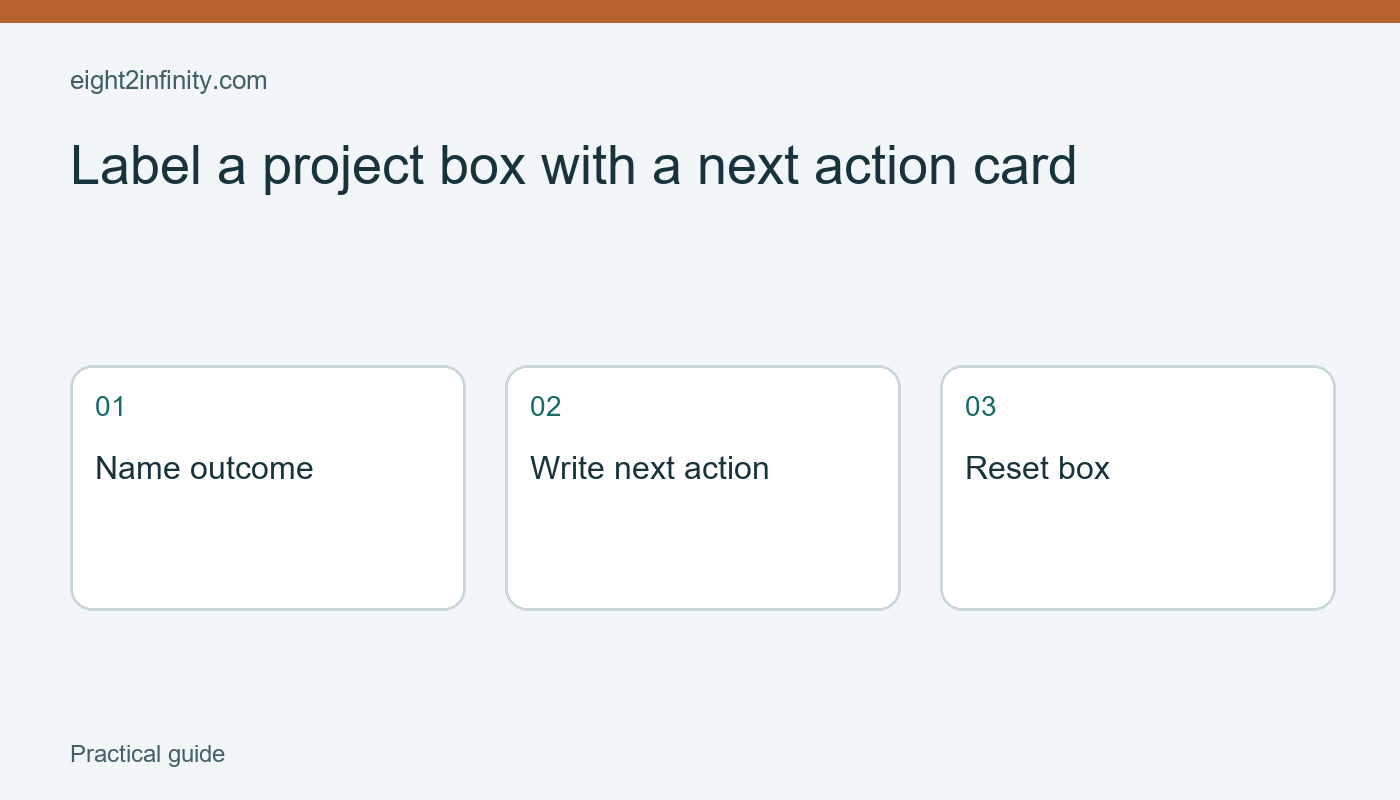
Label a project box with a next action card
Put a next action card on a project box when you want to resume a paused household activity without reconstructing what you were doing. The card should name the project, describe the next physical action, and identify anything you are waiting for. This is particularly useful for a small craft, a photo-sorting session, or a nonhazardous repair research task. It gives the box a purpose beyond storing a collection of objects under a vague label such as miscellaneous.
Choose one paused activity
For an example, imagine a box containing printed photos that you are arranging for a family album. The project is to choose twelve pictures for one page, rather than organize every family photograph. Gather only the materials needed for that limited task. Keep unrelated letters, cables, and stationery elsewhere. A project box works best when its contents belong to the same outcome. Combining several unfinished activities creates another sorting job before any of the original work can resume.
Use a container you already have if it is clean, dry, and suitable for the materials. Do not buy a large box just because the project feels large. A modest container helps define how much work you can keep active at once. EPA encourages reducing unnecessary consumption and reusing suitable items. Here the practical application is to test an existing container first, while remembering that delicate or valuable materials may need storage guidance specific to their condition.
Describe the outcome clearly
Write Project: choose twelve photos for the blue album page at the top of a card. That outcome is more actionable than Photos or Family stuff. A person seeing the box later can understand what completion looks like. Keep the wording honest: the box does not contain a finished album if the selection is still incomplete. For a different project, use an equally concrete result, such as assemble the paper decorations for Saturday's table.
Below the outcome, write Next action: compare the four beach photos and keep two. This is a physical task that can be started when the box is opened. Continue sorting is less useful because it requires you to rediscover where to begin. Avoid making the next action so large that it becomes another project. Finish the album is an outcome; choose two beach photos is a manageable action that moves toward it.
Record the stopping point
Add a brief note about what is already decided. For the photo example, it might say Eight pictures selected in the inner envelope; do not mix them with the undecided pile. Use a separator or envelope to make that state visible in the contents. The card and the arrangement should agree. If the card says a selection is complete but every photograph is loose together, the next session begins with uncertainty despite the written note.
Record the date of the last session and any genuine waiting condition. Waiting for Sam to identify two people in the group picture is useful if that answer affects the selection. Waiting to feel organized is too vague to guide a decision. If no outside information is needed, leave the waiting line blank. The card should describe the real state of the project, including whether the next action can be done now or depends on another event.
Store supporting information inside
Put a short materials list or reference note in the box if it is needed to restart. For the album, this might include the page dimensions and a paper sketch of the arrangement. Do not include sensitive personal details on the outside label. A neutral project name can remain visible while private information stays within appropriate storage. The next action card is a memory aid, not a reason to expose addresses, account information, or other details that do not help identify the box.
Keep tools safely and according to their own requirements. This example concerns paper and photographs, so it does not require sharp tools in the project box. A project involving chemicals, electrical parts, or other hazards needs separate safety and storage guidance; a card cannot make an unsuitable container safe. Limit the method to materials you can store appropriately. If a project cannot be boxed safely, use the card on a folder that points to the proper storage location instead.
Use a restart and reset routine
When you resume, read the card before unpacking everything. Do the next action or revise it if the situation has changed. At the end of the session, update the card and restore the divisions inside the box. This reset should take only a short time. It preserves the value of the work you just completed. Leaving the old next action in place after finishing it creates a misleading instruction for the following session.
If the box remains untouched for several reviews, decide whether to schedule a session, reduce the scope, or close the project. Keeping a container does not create an obligation to finish every old idea. Return useful materials to their ordinary homes if the project is no longer wanted. Avoid turning the card into a permanent guilt label. Its purpose is to support a conscious decision about the activity, including the decision to stop maintaining it.
Test the card after a pause
Close the box for a day, then open it using only the information on the card. Can you identify the outcome, distinguish completed work from undecided materials, and begin the next action without sorting everything again? Ask a household member to read the label if they may share the task. Which phrase was too vague, and what detail would have prevented the confusion? Rewrite only that part. A useful card is one that makes the next session easier, not one that records every moment of the project's history.