Find a triangle perimeter by adding its three sides
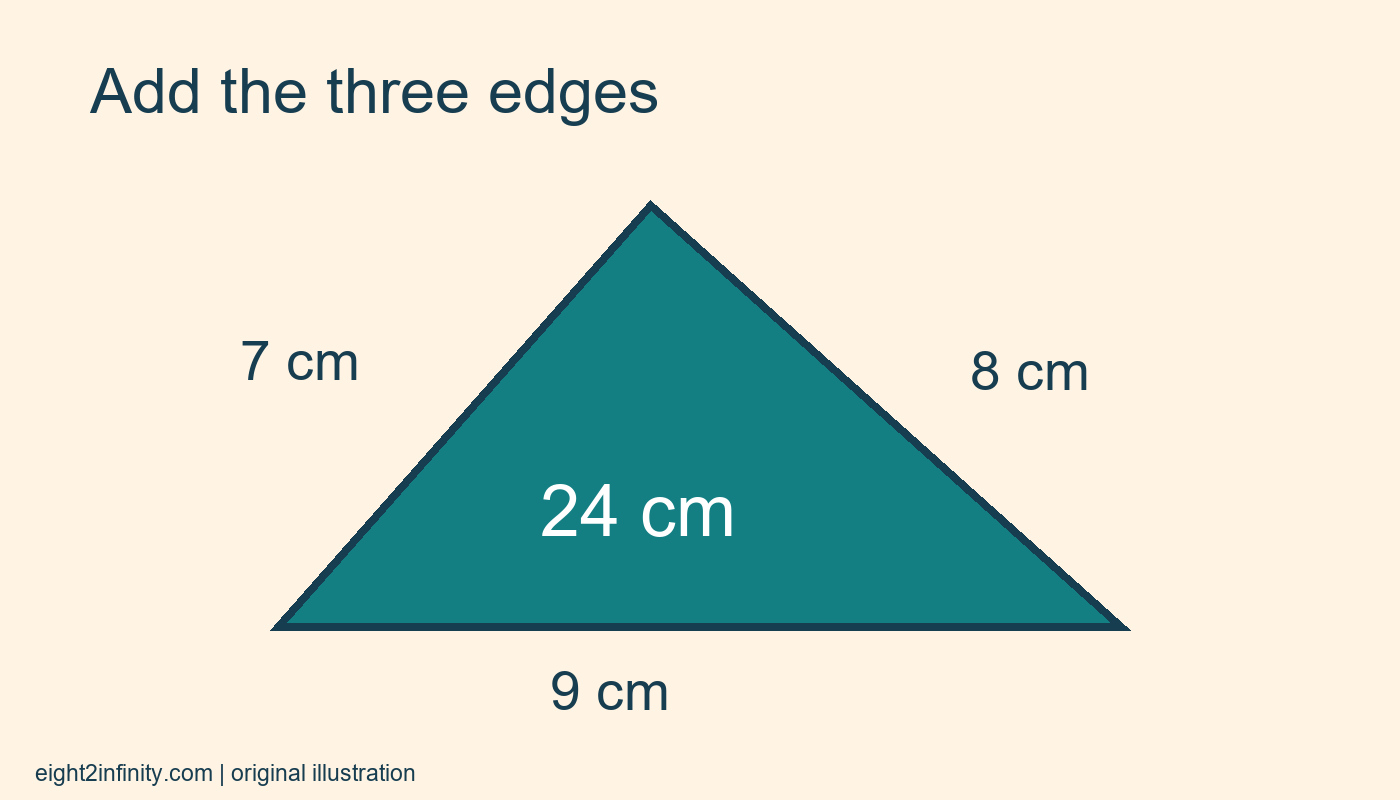
The perimeter of a triangle is the total distance around its three sides. Add the side lengths using the same unit: a triangle with sides 7 cm, 8 cm, and 9 cm has a perimeter of 24 cm. You do not need the triangle's height to answer this question. This lesson uses an original paper-pennant example to connect the calculation with the boundary you are measuring.
You need paper, a pencil, and optionally a ruler or string for a physical model. OpenStax's prealgebra treatment supplies the standard perimeter relationship. The examples and exercises here are original applications of that relationship. A drawing can help you reason, but a sketch that is not to scale should not replace the written side lengths. Use the stated measurements for the arithmetic unless the task explicitly asks you to measure an actual object.
Trace the whole boundary
Draw a triangle and label its sides 7 cm, 8 cm, and 9 cm. Place a dot at one corner. Trace from that dot along the first side, continue along the second, then return to the dot along the third. You have walked the entire outside edge once. Each side belongs in the total exactly once, regardless of whether the triangle points upward, sideways, or downward on the page.
Write P = 7 + 8 + 9 underneath. Add seven and eight to get fifteen, then add nine to get twenty-four. Record P = 24 cm. The unit is centimeters because the quantity is a length along an edge. Square centimeters would describe an area, which is a different question about how much flat surface the triangle covers.
Apply the total to a pennant
Imagine a paper pennant with those side lengths. You want a narrow decorative border all the way around it. The geometric boundary is twenty-four centimeters. If you place a strip only along the nine-centimeter side, you have bordered just one edge. Trace the other two edges on the drawing to show where the missing fifteen centimeters would go.
For a real craft project, the material cut length may need an allowance for joins, folds, or the particular attachment method. Keep that allowance separate from the geometric perimeter. In this lesson, twenty-four centimeters is the boundary length, not a guaranteed shopping or cutting specification for every border material. Stating the difference prevents a correct geometry result from becoming an overconfident practical instruction.
Use an addition check
Add the same sides in a different grouping: 7 + 9 = 16, then 16 + 8 = 24. Both calculations give the same total. This is a useful arithmetic check because a mistaken first sum can otherwise carry through the entire solution. Also compare the total with each individual side: the complete boundary must be longer than any one of its parts for these positive lengths.
If you make a physical model, use string to follow the three edges without stretching it. Mark the starting and ending positions after one full circuit, then compare the string length with the stated perimeter. A rough handmade model may introduce measurement differences, so treat it as a representation rather than evidence that the written arithmetic is wrong. Discuss which uncertainty comes from measuring and which comes from calculating.
Keep units compatible
Suppose a second pennant has sides 5 cm, 60 mm, and 7 cm. Before adding, express all three in one unit. Sixty millimeters equals six centimeters, so the perimeter is 5 + 6 + 7 = 18 cm. Adding the raw numerals five, sixty, and seven would mix unlike units and produce a number with no sensible interpretation as the triangle's perimeter.
Alternatively, convert everything to millimeters: fifty, sixty, and seventy millimeters sum to one hundred eighty millimeters. That is the same length as eighteen centimeters. Comparing the two routes helps you see that changing units changes the numeral but not the physical boundary. Always write the unit beside the final answer so another reader can interpret it correctly.
Distinguish repeated and different sides
If all three sides measure eight centimeters, you can add 8 + 8 + 8 or multiply 3 by 8. Both give twenty-four centimeters. But multiplying one side by three only works when all three side lengths are equal. For the original seven-eight-nine triangle, three times nine would incorrectly pretend that every edge has the longest side's length.
When a diagram marks two sides as equal, use that information carefully. For example, if two sides are six centimeters and the base is five, the perimeter is seventeen centimeters. Read labels and equality marks rather than guessing from a drawing that looks almost symmetrical. A slightly distorted sketch can still represent exact lengths, while an attractive picture can hide unequal edges.
Solve a missing side problem
Suppose a triangle has perimeter twenty-six centimeters and two known sides of eight and nine centimeters. Add the known sides to get seventeen, then subtract seventeen from twenty-six. The missing side is nine centimeters. Check by adding all three: eight plus nine plus nine equals twenty-six. Explain why subtracting only one known side would leave the combined length of two sides rather than identify the missing one.
For your exercise, find the perimeter of a triangle with sides 6 cm, 7 cm, and 10 cm. Then find the missing side when the perimeter is 25 cm and the other sides are 7 cm and 8 cm. The answers are 23 cm and 10 cm respectively. Trace each boundary and explain the operation you chose. Which piece of information would be unnecessary if the only question were perimeter?