Count half hour sessions by dividing a time quantity
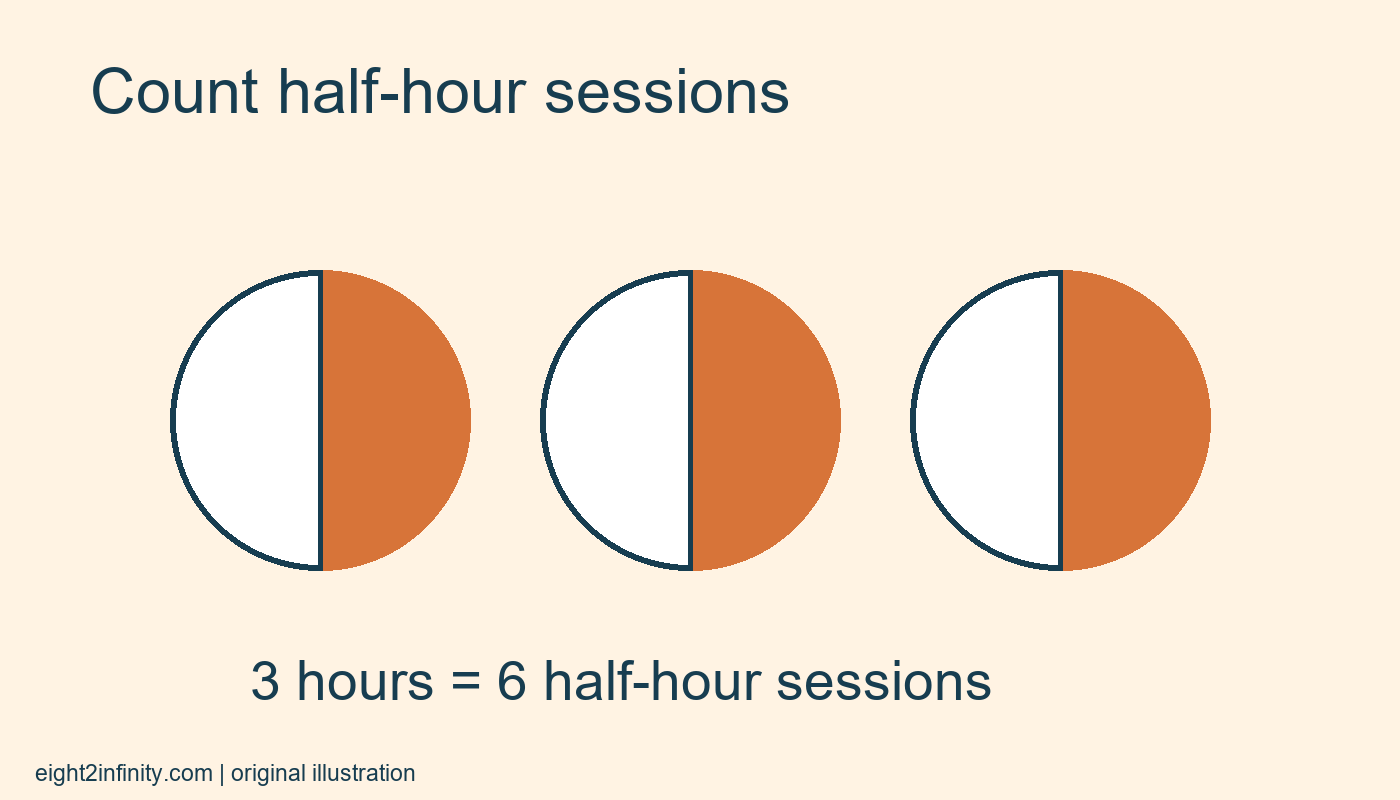
To find how many half-hour sessions fit into three hours, divide three hours by half an hour per session. The answer is six sessions. A useful way to understand this fraction division is to draw three whole hours and split each into two equal parts. This lesson uses an original workshop schedule and keeps the meaning of the units visible throughout the calculation.
OpenStax's prealgebra discussion of fraction division provides the mathematical basis. The session-planning examples below are original exercises. They assume sessions fit back to back with no breaks, travel, setup, or overlap. Real schedules often need those allowances, so treat the arithmetic as one clearly defined model rather than a promise about how much activity a real group can complete in an afternoon.
Draw the available time
Draw three equal rectangles in a row. Label each rectangle One hour. Draw a vertical line through the middle of each so it has two equal sections. Count the sections: there are six. Each section represents half an hour, so the picture shows six half-hour units inside the three-hour total. The divisions must be equal for the half-hour label to make sense.
Write 3 divided by 1/2 = 6 beneath the drawing. Read it as How many halves are contained in three wholes? That question explains why the answer can be larger than three. You are counting smaller units, not claiming that division always makes a quantity smaller. The physical time available is unchanged; only the size of the unit being counted has changed.
Confirm with minutes
Convert three hours to one hundred eighty minutes. A half-hour session lasts thirty minutes. Divide one hundred eighty by thirty to get six. This second route provides a check using whole-number arithmetic. Both approaches describe the same partition of time, so their answers should agree. If one route produces a different session count, inspect the conversion and the divisor before deciding which result to trust.
Keep the units attached while explaining the calculation. One hundred eighty minutes divided by thirty minutes per session gives six sessions. Dividing one hundred eighty by one-half without converting the session length would mix the minute total with an hour-based number. The arithmetic might be executable on a calculator, but the question would be poorly represented. Compatible units are part of the reasoning, not merely a label added afterward.
Connect the reciprocal rule to the model
The familiar fraction rule says dividing by one-half is equivalent to multiplying by two. In this example, two is the number of half-hour units in each whole hour. Three hours therefore contain three groups of two half-hour units, which is six. The diagram gives the reciprocal rule a concrete meaning rather than presenting it as an unexplained instruction to flip a fraction.
Try a total of four hours with the same half-hour session length. Four wholes each contain two halves, so there are eight sessions. Then use two hours: there are four sessions. Notice the consistent relationship. You do not need to redraw a complicated schedule each time, but the drawing remains available when you want to check why the multiplication by two is appropriate.
Change the session size
Now suppose each session lasts one-quarter hour. Split each hour rectangle into four equal sections. Three hours contain twelve quarter-hour sessions. The total time stayed the same while the session unit became smaller, so the count increased. Compare this with half-hour sessions and explain the change using the picture before writing a formula. This prevents the operation from becoming detached from the meaning of the numbers.
For one-hour sessions, the three-hour total contains three sessions. These three cases produce twelve quarter-hour sessions, six half-hour sessions, or three one-hour sessions. They all describe the same total duration under different group sizes. A useful check is to multiply each session count by its session duration and confirm that you return to three hours.
Handle a leftover interval honestly
If you have two and one-quarter hours, you have one hundred thirty-five minutes. Thirty-minute sessions fit four times, using one hundred twenty minutes, with fifteen minutes left. The raw division result is four and one-half session lengths. If the activity requires complete sessions, report four complete sessions and a fifteen-minute remainder rather than claiming five sessions fit.
That interpretation matters in planning. A leftover interval may be useful for setup or a short review, but it is not automatically another complete session. Write down what counts as a session and whether partial sessions are allowed. In a purely mathematical question, four and one-half can be the correct quotient. In a complete-slot scheduling question, the practical answer needs the whole count and the leftover time.
Add real schedule allowances separately
Suppose the three-hour workshop needs a thirty-minute setup period before any sessions. The available session time becomes two and one-half hours, or one hundred fifty minutes. Five half-hour sessions fit. Do the subtraction before counting sessions so the setup time is not quietly double-booked. If breaks occur between sessions, their placement requires a schedule model of its own rather than a casual subtraction that ignores how many breaks are needed.
Your exercise is to count half-hour sessions in four and one-half hours, then check the result in minutes. The answer is nine. Next reserve one hour of that total for another activity; seven half-hour sessions remain possible under the no-break assumption. Explain the difference between total time, available session time, and session length. Which assumption would you change first when adapting the exercise to a real workshop?