Convert mixed metric lengths into centimeters
Convert a length written in meters and centimeters into centimeters by multiplying the meter part by 100 and adding the centimeter part. For example, 2 meters 35 centimeters becomes 200 plus 35, or 235 centimeters. The conversion uses the metric relationship that one meter equals 100 centimeters. Keep the units attached to each step so the multiplication has a clear purpose rather than appearing as an unexplained movement of digits.
This original exercise follows the standard metric prefixes described by the US National Institute of Standards and Technology. Centi means one hundredth, so a centimeter is one hundredth of a meter. The worked examples concern lengths, not areas or volumes. Square and cubic unit conversions need different factors. A statement about centimeters should not be reused unchanged for square centimeters just because the unit names look similar.
Begin with a labeled example
Write 2 m 35 cm on paper. Under it write 2 m equals 200 cm. Then add the remaining 35 cm to get 235 cm. Read the result aloud as two hundred thirty-five centimeters. The meter part has changed units; the centimeter part was already in the target unit. Keeping those roles separate prevents the common mistake of adding 2 and 35 directly to get 37 centimeters, which mixes quantities expressed in different-sized units.
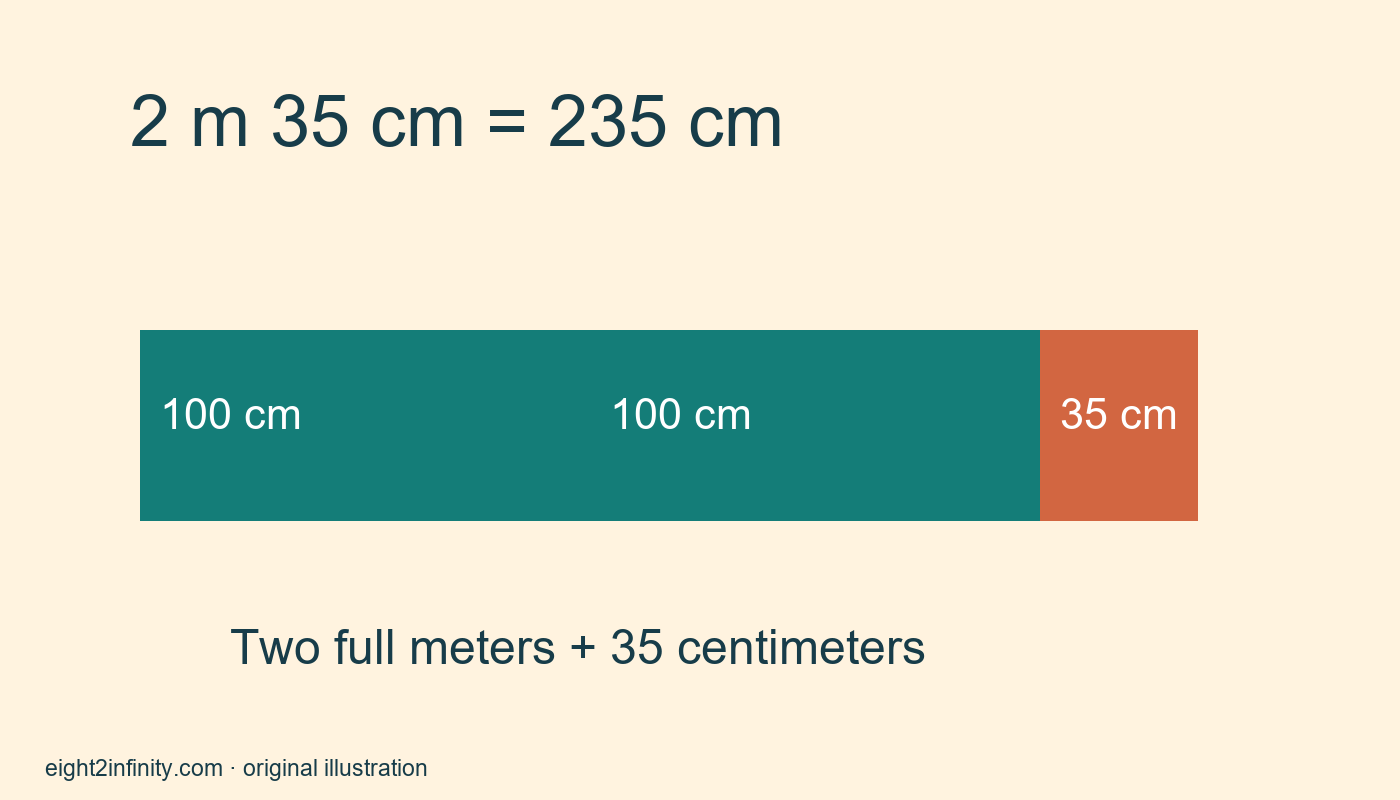
Draw a simple strip with two full one-meter sections and an additional 35-centimeter section. Label each full section 100 cm. The strip is a teaching diagram and does not need to be drawn at actual size, but the labels must agree with the arithmetic. Add 100, 100, and 35 to reach 235. This gives a second explanation of the multiplication: two groups of 100 centimeters account for the two meters.
Work through different amounts
Convert 4 m 8 cm. Four meters becomes 400 cm, and adding 8 gives 408 cm. The answer is not 48 cm or 480 cm. The small centimeter part needs its proper place value in the final number. Compare the result with 4 m 80 cm, which becomes 480 cm. These two examples are deliberately close in wording so the learner must read the unit and quantity carefully rather than copying a digit pattern from the previous line.
Now convert 0 m 75 cm. The meter part contributes zero, so the result stays 75 cm. Next convert 3 m 0 cm to get 300 cm. These boundary cases help establish that the same method works even when one component is zero. Do not invent a centimeter part merely because the original expression has only meters. Three meters is already complete information; the zero is written here only to make the mixed-unit structure explicit for practice.
Connect mixed units with decimal meters
The length 2 m 35 cm can also be written as 2.35 m because 35 centimeters is 35 hundredths of a meter. Likewise, 4 m 8 cm is 4.08 m, not 4.8 m. Eight centimeters is eight hundredths of a meter, while eight tenths of a meter is 80 centimeters. Use the earlier results of 408 and 480 centimeters to show why the zero matters. Decimal notation should preserve the quantity rather than merely shorten its written form.
This connection is useful when a measurement tool or specification uses decimal meters. However, read the source carefully before converting. A value such as 2.35 printed without a unit is incomplete for this exercise. You cannot know whether it means meters, centimeters, or something else. Likewise, a notation from another measuring system may follow different conventions. Identify the unit first, then use the appropriate relationship. Do not assume every pair of digits after a separator represents centimeters.
Check by converting back
Take 235 centimeters and separate it into complete groups of 100. There are two complete groups with 35 centimeters left, so the mixed form is 2 m 35 cm. For 408 centimeters, there are four complete groups with 8 centimeters left. This reverse check is independent enough to catch a misplaced zero. If the reverse form differs from the original measurement, revisit the conversion before using the result in a cutting, fitting, or ordering task.
A rough size check also helps. A little over two meters must be a little over 200 centimeters. An answer of 23.5 centimeters is much shorter and should look suspicious. This does not replace arithmetic, but it gives a useful warning. Ask the learner whether the numerical value should increase when expressing the same length in a smaller unit. Since centimeters are smaller than meters, more of them are needed to describe the same distance.
Practice and explain the units
Try 1 m 6 cm, 5 m 42 cm, and 7 m 90 cm. The answers are 106 cm, 542 cm, and 790 cm. For each, write the meter conversion and the addition as separate steps. Then reverse one result into meters and centimeters. If a learner writes 16 for the first answer, ask them to show where the 100 centimeters in the full meter went. The diagram can reveal the missing quantity more clearly than repeating the rule alone.
For a final exercise, invent two mixed lengths whose centimeter parts differ by a zero, such as 6 m 4 cm and 6 m 40 cm. Convert both and explain the difference without saying only that you moved a decimal point. Can you identify the number of full meters and remaining centimeters in each result? Keep the lesson tied to linear measurement. Accurate units, place value, and a reverse check make this small conversion method understandable and reusable.