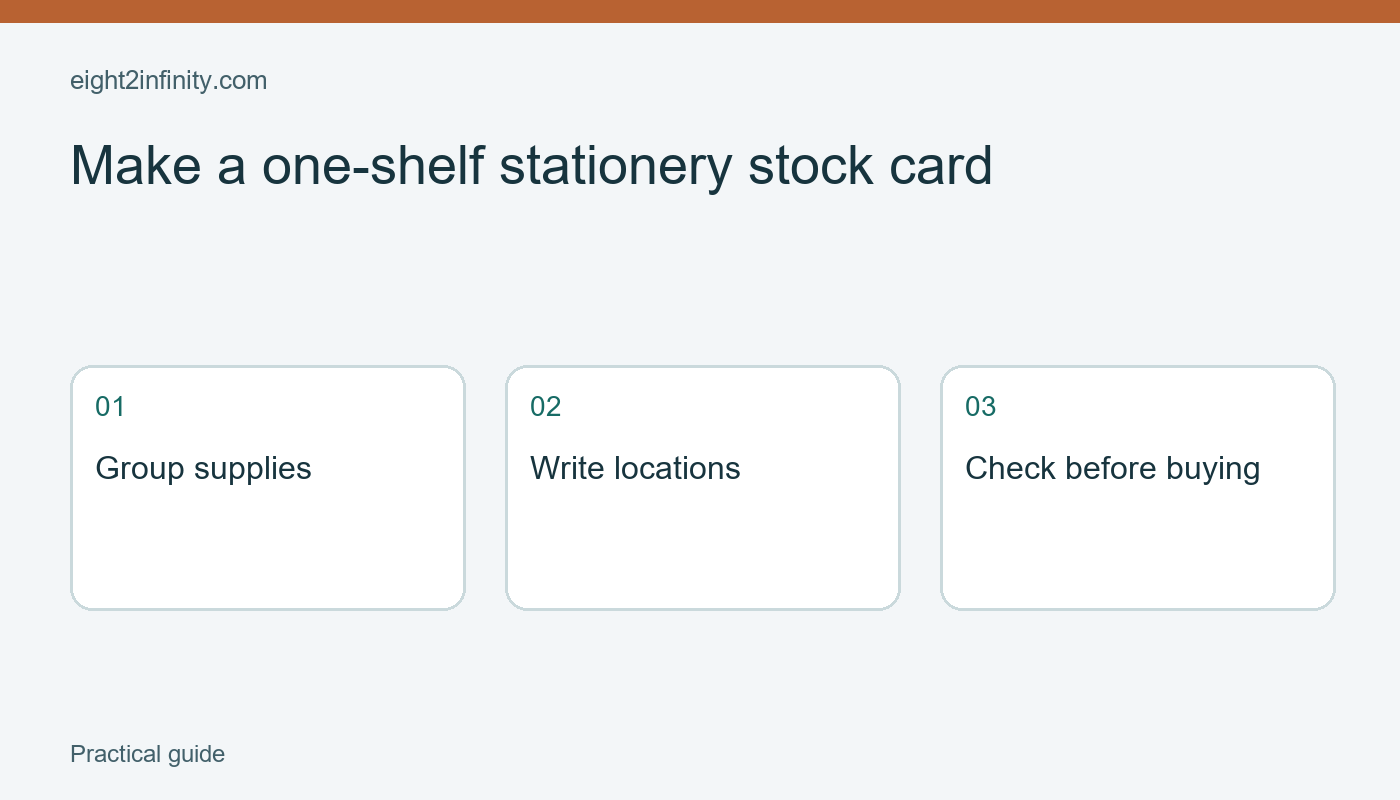
Make a one-shelf stationery stock card
Make a stationery stock card by listing the supplies on one shelf, recording where they belong, and choosing a simple point at which you will check whether more are needed. The card is a small retrieval and shopping aid, not a complete household inventory. Start with the shelf that causes repeated searches or duplicate purchases. A useful stock card should answer what is here and where it goes without requiring you to maintain a complicated tracking system.
Choose a narrow boundary
For this example, use a shelf holding notebooks, envelopes, pens, and sticky notes. Leave craft supplies, printer cartridges, and school textbooks outside the first trial. Mixing every kind of household supply into one list can make the task harder than the original problem. Mark the shelf or container clearly enough that another household member understands the boundary. If an item normally lives somewhere else, return it there rather than expanding the card to include every object you discover.
Gather the supplies onto a clean surface and group like items. Check that pens write and that notebooks still have usable pages before counting them as available stock. Keep a separate decision pile for items that are damaged or no longer useful. Do not count five nonworking pens as five replacements for a working pen. EPA's waste guidance favors reducing unnecessary consumption and reusing suitable items; the card supports that goal by making existing usable supplies easier to see.
Write four practical fields
Use a sheet of paper divided into Item, Home location, Amount now, and Check point. An example row could read Small notebooks, left basket, three unused, check when one remains. Another could read Envelopes, upright file, about twenty, check when the pile is low. The precision should match the decision. Counting every sticky note is unlikely to help if your actual decision is simply whether a spare pad is available for the next school week.
Choose descriptions that the household can interpret consistently. Pens is less informative than Black writing pens if colored markers are stored nearby. At the same time, avoid product codes unless they are needed to buy a compatible item. A stock card that requires reading tiny identifiers for ordinary envelopes will be harder to maintain. Use plain names and a clear location first. Add detail only when it prevents a specific mistake that has already occurred.
Give each group a home
Arrange the shelf so the list corresponds to visible groups. Put notebooks together and keep envelopes upright or flat in a suitable existing container. You do not need matching storage products. A clean reused box can work if it fits the shelf and supports the contents. Label the container rather than every individual object. The person returning an item should be able to recognize its home without asking whoever created the system to supervise the process.
Place the card on the inside of a cabinet door or at the front of the shelf where it is easy to read. Do not bury it under the supplies it describes. If the shelf is shared, explain that Amount now is a rough check rather than a live promise that every item is still there. A handwritten date beside the initial count can help. The card is most useful when its limits are clear and the actual shelf remains visible.
Pick a maintenance rule
For a low-use household shelf, a quick check before shopping may be enough. For frequently used supplies, review the card once a week or when a container becomes nearly empty. Choose one trigger and test it. Requiring everyone to update a count every time they take a pen may create more work than the shelf warrants. A threshold such as check when only one spare notebook remains can be easier to follow than maintaining an exact continuous balance.
Keep shopping decisions separate from automatic purchasing. Reaching the check point means inspect the need, not buy immediately. Perhaps the school term is ending, a similar item is stored elsewhere, or a notebook with several clean pages will serve the task. Write the proposed purchase on your normal shopping list after checking. This pause helps the card prevent duplicates rather than becoming a machine for restocking supplies that your household no longer uses.
Handle exceptions without clutter
If someone borrows the last notebook for a project, a simple note can flag the change. Do not build a detailed lending log into the stock card unless it is actually needed. If a supply repeatedly turns up in another room, consider whether its home location is inconvenient. Moving the group closer to where it is used may solve the problem better than adding more reminders. The shelf arrangement and the card should support ordinary behavior, not demand constant correction.
Review the decision pile after the shelf is organized. Offer clean usable extras only to a person or organization that wants them, and follow local disposal or recycling instructions for unusable materials. The card does not require keeping broken supplies for the sake of a complete count. Avoid promising a particular amount of money or waste saved. The immediate evidence is simpler: you can identify usable stock, retrieve it, and make the next purchase decision with fewer guesses.
Test retrieval and shopping
Ask another person to find one notebook and one envelope using the labels and card. Watch where the instructions are unclear and revise those words. Then pretend you are preparing a shopping list for the coming week. Which items genuinely need a check, and which are already available? After two weeks, remove fields you never used. Would a broad low or enough note work better than a precise count for any item? Keep the smallest version that helps your household make the intended decision.