Build an appliance manual index with model numbers
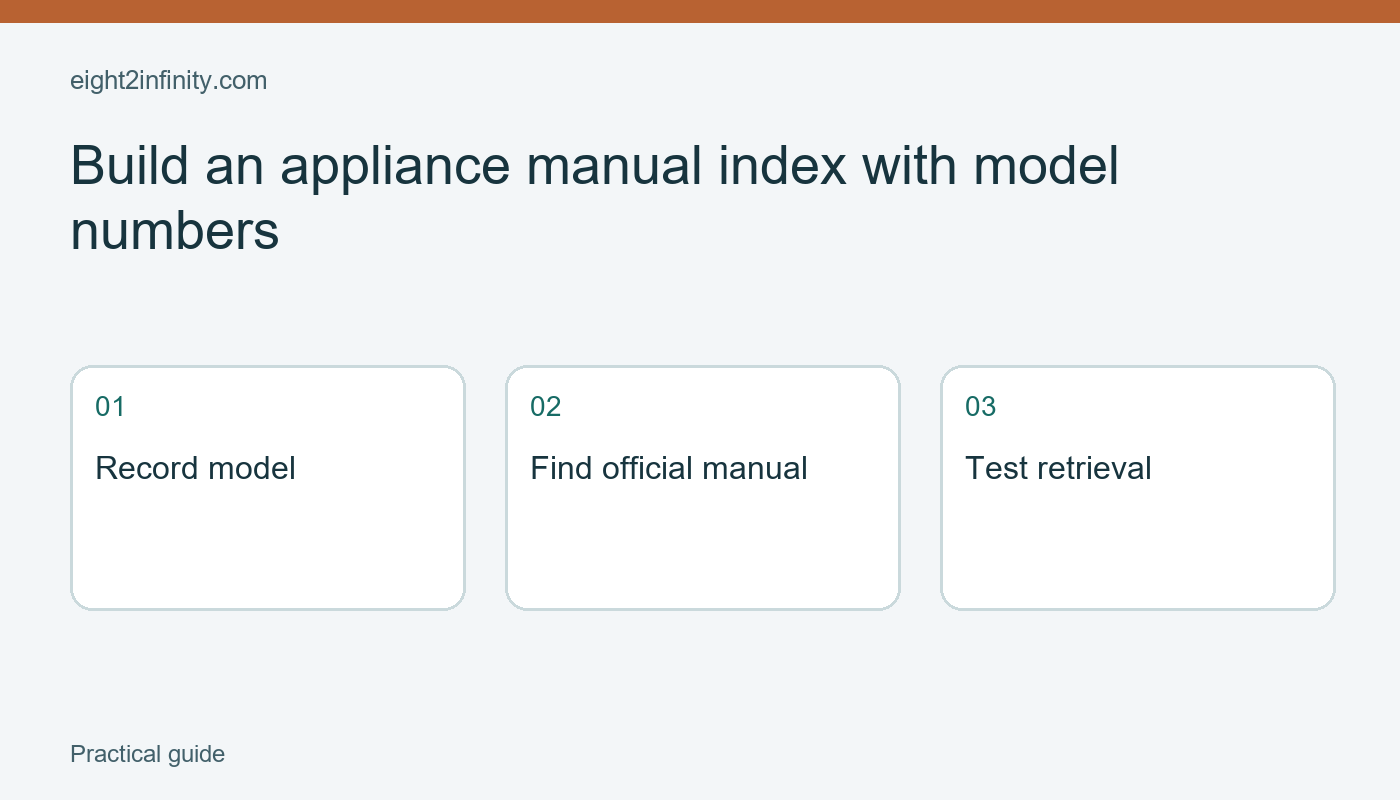
Create an appliance manual index by recording each item's exact model number, linking to the manufacturer's matching manual, and testing whether you can retrieve it quickly. Start with three ordinary appliances rather than cataloging the whole house. The index is an original organization method that can support care and repair decisions; it does not replace the instructions themselves. EPA encourages reuse and repair where suitable, and locating the right documentation makes those decisions easier to investigate.
Choose a small starting group
Pick three appliances whose labels are safely accessible without moving heavy equipment, opening covers, or touching electrical parts. A desk fan, a countertop appliance, and a vacuum cleaner may make a manageable practice group, depending on your home. Do not reach behind an installed machine or dismantle anything just to fill a record. If a label is inaccessible, mark the entry Needs model confirmation and look for purchase paperwork or other safe sources of identification.
Make a simple table with columns for item, location, brand, exact model, manual link, and checked date. A notebook works as well as a spreadsheet for the first three entries. Keep the location specific enough to distinguish similar objects: Desk fan in study is more useful than Fan. Avoid collecting serial numbers or purchase details unless you have a clear need, and keep private information out of any shared copy. The first objective is reliable manual retrieval.
Record the model accurately
Copy the model from the appliance label or verified purchase documentation, preserving letters, numbers, spaces, and suffixes. A single final character can distinguish versions. Read it twice before searching. If a photograph helps, take one only when the label is safely visible. For a fictional example, write Desk fan, study, Example Brand, Model AB-42C. This invented model illustrates the fields; it is not a real product recommendation or a manual you should search for.
Do not substitute a retailer's nickname for the model identifier. A product marketed under the same family name may have several revisions. If you find conflicting identifiers on the box, receipt, and appliance, keep the uncertainty visible and ask the manufacturer which manual applies. It is better to have an incomplete record than a polished index pointing confidently to the wrong instructions. Add a short note explaining where each identifier came from so the next person can verify it.
Find a matching official manual
Go to the manufacturer's official support website and search for the exact model. Check that the manual's model list includes your version and that the document is appropriate for your region. Electrical specifications, accessories, and controls can differ between markets. Avoid treating an unofficial download site as equivalent to the maker's support page. If the official site no longer provides the document, ask support rather than downloading an unfamiliar file simply because its title looks promising.
Enter the support-page link in your index and record the date you checked it. If the maker permits downloading a PDF, save a local copy with a descriptive filename such as Study fan manual exact-model.pdf. Open it to verify that the file is readable and the model is correct. A successful download message does not prove that the document contains the instructions you need. Keep any local copy alongside a note of its official source and document revision where shown.
Test retrieval with a real question
Choose a harmless question, such as Where does the manual describe normal cleaning? Use the index to open the manual and locate that section. Record the section heading or page number if it is useful. Do not carry out a maintenance action merely to test the index, especially if it requires disconnection, tools, or moving equipment. The retrieval exercise asks whether the documentation is findable and relevant, not whether you can improvise a repair from memory.
Ask another household member to find the same manual using your table. If they cannot distinguish the correct item, improve the location description. If the link opens a general product page, replace it with a more useful official support link when available. If the local PDF filename is confusing, rename it consistently. These small tests expose weaknesses that are easy to miss when you are the person who collected the information and already knows where everything is.
Maintain a useful small index
Add a new appliance when it enters the household and archive an entry when the item leaves. Keep records for transferred items only when useful, and pass along the relevant manual appropriately. Check a few links during an occasional household paperwork review rather than promising that every URL will remain unchanged forever. A manufacturer's website can move, so the model identifier remains valuable even when a saved link stops working. The index should survive that ordinary change.
For a reader exercise, create three entries and test two retrieval questions for each. Can you identify the exact model without guessing, open an official matching manual, and locate a routine-use section? Mark any unresolved entry clearly and give it one next action, such as Ask manufacturer about regional suffix. Stop there before expanding the catalog. Three verified records are more useful than fifty unchecked links, and the same small structure can grow gradually as real household questions arise.