Temporarily disable one desktop Chrome extension
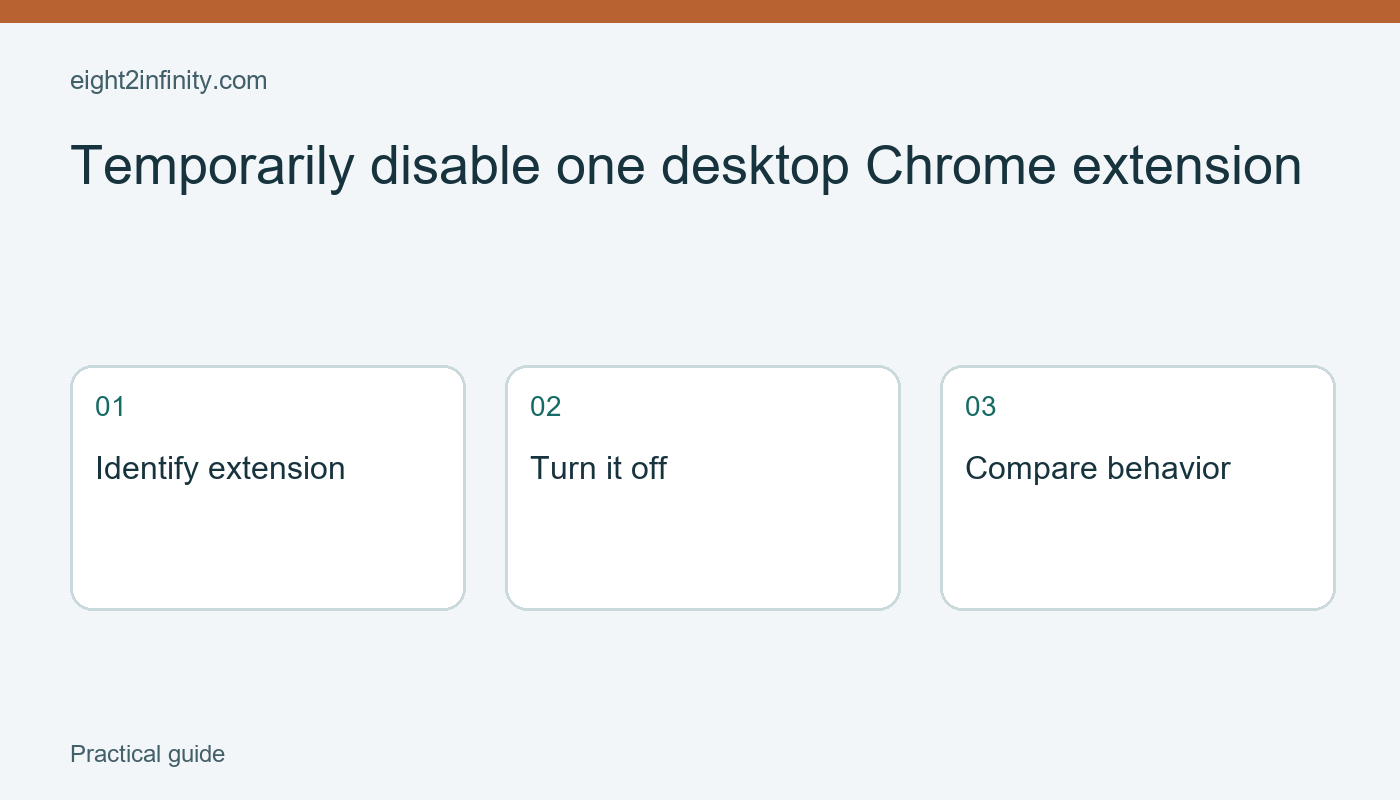
To temporarily disable a desktop Chrome extension, open the extension management page, identify the correct extension, and switch it off. Disabling lets you compare browser behavior without immediately removing the extension. If you are troubleshooting, change one extension at a time and record what happened.
This guide is a modest diagnostic exercise, not a promise that extensions cause every browser problem. Network issues, site changes, cookies, browser settings, and many other factors can affect a page. The example uses a nonessential personal extension on a device you are allowed to manage. Follow your organization's instructions for work or school browsers.
Define the behavior you want to compare
Write down a specific observation before changing settings. For example, a public reference page might display an unwanted reading overlay. Record the page address and what you see. A vague statement such as Chrome feels strange makes it hard to tell whether a later change helped or merely coincided with a different situation.
Save any work in open sites before troubleshooting. Reloading a page can discard unsaved form entries or drafts. Use an ordinary public page for the first exercise rather than a payment, account-recovery, or administrative screen. The diagnostic should be easy to reverse and should not interrupt an essential task.
Identify which extension you intend to test and why. If you installed a reading helper and the issue concerns a reading overlay, that is a reasonable candidate. It remains a hypothesis. Do not label an extension malicious or broken solely because its function appears related to the symptom.
Open the extension controls
In desktop Chrome, open the menu and navigate to Extensions, then Manage extensions. Interface wording can change between versions. You can also enter chrome://extensions in the address bar to open Chrome's extension management page. Confirm that you are in the intended profile, because different profiles can contain different extensions.
Read the extension's name and details carefully. Several products may use similar icons or names. If necessary, inspect its details to distinguish it from another extension. Do not remove or disable something just because its icon looks unfamiliar. On a managed device, an administrator may have installed an extension for a required purpose.
Find the extension's enabled toggle and turn it off. Leave other extensions unchanged for this comparison. Note the time and the action in your troubleshooting note. A simple record such as Reading helper off, public page reloaded gives you a basis for a later decision instead of relying on memory.
Compare the same page
Return to the reference page and reload it after ensuring that no unsaved work will be lost. Observe the same feature you recorded earlier. If the overlay disappears, the extension may be involved in that behavior. If nothing changes, avoid concluding immediately that the extension has no role in every possible situation.
Some behavior may depend on a newly opened tab, site state, or another condition. Keep the comparison narrow: the same page, the same task, and one setting changed. If further investigation is needed, make a separate note for the next hypothesis. Randomly toggling several settings makes the results harder to interpret.
If the problem disappears, consider whether the extension is functioning as designed. A reading overlay may simply be an enabled feature rather than a fault. Check the extension's own documentation or settings before deciding to remove it. You may prefer to leave it disabled until you understand the option you need.
Restore or remove deliberately
To restore the extension, return to its management card and turn it on again. Reload the practice page if needed and check that the expected feature returns. This comparison can strengthen your understanding of the relationship, but it still does not establish that every issue on the site comes from that extension.
Removal is a separate action. Chrome provides a Remove command, but uninstalling can have consequences for extension-specific settings or data. Consult the developer's documentation before removing a tool that stores information you need. This article does not promise that reinstalling will restore every preference or record.
Do not disable a required organizational extension to bypass a policy. If the controls are unavailable or the browser says the item is managed, contact the appropriate administrator with your specific observation. A page address, browser version, and brief symptom description are more useful than repeated attempts to override a managed setting.
Keep the conclusion proportionate
Your final note might say that the overlay was absent after disabling one reading helper on one page. That is a clear observation. It is more accurate than claiming that Chrome was repaired permanently or that the extension is unsafe. If the issue returns with the extension still disabled, preserve that new evidence and revisit the hypothesis.
For a reader exercise, choose a nonessential extension you recognize, record one visible feature, turn the extension off, and compare a harmless page. Then restore the setting if appropriate. Can you explain exactly what changed and what remains uncertain? End with the browser in the state you actually want, rather than leaving several forgotten experiments active.