
Short answer: Reset a cluttered entryway in 30 minutes with a small-space checklist, storage rules, and simple habits that keep shoes, bags, and paper under control.
The entryway is where good intentions go to die. One rushed morning leaves shoes kicked sideways, a bag on the floor, unopened mail on a chair, and suddenly the whole home feels more chaotic than it is.
That is exactly why an entryway reset works so well as a practical-living project. It is small enough to finish in one session, visible enough to improve your day immediately, and important enough to reduce everyday friction for everyone in the house.
If your space is tiny, the goal is not magazine styling. The goal is making it obvious where shoes, keys, bags, and paper belong so you can walk in, put things down once, and move on.
Why the entryway gets messy so fast
Entryways do not become clutter magnets because people are lazy. They become clutter magnets because too many jobs are competing in too little space. One corner is trying to store shoes, charge devices, collect deliveries, hold coats, and act as a drop zone for everything you forgot to deal with on the way in.
Small spaces also punish vague storage. If there is no clear tray for keys, they land anywhere. If there is no real spot for incoming paper, it stacks. If everyone can toss shoes wherever they fit, the floor becomes the system.
A good reset solves this by assigning a single home to your highest-frequency items first. You do not need more containers until you have decided what the space should and should not hold.
The 30-minute reset plan
Start with a fast clear-out. Pick up everything in the entryway and sort it into five piles: shoes, bags, paper, seasonal gear, and misplaced items. Anything that belongs elsewhere leaves the area immediately. Do not create a second clutter pile nearby.
Next, define only four zones: shoes, grab-and-go essentials, outerwear, and paper. If an item does not fit one of those jobs, question whether it belongs there. A tiny entryway cannot be the home for hobby supplies, backup chargers, unopened packages, and random decor all at once.
Finish by choosing visible limits. One shoe tray, one basket, one hook rail, one paper slot. Limits matter because they tell you when the system is full before the room feels out of control.
Use this order if you only have 30 minutes
- Clear the floor first so the space looks better immediately
- Set out a tray or mat for daily shoes only
- Give keys, wallets, and earbuds one tray or bowl
- Hang bags and coats on hooks instead of chairs
- Recycle junk mail before it crosses into the house
What to store and what to move elsewhere
Keep only what supports the first five minutes after you enter or leave the house. Daily shoes, the bag you actually use, keys, sunglasses, umbrellas, and perhaps a compact cleaning tool like a lint brush or shoe cloth belong here. Multiples and backups usually do not.
Seasonal overflow should live somewhere else. That means extra boots, off-season jackets, sports gear, and reusable shopping bag collections need a secondary storage spot in a closet, cabinet, or utility area. Your entryway should hold the current rotation, not your whole inventory.
Paper is the quiet clutter source most people underestimate. If school forms, receipts, and mail all land here, give them a vertical file or wall pocket and an expiration rule. Process it daily or at least twice a week so the paper system stays small.
Small-space upgrades that actually help
The best upgrade for a small entryway is almost always vertical. Hooks, a narrow wall shelf, or a slim organizer gives you storage without stealing walking space. A wall mirror can also help the area feel brighter while doing one last-out-the-door check.
If shoes are the main issue, use a tray with a hard limit instead of an open pile. A tray creates a boundary and catches dirt. If your household tends to kick off too many pairs, switch to a one-in, one-out rule for the front door area.
If you want the space to look styled, add that last. A small plant, framed print, or lamp only works after the practical zones are stable. Decor should support calm, not compete with the landing gear your household truly needs.
How to keep the reset from collapsing next week
The smartest maintenance rule is an evening two-minute reset. Put away shoes that drifted, clear the paper slot, return keys to the tray, and hang bags properly. It is easier to do that nightly than to rescue the whole space every Saturday.
Make the system easier than the mess. If the shoe tray is too far away, nobody will use it. If the hooks are too high for children, backpacks will end up on the floor. If the paper slot is too small, the kitchen counter becomes the backup plan.
Expect to adjust. Real homes reveal their problems in use. After a week, ask what keeps escaping the system. That is your clue that the zone, limit, or storage type needs refining.
Quick recap
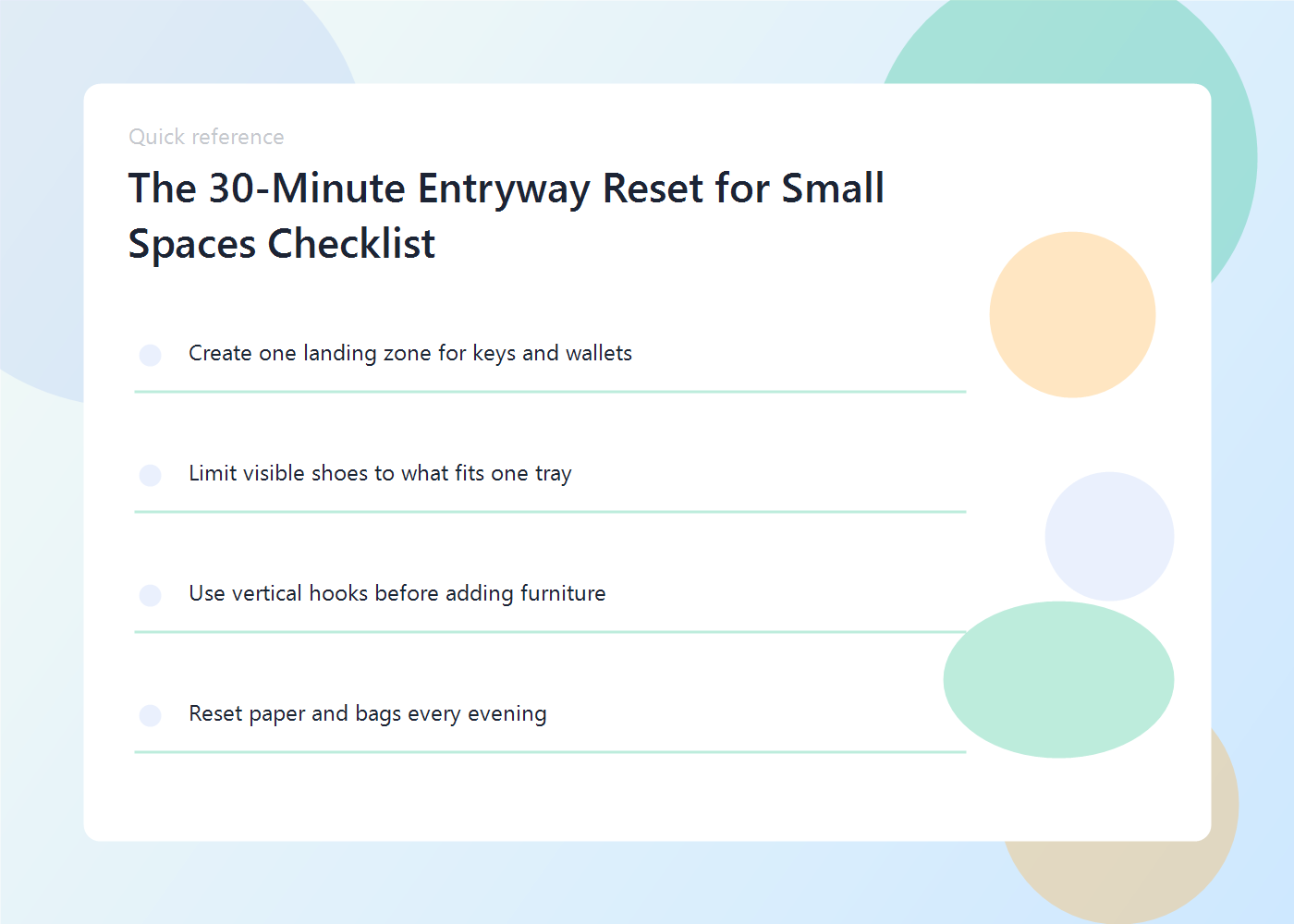
- Create one landing zone for keys and wallets
- Limit visible shoes to what fits one tray
- Use vertical hooks before adding furniture
- Reset paper and bags every evening
FAQ
How many shoes should stay in a small entryway?
Only the pairs currently in daily rotation. A tray or mat with a fixed boundary works better than an open pile because it tells you when the area is full.
What if I do not have a real hallway or foyer?
Use a micro-entryway setup near the door: a hook rail, one tray for keys, and one shoe mat. Even a wall section can function as a landing zone if the jobs are clear.
How often should I declutter the entryway?
A quick daily reset plus a weekly five-minute check is usually enough. Seasonal gear needs a larger swap a few times a year.
Related reads on Eight2Infinity
Why this topic matters right now
- 2026 decluttering checklists and home-organization trend coverage point to small, focused resets instead of whole-house overhauls.
- Entryways are a common clutter trigger because they collect shoes, mail, bags, umbrellas, and impulse-drop items in one tiny zone.