

Short answer: Build a realistic family media plan with screen-free times, better device rules, and the AAP 5 C’s so your household can reduce fights without banning tech.
Most families do not need a dramatic anti-screen reset. They need a plan that makes normal life easier: homework gets done, sleep stays protected, meals feel human, and nobody is negotiating YouTube at 9:45 p.m. for the fourth time.
That is why the idea of a family media plan has become more useful than one blunt screen-time number. Different ages, school demands, group chats, games, and creative tools all require more nuance than a single daily limit can offer.
A workable plan is not about controlling every click. It is about protecting the parts of childhood and family life that matter most while giving kids a clear framework they can understand and eventually help manage.
Important: Every child and family situation is different. Use this guidance as a practical starting point and seek professional support when safety or mental health concerns are involved.
Start with what you want more of, not what you want less of
The most effective media plans begin with family priorities. If your real goal is better sleep, calmer mornings, less arguing at dinner, or more outdoor play, those goals should shape the rules. Otherwise the plan becomes a list of punishments with no larger purpose.
Write down three household priorities first. For example: devices stay out of bedrooms overnight, homework comes before entertainment media, and dinner stays phone-free. Those priorities are easier to defend than random time caps because they connect to real outcomes.
Children usually respond better when the plan sounds like a family operating system instead of a personal crackdown. The message is not ‘you are the problem.’ The message is ‘we are protecting sleep, focus, and connection in this house.’
Use the AAP 5 C’s as your conversation tool
The AAP’s 5 C’s framework gives parents a practical way to judge media without getting lost in panic or guilt. Think about the child, the content, whether media is being used to stay calm all the time, what it may be crowding out, and how you will keep communication open.
This approach is useful because it shifts the conversation from ‘How many minutes?’ to ‘What is happening here?’ A video chat with grandparents, a math tutorial, a multiplayer game with friends, and endless short-form scrolling are not the same experience.
You do not need to recite the framework formally. You can turn it into simple questions: Is this helping or draining you? Is it age-appropriate? Is it replacing sleep, movement, or family time? Can we talk openly about what you see online?
Simple questions to ask before saying yes
- What is this app or video actually for?
- Will it interfere with homework, sleep, or getting ready?
- Is this something we are comfortable talking about together?
- Does it fit the child’s age, maturity, and current stress level?
- Is this active use, creative use, or just automatic scrolling?
Write rules for moments, not just total time
Families often struggle because they only discuss totals. But most conflicts happen around moments: before school, during homework, at dinner, in the car, right before bed, or during emotional meltdowns. That is where your rules need to be concrete.
For many homes, the highest-value rules are screen-free meals, no personal devices in bedrooms overnight, and a clear cut-off before sleep. Another common win is creating a homework flow: music okay, messaging limited, entertainment media later.
When children are older, you can keep the plan realistic by separating schoolwork, creative use, and social use from pure entertainment. That avoids endless arguments about whether every minute on a device counts the same.
Make the plan visible and easy to follow
A media plan works better when it is written down. That can be a note on the fridge, a shared family document, or a simple one-page agreement. Verbal rules tend to mutate in the moment, especially when everyone is tired.
Be specific enough that another adult could follow the same rule. ‘Use screens responsibly’ is vague. ‘Tablets stay in the living room after dinner’ is clear. ‘Phones charge in the kitchen at 9 p.m. on school nights’ is even clearer.
If your children are old enough, let them help write parts of the plan. Kids are more likely to follow boundaries they helped shape, especially if they get to suggest reasonable privileges in return for consistent follow-through.
What to do when the plan stops working
Every media plan needs revision. A new school year, exam season, travel, sports, summer break, or a new device can change what the household needs. The goal is not to get the perfect rules on day one. The goal is to build a system you can revisit without drama.
If the plan breaks, look for friction points instead of blaming character. Are notifications too tempting? Are devices charging in bedrooms? Are adults ignoring the same rules they expect children to follow? Most plan failures are structural, not moral.
Review the plan every two weeks at first. Keep what is working, simplify what is not, and add only one new rule at a time. Families do better with a few reliable boundaries than a complicated list nobody remembers.
Quick recap
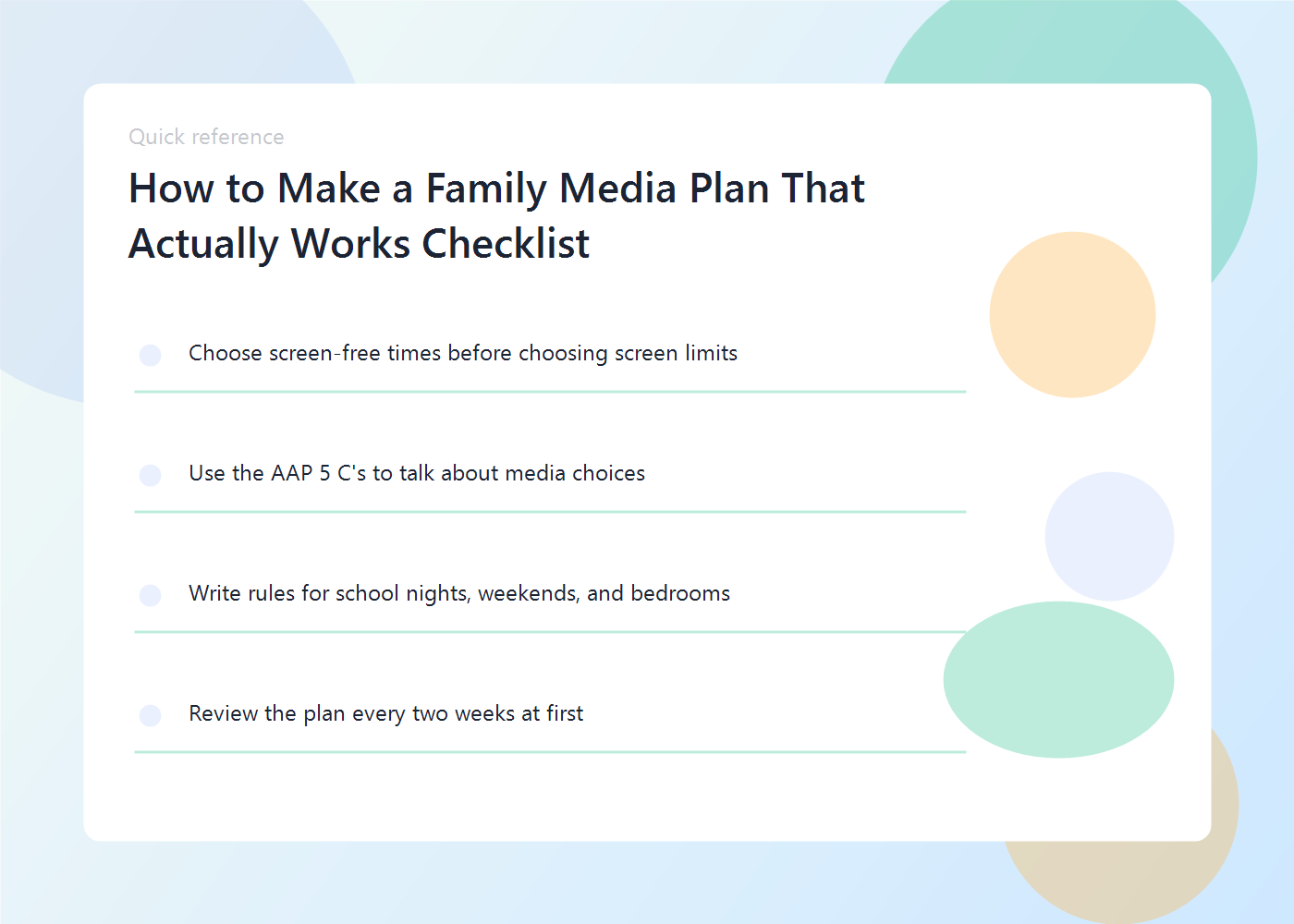
- Choose screen-free times before choosing screen limits
- Use the AAP 5 C’s to talk about media choices
- Write rules for school nights, weekends, and bedrooms
- Review the plan every two weeks at first
FAQ
At what age should a family media plan start?
As soon as screens become part of daily life. For younger children it may be mostly parent rules; for older kids and teens it should become a shared agreement.
Should every child have the same screen rules?
Not always. Rules can differ by age, maturity, school needs, and device access, but core household boundaries like sleep protection and phone-free meals can stay consistent.
What if my child says all their friends have fewer limits?
Stay calm and return to your family priorities. Explain what your plan protects and, when possible, offer flexibility inside the boundaries rather than abandoning them.
Related reads on Eight2Infinity
Why this topic matters right now
- The American Academy of Pediatrics now emphasizes the quality and context of media use, not only the total minutes.
- Parents are actively looking for practical screen-time frameworks that reduce conflict without turning every device decision into a battle.