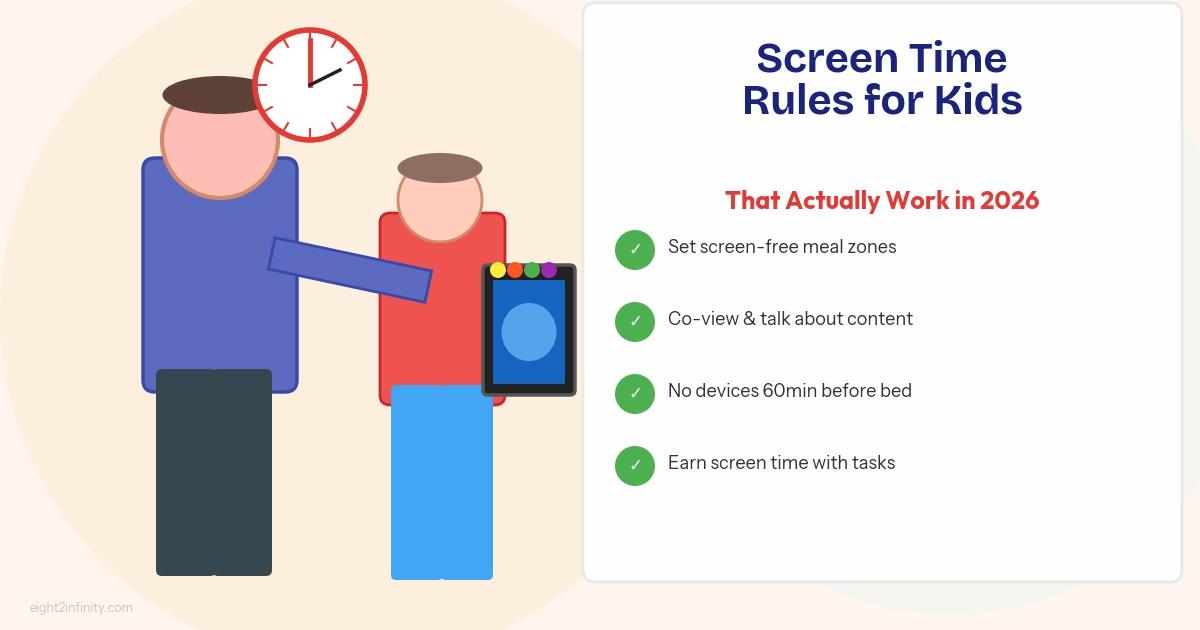
Screen Time Rules for Kids That Actually Work in 2026
Slug: screen-time-rules-for-kids-that-workCategory: Parenting > Family WellnessKeyword: screen time rules for kidsExcerpt: Forget strict hour limits — here's how to set screen time rules for kids that work in 2026, based on the latest expert guidance and real-family strategies.
Why Old Screen Time Rules No Longer Work
The idea of limiting kids to "two hours of screen time per day" made sense in 2010, when screens meant TV and video games. In 2026, screens are how children learn, socialise, create, and communicate. A blanket hour limit fails to distinguish between a child watching educational content, video-calling a grandparent, or doom-scrolling social media for hours.
In early 2026, the American Academy of Pediatrics updated its guidance, moving away from rigid time limits toward a quality-first framework built around three questions: What is the child watching? What is it replacing? What is the context?
The New Framework: Quality, Context, and Displacement
Rather than counting minutes, today's experts recommend assessing screen time through three lenses. First, quality: interactive, educational, or creative screen use is very different from passive consumption of short-form videos. Second, context: co-viewing with a parent or sibling adds relational value. Third, displacement: if screens are consistently replacing sleep, physical activity, homework, or face-to-face play, that's when to intervene.
Practical Screen Time Rules That Families Can Actually Follow
Rule 1: Screens Off at Mealtimes and Bedtime
This is the non-negotiable most family experts agree on. Devices away during all meals — including breakfast — and removed from bedrooms 60 minutes before sleep. Blue light disrupts melatonin production, and the social habit of shared meals without screens builds connection. Use a charging station outside bedrooms to make this frictionless.
Rule 2: Earn Screen Time With Real-World Activities First
Many families find success with a simple "earn then enjoy" model: homework done, outdoor time taken, chores completed — then screens are available. This isn't punishment; it's sequencing that ensures essentials don't get displaced.
Rule 3: Create a Household Media Plan Together
Sit down with your children (even young ones) and co-create a family media plan. When kids are involved in setting the rules, they're far more likely to follow them. Include what platforms are allowed, for how long, and what the consequences of rule-breaking are — agreed in advance.
Rule 4: Designate Screen-Free Zones and Times
The living room sofa and the car are natural screen-free zones for many families. So is the first hour after school, which many child development experts recommend as unstructured downtime. Consistency matters more than perfection — even three or four screen-free windows a day makes a measurable difference.
Rule 5: Watch and Discuss Rather Than Just Restrict
Co-viewing gives you insight into what your child is consuming and opens conversation. If your 10-year-old is watching YouTube, watch an episode together occasionally. Ask what they find funny or interesting. This builds media literacy and keeps communication open.
Age-by-Age Guidance
Under 18 months: avoid screens entirely except video calls. Ages 2–5: up to one hour of high-quality programming daily, co-viewed where possible. Ages 6–12: consistent household limits, with focus on quality and balance. Teenagers: focus on sleep, homework, and physical activity not being displaced — autonomy increases, but boundaries on social media remain important.
Tools That Help
Built-in parental controls on iOS (Screen Time) and Android (Family Link) allow you to set app limits, schedule downtime, and monitor usage without constant policing. Router-based controls like Circle or your broadband provider's family settings can enforce household-wide rules automatically.
For more on raising children in a digital world, explore our parenting guides and our section on family wellness.
Frequently Asked Questions
How much screen time should a 7-year-old have per day?
Rather than a fixed number, assess whether screens are displacing sleep, physical activity, or learning. For most school-age children, one to two hours of recreational screen time on weekdays and slightly more at weekends is a reasonable baseline, with quality prioritised over quantity.
Should phones be allowed in children's bedrooms?
Most child sleep experts recommend keeping all screens out of children's bedrooms overnight. Use a family charging station in a shared space to make this a household norm rather than a punishment.
At what age should children have their own smartphone?
There's no universal right answer, but many families and schools are delaying smartphones until secondary school age (11–13) and opting for basic phones earlier if contact is needed.
What counts as "good" screen time?
Educational content, creative activities (drawing apps, coding, music), video calling family, and interactive learning games generally qualify as high-quality screen use. Passive short-form video consumption for extended periods is typically lower quality.
How do I handle screen time arguments with my child?
Create the rules together in advance and write them down. When limits are hit, point to the agreed plan rather than making an in-the-moment decision. This removes the argument dynamic and makes the rules feel fair rather than arbitrary.