• About
  • Contact
  • Privacy Policy
  • Terms
  • Editorial Policy
  • Affiliate Disclosure
No Result
View All Result
  • Login
Eight to Infinity
  • Home
  • Parenting
    • Child Safety
    • Family Wellness
    • Kids Activities
    • School & Learning
  • Practical Living
    • Cleaning
    • Home Décor
    • Home Improvement
    • Organization
    • Pest Control
  • Pet Care
    • Bird Care
    • Budgie Care
    • Beginner Pet Guides
  • Technology
    • AI Tools
    • Apps
    • Online Safety
    • How-To Tech
  • Money & Work
    • Career
    • Entrepreneurship
    • Financial Planning
    • Investment Advice
    • Making Money Online
  • Food
    • Cooking Tips
    • Recipes
  • Health
    • Healthy Eating
    • Mental Health
    • Wellness
  • Education
    • Career Education
    • Student Guides
    • Study Abroad
  • Travel
    • Destinations
  • Science
    • Facts
  • Lifestyle
    • Beauty
    • Fashion
      • Footwear
    • All Post
  • Home
  • Parenting
    • Child Safety
    • Family Wellness
    • Kids Activities
    • School & Learning
  • Practical Living
    • Cleaning
    • Home Décor
    • Home Improvement
    • Organization
    • Pest Control
  • Pet Care
    • Bird Care
    • Budgie Care
    • Beginner Pet Guides
  • Technology
    • AI Tools
    • Apps
    • Online Safety
    • How-To Tech
  • Money & Work
    • Career
    • Entrepreneurship
    • Financial Planning
    • Investment Advice
    • Making Money Online
  • Food
    • Cooking Tips
    • Recipes
  • Health
    • Healthy Eating
    • Mental Health
    • Wellness
  • Education
    • Career Education
    • Student Guides
    • Study Abroad
  • Travel
    • Destinations
  • Science
    • Facts
  • Lifestyle
    • Beauty
    • Fashion
      • Footwear
    • All Post
No Result
View All Result
Eight to Infinity
No Result
View All Result
Home Business and Finance
The 50/30/20 Budget Rule Explained for Beginners

The 50/30/20 Budget Rule Explained for Beginners

by Nahida Azmin Nishu
May 24, 2026
in Business and Finance
0
ADVERTISEMENT
3
SHARES
20
VIEWS
Share on FacebookShare on Twitter

The 50/30/20 Budget Rule Explained for Beginners

Slug: 50-30-20-budget-rule-explained-beginnersCategory: Business and Finance > Financial PlanningKeyword: 50 30 20 budget rule beginnersExcerpt: The 50/30/20 rule is one of the simplest budgeting frameworks for beginners. Here's exactly how it works, with examples and tips to make it work for your income.

What Is the 50/30/20 Rule?

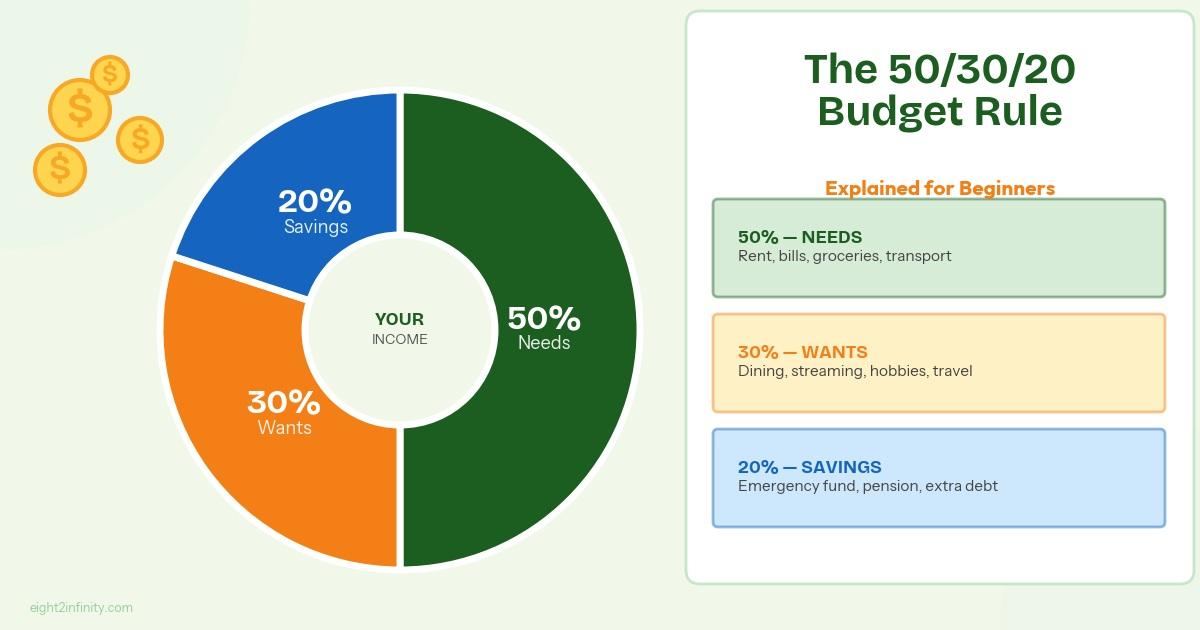
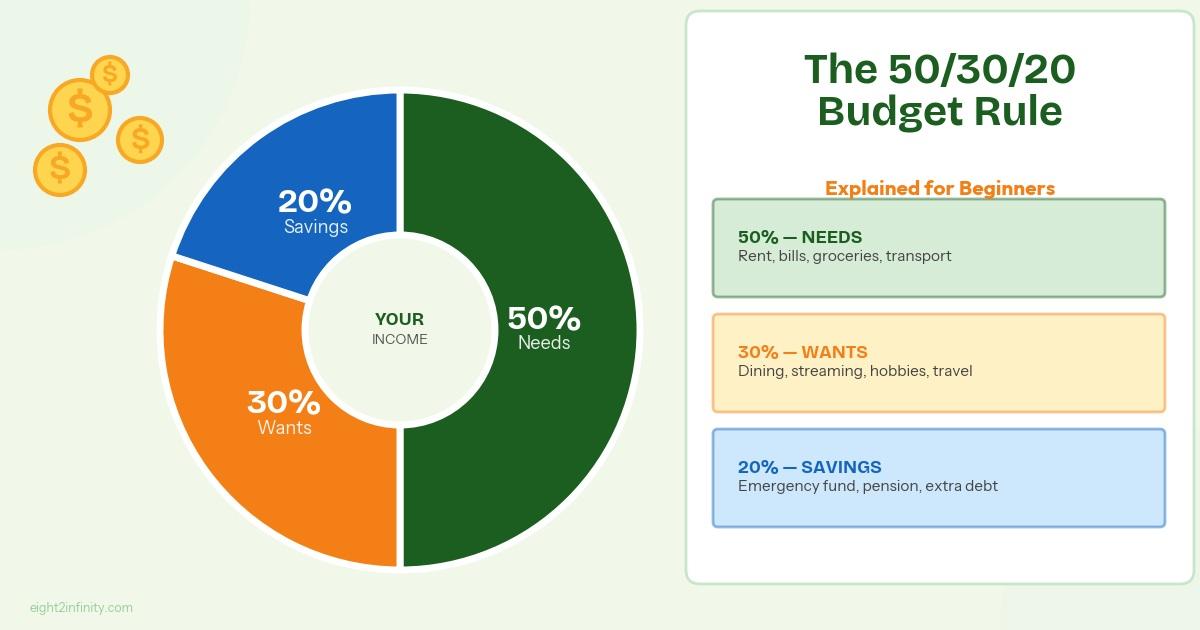
The 50/30/20 rule is a budgeting framework that divides your after-tax income into three categories: 50% for needs, 30% for wants, and 20% for savings and debt repayment. It was popularised by US Senator Elizabeth Warren in her book All Your Worth and remains one of the most recommended starting budgets for anyone new to personal finance.

Its appeal is simplicity. Rather than tracking every individual purchase in a spreadsheet, you manage three broad buckets — which makes it far easier to stick to long term.

ADVERTISEMENT

Breaking Down the Three Categories

50% — Needs

Needs are essential expenses you cannot reasonably live without: rent or mortgage payments, utility bills (gas, electricity, water), groceries, transport to work, minimum debt repayments, and basic insurance. If you find that your needs exceed 50% of your take-home pay — common in high cost-of-living cities — you'll need to either reduce spending in this category over time or adjust the percentages to suit your situation.

30% — Wants

Wants are everything that improves your quality of life but isn't strictly essential: streaming subscriptions, dining out, gym memberships, holidays, hobbies, clothes beyond the basics, and entertainment. Many people find this the trickiest category — it requires honestly categorising expenses. A gym membership might feel like a need, but it's technically a want (you could exercise for free). That's fine — but know what it is.

20% — Savings and Debt Repayment

This 20% should be directed toward building your financial future: an emergency fund (aiming for three to six months of expenses), pension or retirement contributions, paying off non-essential debt faster than the minimum, and longer-term savings goals like a house deposit. Pay yourself first — set up an automatic transfer on payday so this 20% moves to savings before you can spend it.

A Practical Example

Say your take-home pay is £2,500 per month. Under the 50/30/20 rule: £1,250 goes to needs (rent, bills, food, transport), £750 goes to wants (eating out, subscriptions, hobbies), and £500 goes to savings and debt repayment. Simple to calculate, simple to monitor.

When the 50/30/20 Rule Needs Adjusting

The rule is a starting point, not a law. If you have high-interest debt, some financial advisers recommend temporarily flipping to a 50/20/30 allocation — directing 30% to debt repayment until you're clear. If you live in a very expensive city, your needs may naturally consume 60–65%, requiring you to shrink the wants category. The underlying principle — be intentional about every pound — matters more than hitting exact percentages.

Tools to Implement It

Budgeting apps like YNAB, Emma, or Monzo's budgeting features make tracking these three categories straightforward. Set up spending categories that map to your three buckets and review weekly. Most apps will send alerts when you're approaching a category limit.

For more financial guidance, visit our Business and Finance section. Please note: this article is for informational purposes only and does not constitute financial advice. For advice tailored to your personal circumstances, consult a qualified financial adviser.

Frequently Asked Questions

Does the 50/30/20 rule work on a low income?

It can be difficult to apply rigidly on a very low income where needs may exceed 50%. In these cases, focus on saving whatever percentage is possible — even 5% — and work to reduce essential costs over time. The priority should be building any emergency fund, however small.

What counts as a "need" vs a "want"?

A need is something you genuinely cannot live and work without. Rent, basic groceries, utilities, and transport to work are needs. A Netflix subscription, takeaway meals, and gym membership are wants — valuable, but not essential to survival or employment.

Should I include pension contributions in the 20%?

Yes — pension contributions, ISA deposits, emergency fund top-ups, and additional debt payments all belong in the 20% savings bucket. Workplace pension contributions (including employer match) are especially valuable and should be maximised where possible.

ADVERTISEMENT

What if I have a lot of debt?

Prioritise high-interest debt (credit cards, payday loans) as aggressively as possible within your 20% — or temporarily increase it to 30% by reducing the wants category until the debt is cleared.

Is the 50/30/20 rule the best budgeting method?

It's one of the best for beginners due to its simplicity. Zero-based budgeting (allocating every pound a job) is more precise but requires more time. The best method is the one you'll actually stick to.
Tags: 50 30 20 budget rule
Previous Post

Best Free AI Tools to Boost Your Productivity in 2026

Next Post

5 High-Protein Meals You Can Make in 20 Minutes

Nahida Azmin Nishu

Nahida Azmin Nishu

Related Posts

Business and Finance

How to Build an Emergency Fund From Scratch on Any Income

May 24, 2026
A freelancer drafting a client proposal after a discovery call on a laptop.
Business and Finance

Freelance Proposal Template for Beginners After Discovery Calls

May 23, 2026
A freelancer reviewing project notes, a calculator, and a simple pricing worksheet.
Business and Finance

How to Price Freelance Work When You’re Just Starting Out

May 22, 2026
Two labeled jars on a table, one for emergency savings and one for planned expenses.
Business and Finance

Emergency Fund vs. Sinking Fund: What to Use First?

May 21, 2026
Next Post
5 High-Protein Meals You Can Make in 20 Minutes

5 High-Protein Meals You Can Make in 20 Minutes

No Result
View All Result
ADVERTISEMENT

Categories

  • All Post (66)
  • Business and Finance (12)
    • Career (4)
    • Entrepreneurship (2)
    • Financial Planning (3)
    • Investment Advice (2)
  • Education (12)
    • Student Guides (3)
    • Study Abroad (1)
  • Facts (28)
  • Food and Drink (25)
    • Cooking Tips (2)
    • Recipes (6)
  • Health and Fitness (36)
    • Mental Health (12)
    • Wellness (4)
  • International News (1)
  • Lifestyle (54)
    • Beauty (5)
    • Fashion (22)
      • Footwear (3)
  • Parenting (6)
    • Child Safety (1)
    • Family Wellness (2)
    • Kids Activities (2)
  • Pet Care (9)
    • Beginner Pet Guides (1)
    • Bird Care (1)
    • Budgie Care (4)
  • Practical Living (8)
    • Organization (3)
    • Pest Control (2)
  • Science (7)
  • Technology (32)
    • AI Tools (1)
    • Apps (2)
    • How-To Tech (1)
    • Online Safety (3)
  • Travel (32)
    • Destinations (13)
  • WordPress Updates (1)

Recent.

Simple Morning Skincare Routine for Beginners (All Skin Types)

Simple Morning Skincare Routine for Beginners (All Skin Types)

May 24, 2026
Best Weekend Getaways in the UK for Families on a Budget

Best Weekend Getaways in the UK for Families on a Budget

May 24, 2026
How to Write a CV With No Experience: Step-by-Step Guide for Students

How to Write a CV With No Experience: Step-by-Step Guide for Students

May 24, 2026
ADVERTISEMENT
Facebook Youtube Instagram

Eight to Infinity is a online magazine website where you can find something that you might interested to know or find something new to know.

Category

  • AI Tools (1)
  • All Post (66)
  • Apps (2)
  • Beauty (5)
  • Beginner Pet Guides (1)
  • Bird Care (1)
  • Budgie Care (4)
  • Business and Finance (9)
  • Career (4)
  • Child Safety (1)
  • Cooking Tips (2)
  • Destinations (13)
  • Education (12)
  • Entrepreneurship (2)
  • Facts (28)
  • Family Wellness (2)
  • Fashion (21)
  • Financial Planning (3)
  • Food and Drink (24)
  • Footwear (3)
  • Health and Fitness (24)
  • How-To Tech (1)
  • International News (1)
  • Investment Advice (2)
  • Kids Activities (2)
  • Lifestyle (32)
  • Mental Health (12)
  • Online Safety (3)
  • Organization (3)
  • Parenting (6)
  • Pest Control (2)
  • Pet Care (8)
  • Practical Living (8)
  • Recipes (6)
  • Science (7)
  • Student Guides (3)
  • Study Abroad (1)
  • Technology (32)
  • Travel (32)
  • Wellness (4)
  • WordPress Updates (1)

Tags

academic excellence and Australia awareness benefits Bird Care climate change college students Create Apple ID DIY hair masks dos exploring Facebook security fashion future Galah Cockatoo German culture hair care hair repair health Healthy Lifestyle higher education home remedies honeymoon destinations how impact Instant Noodles intersection mental health education mental illness natural remedies nourishing ingredients Nutrition parakeet care Parenting Tips Pet Birds romantic getaways Rome stigma street the travel wildlife Windows 11 world

© 2024 Eight to Infinity - Developed by ZaeimTech.

No Result
View All Result
  • Home
  • Parenting
    • Child Safety
    • Family Wellness
    • Kids Activities
    • School & Learning
  • Practical Living
    • Cleaning
    • Home Décor
    • Home Improvement
    • Organization
    • Pest Control
  • Pet Care
    • Bird Care
    • Budgie Care
    • Beginner Pet Guides
  • Technology
    • AI Tools
    • Apps
    • Online Safety
    • How-To Tech
  • Money & Work
    • Career
    • Entrepreneurship
    • Financial Planning
    • Investment Advice
    • Making Money Online
  • Food
    • Cooking Tips
    • Recipes
  • Health
    • Healthy Eating
    • Mental Health
    • Wellness
  • Education
    • Career Education
    • Student Guides
    • Study Abroad
  • Travel
    • Destinations
  • Science
    • Facts
  • Lifestyle
    • Beauty
    • Fashion
      • Footwear
    • All Post

© 2024 Eight to Infinity - Developed by ZaeimTech.

Welcome Back!

Login to your account below

Forgotten Password?

Retrieve your password

Please enter your username or email address to reset your password.

Log In
  • Understanding 1096 Requirements: Legal Obligations Explained
This website uses cookies. By continuing to use this website you are giving consent to cookies being used. Visit our Privacy and Cookie Policy.