How to Study Smarter Using the Pomodoro Technique
Slug: pomodoro-technique-study-tipsCategory: Education > Student GuidesKeyword: pomodoro technique study tipsExcerpt: The Pomodoro Technique is one of the most proven study methods available. Here's exactly how it works and how students can use it to study smarter, not harder.
What Is the Pomodoro Technique?
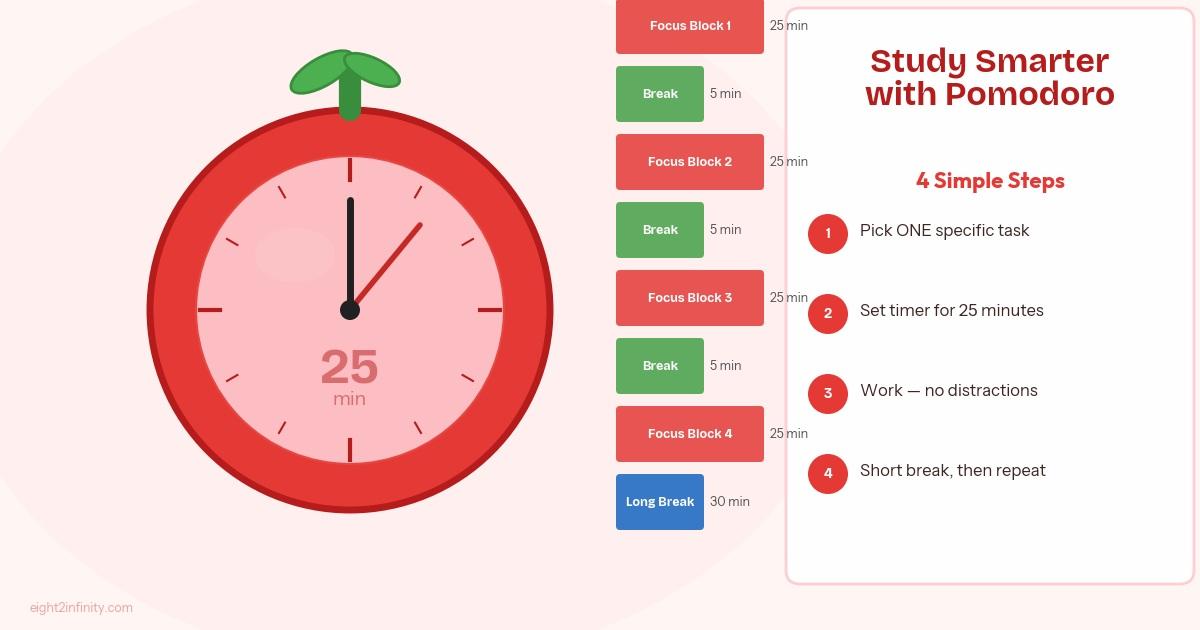
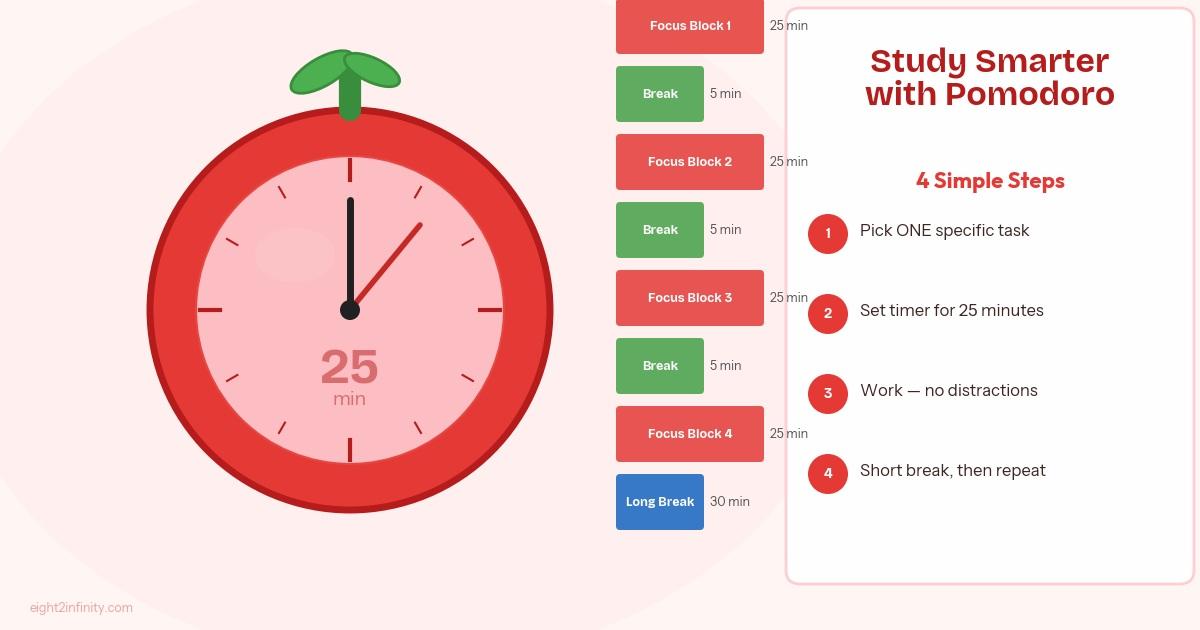
The Pomodoro Technique is a time management method developed by Francesco Cirillo in the late 1980s. The name comes from the Italian word for tomato — Cirillo used a tomato-shaped kitchen timer as a student. The method works by dividing study time into focused 25-minute blocks (called "pomodoros") separated by short breaks.
Decades of research on attention and cognitive performance supports the core insight behind it: sustained focused attention is finite, and short breaks actively restore it. Attempting to study for hours without breaks typically produces diminishing returns well before the session ends.
The Pomodoro Method: Step by Step
Step 1: Choose One Task to Focus On
Before setting your timer, pick a single, specific task. "Study biology" is too vague. "Read and make notes on Chapter 6: Cellular Respiration" is a Pomodoro-ready task. Specificity matters — it prevents the mental friction of deciding what to do during the session.
Step 2: Set a Timer for 25 Minutes
Set a timer — your phone, a physical timer, or a Pomodoro app like Forest, Be Focused, or Pomofocus. During these 25 minutes, you work on that single task only. If you think of something else to do, write it on a paper beside you and return to it after the session. Don't multitask. Don't check your phone.
Step 3: Take a 5-Minute Break
When the timer rings, stop immediately — even if you're mid-sentence. Take a proper break: stand up, stretch, make a drink, look out a window. Don't browse social media — this defeats the restorative purpose. The break should feel genuinely restful.
Step 4: After Four Pomodoros, Take a 20–30 Minute Break
After completing four 25-minute work blocks, take a longer break of 20–30 minutes. This is a proper rest: go for a short walk, eat something, have a conversation. Your brain needs deeper recovery after sustained cognitive effort.
Why the Pomodoro Technique Works for Students
It makes large tasks feel manageable. "Study for my maths exam" is overwhelming; "do four Pomodoros on quadratic equations" is achievable. It reduces procrastination — committing to just 25 minutes is a much lower psychological barrier than "three hours of revision." And it creates a natural self-measurement: you can track how many Pomodoros a task actually requires, improving your planning for future study sessions.
Adapting the Technique for Different Study Types
Some tasks — reading, problem sets, essay writing — suit the standard 25/5 format well. For tasks requiring deeper flow states (creative writing, complex mathematics), some students extend their Pomodoro to 45 or 50 minutes once they've built up their focus capacity. Experiment with what works for you, but start with the standard format.
Useful Tools
Forest app (iOS/Android) grows a virtual tree during your focus period — if you leave the app, the tree dies. It adds a satisfying visual element to the technique. Pomofocus.io is a free browser-based Pomodoro timer. Physical kitchen timers work just as well and have the advantage of being a visible, tactile commitment device.
For more strategies to improve your academic performance, explore our Education guides and our Lifestyle section for broader productivity tips.
Frequently Asked Questions
Can I change the 25-minute work block?
Yes. While 25 minutes is the standard, the principle is to work in defined focused blocks with deliberate breaks. Many students find 30 or 45 minutes works better for deep reading or problem-solving once they've built their focus capacity.
What should I do during the 5-minute break?
Stand up, move around, make a drink, look away from screens. Avoid social media or anything that's cognitively stimulating — the break should rest your attention, not redirect it.
Does the Pomodoro Technique work for exam revision?
Extremely well. It pairs naturally with spaced repetition — after completing Pomodoros on a topic, reviewing it in a later session reinforces long-term retention significantly better than one long marathon session.
What if I get interrupted during a Pomodoro?
If interrupted internally (a thought or urge), write it down and return to your task. If interrupted externally (someone speaks to you), you have two choices: handle it quickly and restart the Pomodoro, or let it go to voicemail/message and continue. Serious interruptions mean restarting the timer from zero.
How many Pomodoros should I do per day?
Most people find four to eight Pomodoros (2–4 hours of focused work) is sustainable for daily study. Quality of attention matters more than volume — eight distracted Pomodoros are worth less than four fully focused ones.