Estimate Whole Number Sums Before Calculating
To estimate a sum, round each number to a useful place value, add the rounded numbers, and compare that estimate with the exact answer. State how you rounded. The estimate should tell you roughly how large the result ought to be, helping you notice a missing digit or an incorrect operation. It is a check, not a replacement when an exact count is required.
This lesson uses original examples about books, visitors, and classroom supplies. You can work with a pencil and paper or verify the final arithmetic on a calculator. OpenStax explains whole-number place value and the usual school rounding rule. The exercises here show how to choose a degree of rounding that suits the question and how to explain the difference between an estimate and an exact result.
Choose the place value before rounding
Imagine that three school rooms have 248, 367, and 192 books. To get a quick approximate total, round to the nearest hundred. The numbers become 200, 400, and 200. Adding gives an estimate of 800 books. Write about 800 rather than exactly 800, because the rounded inputs do not represent the original counts precisely.
Now add the original numbers. The exact sum is 807 books. That is close to the estimate, which supports the size of the result. The estimate alone does not prove that every addition step was correct, but it makes a result such as 8,070 or 80 immediately suspicious. A useful check can narrow the kinds of mistakes you need to investigate.
If you want a closer estimate, round the same numbers to the nearest ten. They become 250, 370, and 190, for a total of 810. The finer rounding gives a closer result in this example. It also requires slightly more mental work. Choose a precision that helps answer the question instead of assuming that the most detailed estimate is always the most useful one.
Follow a consistent rounding rule
For these positive whole-number exercises, look at the digit immediately to the right of the place you are rounding to. If it is 5 or more, increase the retained digit by one; otherwise leave it. Replace the digits to the right with zeros. This is the ordinary school convention used here. Other disciplines or software may use different conventions for exact halfway cases.
For 367 rounded to the nearest hundred, inspect the tens digit, 6. That makes the result 400. For 248, inspect the tens digit, 4, which gives 200. Do not decide based on the final digit unless it is the digit relevant to the chosen place. Looking at the wrong position is a common way to produce a neat-looking but incorrect rounded number.
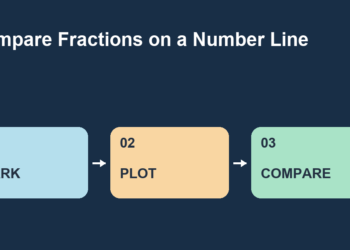
Use a number line if the rule feels abstract. For rounding 248 to the nearest hundred, place it between 200 and 300. It is 48 away from 200 and 52 away from 300, so 200 is nearer. This distance comparison explains the result. The digit rule is a shortcut for that relationship, not an unrelated trick you must accept without a reason.
Explain whether the estimate is high or low
An estimate made by rounding to the nearest hundred may include some upward and some downward changes. In the book example, the adjustments partly cancel. You cannot assume every nearest-value estimate is either above or below the exact sum. Compare the changes or calculate the exact result if that distinction matters to the decision.
For a guaranteed lower rough total of positive counts, you can deliberately round each number down at the chosen place. The books would become 200, 300, and 100, giving 600. For an upper rough total, rounding each up to the next hundred gives 300, 400, and 200, or 900. Label these as lower and upper bounds rather than pretending they use the nearest-hundred rule.
Those bounds are broad, but they show that the exact total belongs between 600 and 900. They would not justify ordering only 800 labels if every book needs one. A rough estimate and an exact procurement count serve different purposes. This is an educational arithmetic example, so no purchase recommendation follows from the invented quantities.
Use estimation to investigate an error
Suppose an answer sheet reports 1,507 for 248 plus 367 plus 192. Compare it with the approximate total of 800. The gap is large enough to justify checking the written addition. Align the place values and add again. Estimation points you toward a problem, but the next step is to inspect the exact work rather than replacing the answer with the estimate.
For another example, estimate 1,284 plus 2,716 to the nearest thousand. You get 1,000 plus 3,000, or 4,000. The exact answer also happens to be 4,000. An estimate can coincide with the exact total, but that does not mean the rounded inputs were unchanged. Describe the method accurately even when the final numbers match.
Try three totals yourself
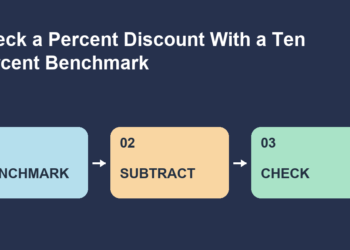
Estimate 423 plus 286, then 1,146 plus 2,382, and finally 78 plus 119. Choose a place value and state it before adding. Calculate exact answers of 709, 3,528, and 197 afterward. Our percent-discount benchmark guide applies a similar reasonableness check in a different setting. Which rounding choice made each comparison easiest to explain, and when would you still need the exact answer?