Convert Minutes to Hours by Following the Units
To convert minutes into hours, divide by 60 because one hour contains 60 minutes. To express the answer as hours and minutes, divide into complete groups of 60 and keep the remaining minutes. These are two ways to describe the same duration. For example, 150 minutes is 2.5 hours, which is also 2 hours 30 minutes. The decimal part represents a fraction of an hour, not a number of minutes.
This lesson uses original practice problems with reading sessions and workshop activities. It is a basic measurement exercise rather than a rule for payroll, billing, or a particular scheduling system. Those systems may have separate rounding conventions. Here, the goal is to keep the units visible so the calculation remains understandable and easy to check.
Begin with a complete group of sixty
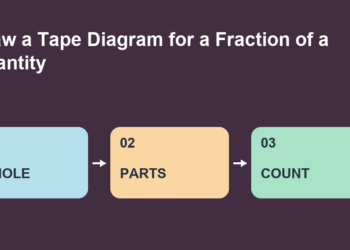
Draw three equal boxes and label each box 60 minutes. Together they represent 180 minutes. Because each box is one hour, the same total is 3 hours. The calculation is 180 divided by 60 equals 3. Label the answer hours, since the question asks how many one-hour groups fit into the original duration.
Now try 120 minutes. Two boxes of 60 minutes make 120, so the answer is 2 hours. Then try 45 minutes. The answer must be less than one hour because 45 is less than 60. This size check is valuable before you use a calculator. If a calculation turns 45 minutes into several hours, you know the direction or operation needs another look.
OpenStax's lesson on ratios and rates explains the general idea of relating quantities with different units. This exercise applies that idea to time with its own numbers and diagrams. Writing 60 minutes per hour reminds you what the conversion means instead of leaving you with a memorized instruction to divide a number for no visible reason.
Handle a remainder without losing its meaning
Consider a workshop lasting 135 minutes. Two complete groups of 60 account for 120 minutes. Subtract 120 from 135 to find the 15 minutes left over. The duration is therefore 2 hours 15 minutes. You can verify it by reversing the calculation: 2 times 60 plus 15 equals 135.
For a decimal answer, divide 135 by 60 to get 2.25 hours. The 0.25 means one quarter of an hour. One quarter of 60 minutes is 15 minutes, so the decimal and mixed-unit answers agree. It would be incorrect to read 2.25 hours as 2 hours 25 minutes. That interpretation confuses a base-ten fraction with the sixty-minute structure of an hour.
Try 210 minutes next. Three groups of 60 use 180 minutes, leaving 30. The mixed-unit answer is 3 hours 30 minutes. The decimal answer is 3.5 hours. Half an hour is 30 minutes, so the two forms match. In your notes, put the unit directly beside each answer to make it clear which form you used.
Add durations before or after converting
Suppose you read for 35 minutes on Monday, 40 minutes on Tuesday, and 45 minutes on Wednesday. Adding gives 120 minutes, which converts to 2 hours. For this small example, adding the minutes first is convenient and avoids writing several recurring decimals. The result is the total duration, not a claim that the sessions happened continuously.
If a plan lists 1 hour 20 minutes and 50 minutes, first express them on one basis. The first duration is 80 minutes. Add 50 to get 130 minutes, which is 2 hours 10 minutes. Keep the working visible until the answer is checked. Adding 1.20 and 0.50 as ordinary decimals would not correctly represent those hours-and-minutes labels.
When using a calculator, enter the conversion that matches the units in your written setup. A calculator can divide 130 by 60 correctly, but it cannot know whether you meant minutes, seconds, or a clock reading. Labeling the quantities is part of the solution. Arithmetic accuracy alone does not protect you from solving the wrong measurement problem.
Distinguish duration from clock time
A duration of 90 minutes tells you how long something lasts. A clock reading such as 9:30 tells you a position within a day. If a session begins at 9:30 and lasts 90 minutes, you add 1 hour 30 minutes to find 11:00, assuming the same day and no unusual time adjustment. Converting a duration is only one step in that scheduling problem.
Avoid treating a colon and a decimal point as interchangeable notation. A written duration of 1:30 usually means 1 hour 30 minutes when that format has been defined. A decimal duration of 1.30 hours equals 1 hour plus 0.30 times 60 minutes, or 1 hour 18 minutes. State the intended format before exchanging a list of durations with someone else.
Practice and check in reverse
Convert 75, 165, and 240 minutes into hours and minutes. The answers are 1 hour 15 minutes, 2 hours 45 minutes, and 4 hours. Reverse each answer by multiplying the complete hours by 60 and adding the remainder. Our guide to comparing fractions on a number line offers another way to understand parts of a whole. Why does 0.75 of an hour equal 45 minutes rather than 75 minutes?