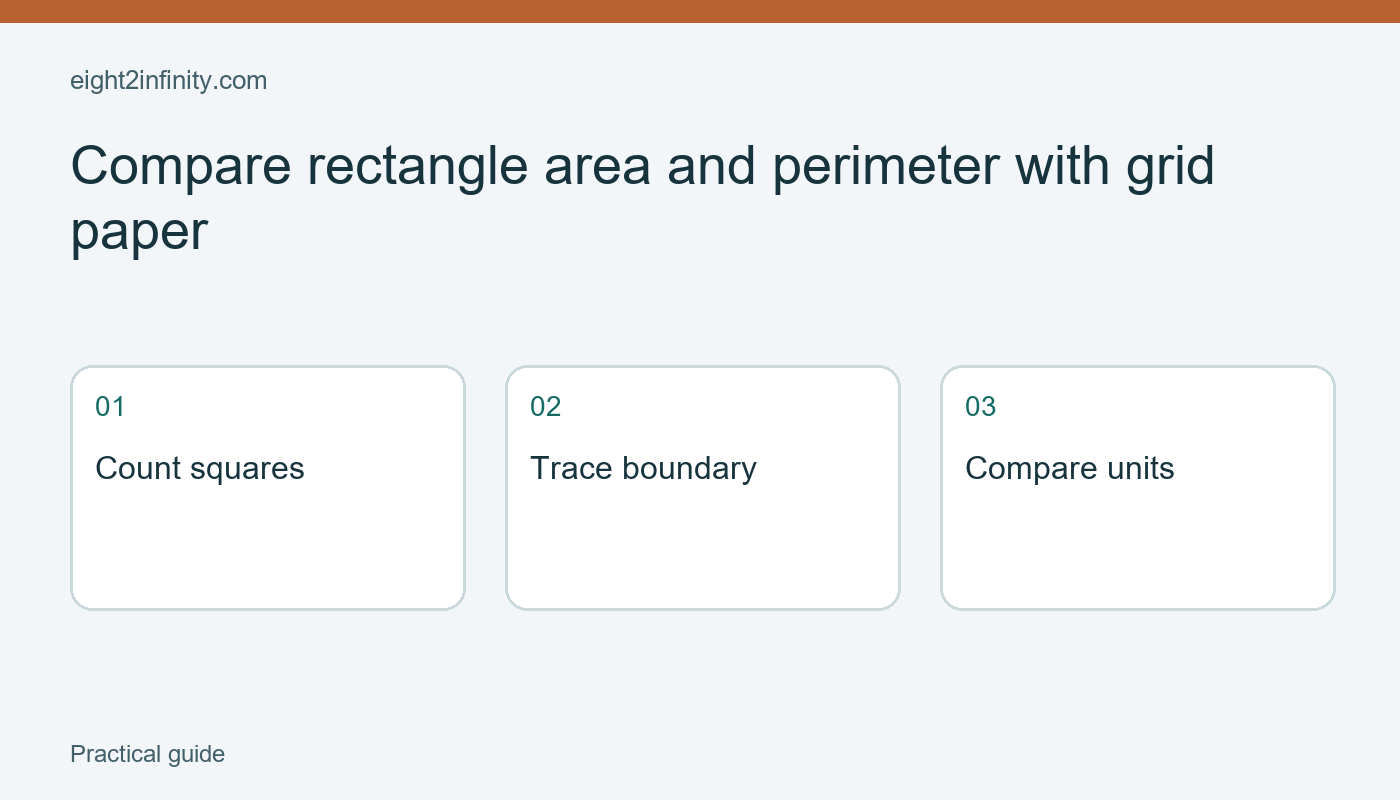
Compare rectangle area and perimeter with grid paper
Area counts the surface inside a rectangle, while perimeter measures the distance around its boundary. Use grid paper to make the distinction visible: count the small squares for area and trace the outside edges for perimeter. The units differ because you are measuring different things. This lesson uses original rectangles and arithmetic you can reproduce with a pencil. It is a learning exercise, not a specification for buying materials or measuring a real construction project.
Draw a rectangle you can inspect
Use paper with equal square cells. Draw a rectangle five cells long and three cells wide, following the grid lines. Label each cell edge as one unit. Keep the word unit until you have decided whether the drawing represents centimeters, meters, or something else. A diagram without a scale should not be treated as a measured real object. For the first example, the equal cells make it possible to count everything directly before introducing a shortcut.
Shade the inside lightly. There are three rows with five squares in each, so the rectangle contains fifteen unit squares. Write Area = 15 square units. The square-unit label means you counted little surfaces, each one unit long and one unit wide. You did not count fifteen line segments. If a learner writes only 15, ask what that number describes. Naming the quantity and the unit makes the answer easier to understand and compare with another measurement.
Trace the outside boundary
Use a different pencil color to trace around the rectangle. Count five unit lengths along the top, three down the right, five along the bottom, and three up the left. The total is sixteen units. Write Perimeter = 16 units. Count each outside edge once; interior grid lines are not part of the perimeter. The tracing exercise helps prevent a common mistake in which a learner counts every visible line inside the drawing and loses track of the boundary.
Now explain the same result without counting one segment at a time. Opposite sides of this rectangle have equal lengths, so the boundary total is 5 + 3 + 5 + 3, or twice the sum of 5 and 3. The inside count is 5 multiplied by 3. OpenStax distinguishes linear and square measurement and presents rectangle properties. Here, the original grid example lets you see why the two operations answer different questions rather than memorizing formulas without a picture.
Compare a second shape
Draw another rectangle six cells long and two cells wide. Count twelve squares inside, then trace a perimeter of sixteen units: 6 + 2 + 6 + 2. Compare it with the first rectangle. Both boundaries total sixteen units, but their areas differ: twelve square units and fifteen square units. Equal perimeter does not guarantee equal area. The grid gives you a direct way to check that claim without relying on an illustration drawn to an unknown scale.
Imagine using string to outline each rectangle and paper tiles to cover it. You would need the same string length for the two boundaries, but different numbers of tiles for the interiors. This analogy describes two different measurements, not a shopping recommendation. Real string can stretch and real tiles have gaps and cutting losses. In the classroom drawing, the ideal equal grid cells let us isolate the mathematics before introducing those practical complications in a separate measurement problem.
Compare equal areas next
Draw a third rectangle three cells long and four cells wide. Its area is twelve square units, matching the six-by-two rectangle. Its perimeter is fourteen units because 3 + 4 + 3 + 4 = 14. Equal area does not guarantee equal perimeter either. Put the dimensions, area, and perimeter of all three examples in a small table. Read each column separately so you do not accidentally compare a boundary length with a surface count.
If the numbers feel confusing, cover the formulas and return to counting. For the three-by-four shape, point to each row of three squares and count four such rows. Then trace only the outside. A learner who can explain those actions has a stronger basis for using the formulas. If the drawing is unclear, redraw it with heavier boundary lines and lighter interior lines. Good notation should reveal the difference between inside and outside rather than making both look identical.
Practice with a prediction
Before drawing a two-by-seven rectangle, predict its area and perimeter. Multiplying the side lengths gives fourteen square units. Adding all four sides gives eighteen units. Draw it and check both predictions by counting. If one answer differs, inspect whether you counted cells or grid intersections. Seven cells require eight grid-line positions along that direction, so counting the dots at the corners can lead to an off-by-one mistake. Count the actual lengths and surfaces requested.
For a final exercise, find two different rectangles on the grid that have an area of twenty-four square units. Record their side lengths and perimeters, then explain why the perimeters need not match. A four-by-six rectangle has perimeter twenty units, while a three-by-eight rectangle has perimeter twenty-two. Can you verify both without the formula? Describe which part of each drawing represents area and which represents perimeter. Keep those descriptions beside the arithmetic so the meaning stays attached to the numbers.