Short answer: Feeling stiff after hours at a desk? This 5-minute mobility reset helps you loosen up, breathe better, and move more comfortably without a full workout.
Most desk workers do not need a perfect exercise routine at 2 p.m. They need a way to stop feeling like their body is turning into office furniture. Tight hips, a stiff upper back, cranky shoulders, and low energy often come from staying in one position too long, not from personal failure.
A short mobility reset helps because it interrupts the freeze. Five focused minutes can improve how you breathe, stand, walk, and return to work. It is not a replacement for medical care, strength training, or regular exercise, but it is a useful daily bridge.
This is general education, not medical advice. If you have an injury, significant pain, numbness, dizziness, or a diagnosed condition that affects movement, check with a qualified clinician before trying a new routine.
Important: This article is for general wellness education only and is not medical advice, diagnosis, or treatment.
Why a short reset can work surprisingly well
Long sitting sessions often create one familiar pattern: chest tightness, shoulder rounding, less spinal movement, sleepy hips, and ankles that barely change position all day. A short mobility break reverses that pattern just enough to make the rest of the day feel easier.
The real benefit is consistency. A five-minute reset is short enough that you can actually repeat it during a busy week. That matters more than saving a perfect 40-minute routine for the days when life is calm.
Mobility work also pairs well with attention and energy. Many people feel mentally clearer after changing position, breathing deeply, and moving joints that have been stuck in small ranges all morning.
The 5-minute desk-worker routine
Start with chin tucks and gentle neck turns for about 30 seconds to wake up your head and neck position. Follow with a doorway or standing chest opener for another 30 seconds so the front of the shoulders can soften.
Next, do thoracic extensions over the back of a chair or standing reach-and-rotate movements for one minute. Then move to hip flexor stretches or split-stance rocks for one minute so the front of the hips gets a chance to open after hours of sitting.
Finish with ankle rocks, calf pumps, and a slow sit-to-stand pattern for the last two minutes. That sequence reminds your body how to move from the feet upward instead of treating mobility like a neck-and-shoulders problem only.
Sample 5-minute flow
- 30 seconds: chin tucks and gentle neck turns
- 30 seconds: chest opener or doorway stretch
- 60 seconds: thoracic extension or reach-and-rotate
- 60 seconds: hip flexor stretch or split-stance rocks
- 60 seconds: ankle rocks and calf pumps
- 60 seconds: slow sit-to-stand with steady breathing
How to make the reset feel better, not harder
Mobility work should feel like a release, not a punishment. Move slowly enough that you can notice tension dropping. Sharp pain, pinching, tingling, or forceful bouncing are signs to stop and reassess.
Breathing changes the experience more than most people expect. Exhale as you soften into a stretch or rotate through the upper back. When people hold their breath, even simple positions can feel more aggressive than necessary.
If one move does not suit your body, swap it. The goal is not to perform a trendy sequence exactly. The goal is to restore some motion to the areas that feel stale from sitting.
When to use this routine during the day
The best time is the moment stiffness begins affecting your focus or comfort, not the moment you finally collapse after eight hours. Many people benefit from one reset before lunch and another in the late afternoon.
Pair the routine with existing habits so you do not have to remember it from scratch. Try it after a long meeting, before your commute home, or every time you refill your water bottle. Habit pairing makes short routines much more likely to stick.
Even on busy days, one cycle is better than none. The purpose is to interrupt long stillness. You do not need special clothes, a mat, or a dramatic sweat session to get value from it.
What this routine can and cannot do
A mobility reset can ease stiffness, improve movement awareness, and make you feel less compressed. It can support better habits and help you stay more comfortable between workouts or walks.
What it cannot do is diagnose back pain, heal injuries, or replace individualized treatment for persistent symptoms. If you are dealing with ongoing pain, repeated headaches, weakness, or symptoms that keep returning, professional assessment matters.
Use this routine as supportive everyday care. It works best alongside walking, strength work, regular breaks, and a workstation setup that does not force your body into the same shape all day.
Quick recap
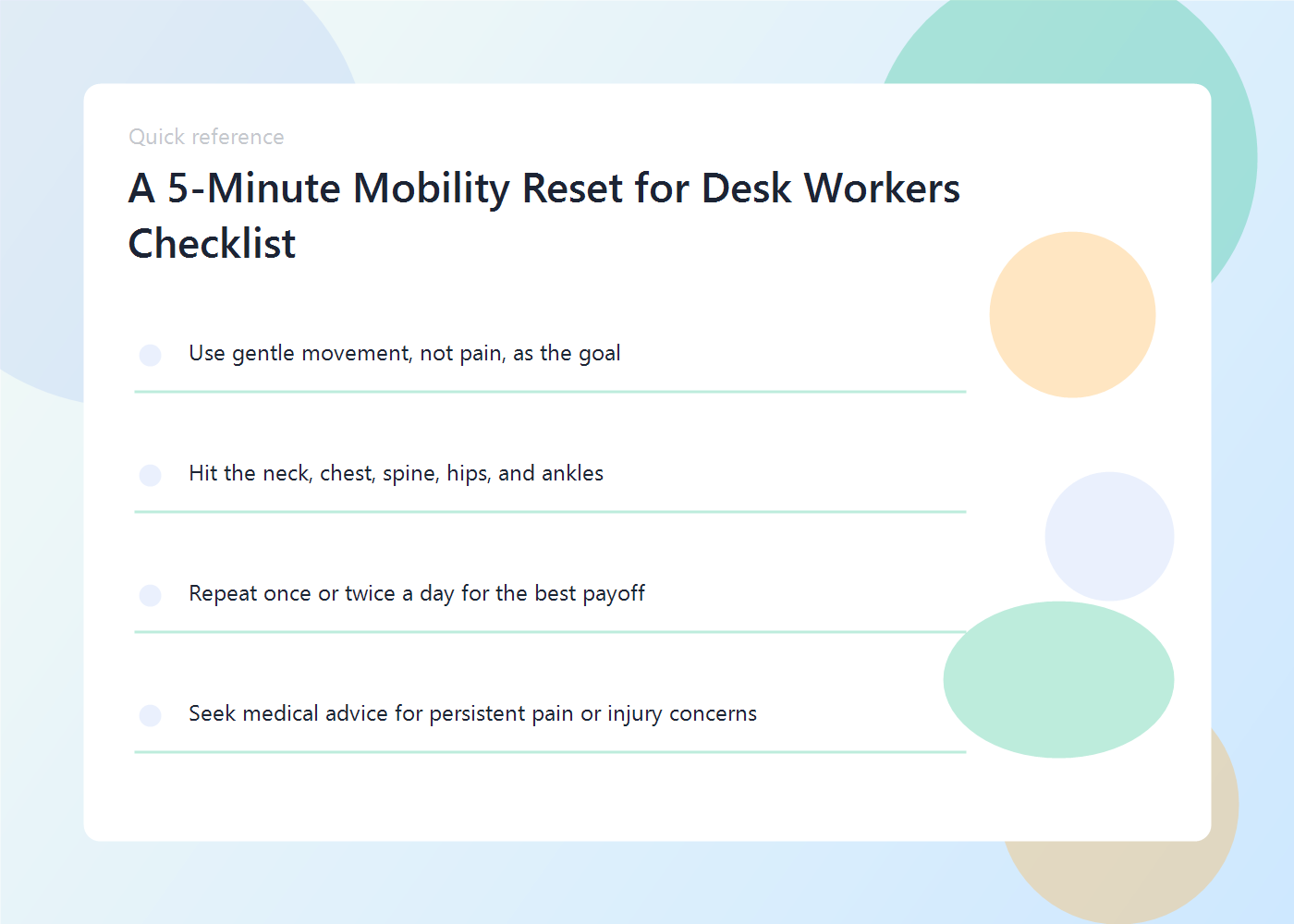
- Use gentle movement, not pain, as the goal
- Hit the neck, chest, spine, hips, and ankles
- Repeat once or twice a day for the best payoff
- Seek medical advice for persistent pain or injury concerns
FAQ
How often should desk workers do mobility breaks?
Even one or two short breaks a day can help, especially during long sitting periods. Consistency matters more than duration.
Should mobility exercises hurt?
No. Gentle stretch sensation is fine, but sharp pain, numbness, dizziness, or worsening symptoms are reasons to stop and seek guidance.
Is this a workout?
Not really. Think of it as a movement reset that supports comfort and circulation, not a replacement for strength or cardio exercise.
Related reads on Eight2Infinity
Why this topic matters right now
- Recent health content and workplace wellness guidance continue to focus on short, repeatable movement breaks for people who sit for long stretches.
- This article offers general wellness information only and is not medical diagnosis or treatment advice.