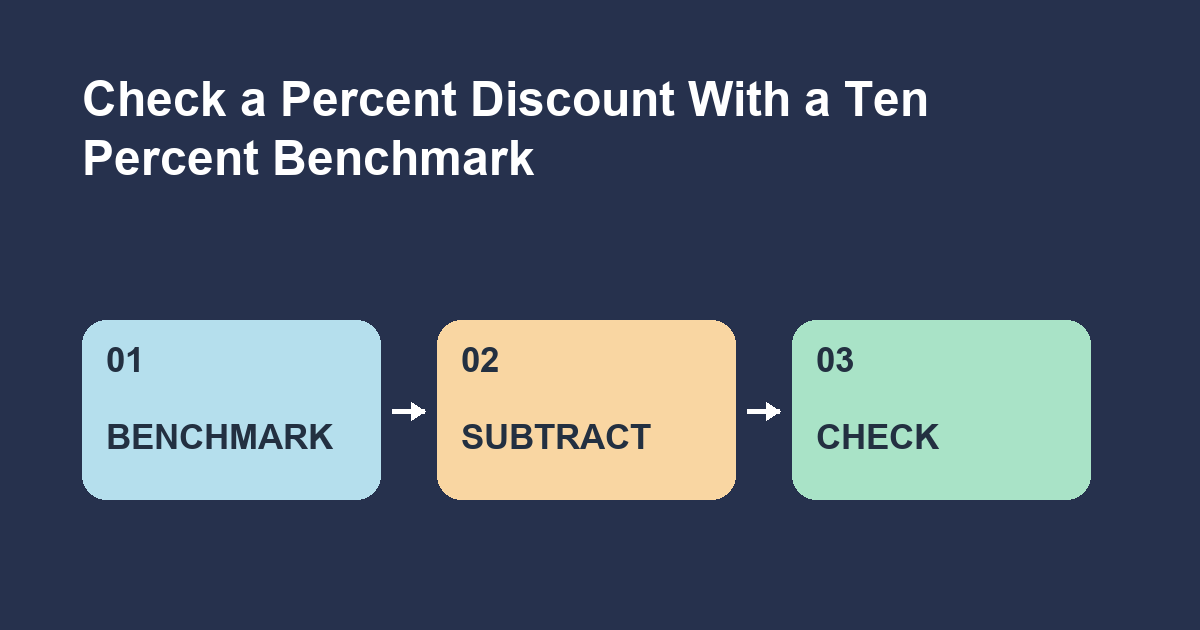
Find 10 percent of the original price as a benchmark, then build the discount from that amount. For a 15 percent discount on 60, ten percent is 6 and five percent is 3. The discount is 9 and the price before any tax is 51.
Label the two amounts
Write Original price 60 at the top of the page. Draw two arrows down to Discount 9 and Price after discount 51. The percent tells you what fraction of the original amount to remove. It helps to keep both results visible so the amount saved never gets mistaken for the price paid.
Check with a different calculation
Paying after a 15 percent discount means paying 85 percent of the original amount. Multiply 60 by 0.85 and compare it with the subtraction result. For a classroom extension, apply another 10 percent discount to 51. Ten percent of the new price is 5.10, so the result is 45.90. Each discount uses its own starting amount.
Try a new example
Find 25 percent off 48 by combining two tens and a five, then check by taking one quarter. What is the amount saved, and what is the final price? The checks are 12 and 36.