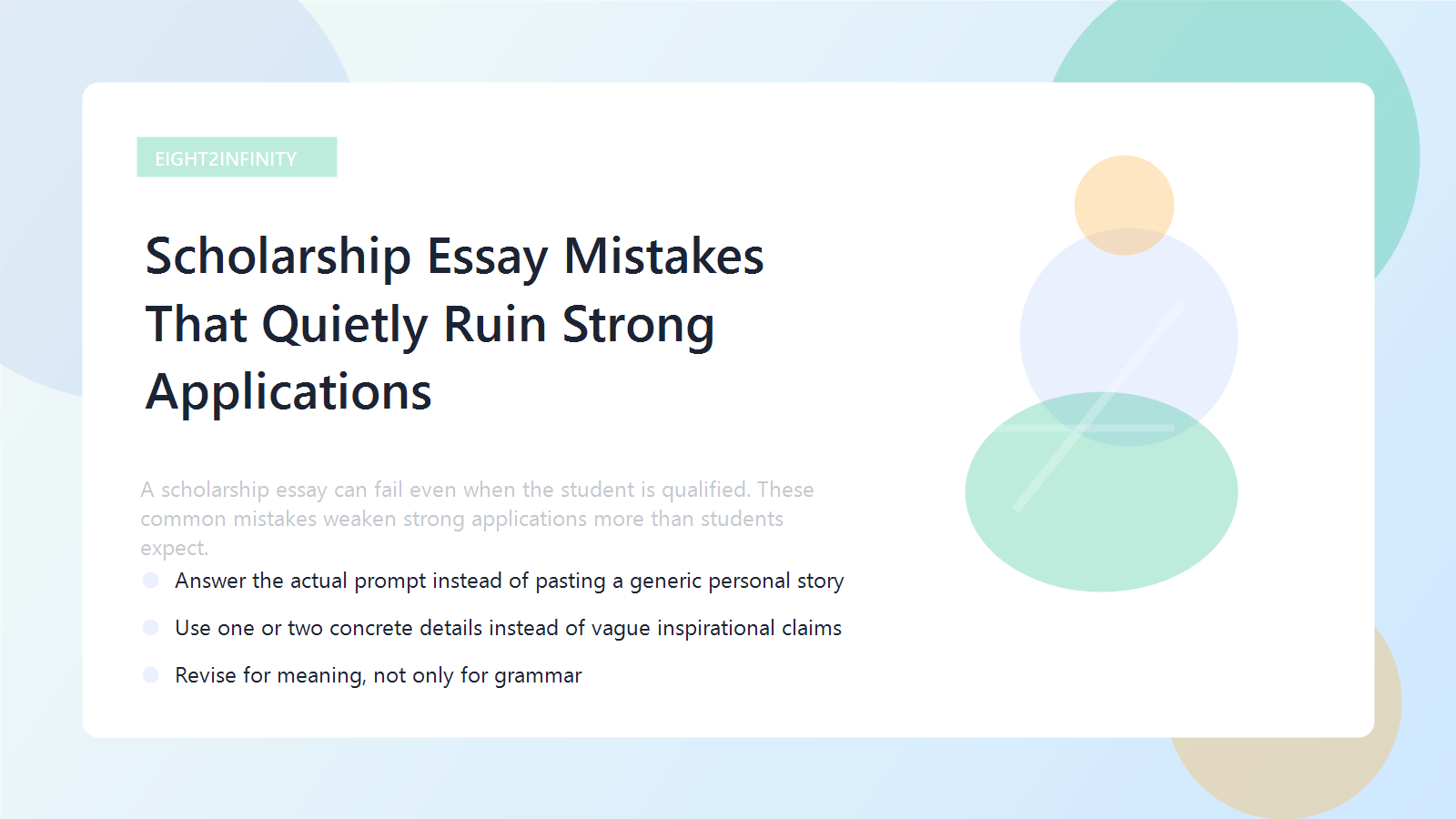
Short answer: A scholarship essay can fail even when the student is qualified. These common mistakes weaken strong applications more than students expect.
A student can be genuinely qualified and still write a weak scholarship essay. That is one reason these essays feel more frustrating than people expect.
The problem is rarely raw intelligence. It is usually process. Students answer the wrong question, sound too generic, submit something that never feels like a real person, or polish a first draft that needed deeper revision.
A strong scholarship essay does not need to sound grand. It needs to sound specific, intentional, and clearly connected to what the scholarship is actually asking.
Why good students still write weak essays
Many students focus so hard on sounding impressive that they stop sounding real. The result is broad language about leadership, resilience, or passion without enough detail to make any of it memorable.
Reviewers often read many essays in a row. Generic determination and recycled personal-growth language blur together fast unless a student gives the reader something grounded and clear.
The most common scholarship essay mistakes
Missing the prompt is one of the biggest errors. A well-written essay still fails if it answers a different question than the one being asked. Another common issue is choosing a dramatic story without making the insight or lesson clear enough to matter.
Students also damage strong applications by ignoring length limits, sending obvious template writing, or assuming grammar cleanup is the same as revision.
Mistakes worth checking for before you submit
- You answered a nearby question instead of the real prompt
- The essay sounds formal but not personal
- There are no memorable concrete details
- The conclusion repeats instead of clarifying your point
- Formatting or submission instructions were missed
What a stronger essay usually does
A stronger essay chooses one clear angle and supports it with a few concrete moments. That may be one small classroom experience, a family responsibility, a community project, or a decision that changed how the student thinks.
Specificity matters because it helps reviewers trust the voice. One well-chosen example usually does more work than a long list of claims about being hardworking and determined.
How to revise with better judgment
After the first draft, ask what the essay is actually saying about you. If another reader cannot answer that clearly, the essay still needs sharper focus.
Use one revision pass for content and one for clarity. Grammar matters, but meaning matters more. A clean sentence is not helpful if the idea inside it is still vague.
What to do when applying to many scholarships
Reusing structure is fine. Reusing the exact same emotional script for every scholarship is where quality drops. A short customization pass for the values, wording, and prompt emphasis can make a big difference.
If you are overwhelmed, start by identifying what this scholarship seems to reward most, then shape your story around that value instead of mass-submitting one unchanged essay everywhere.
Quick recap
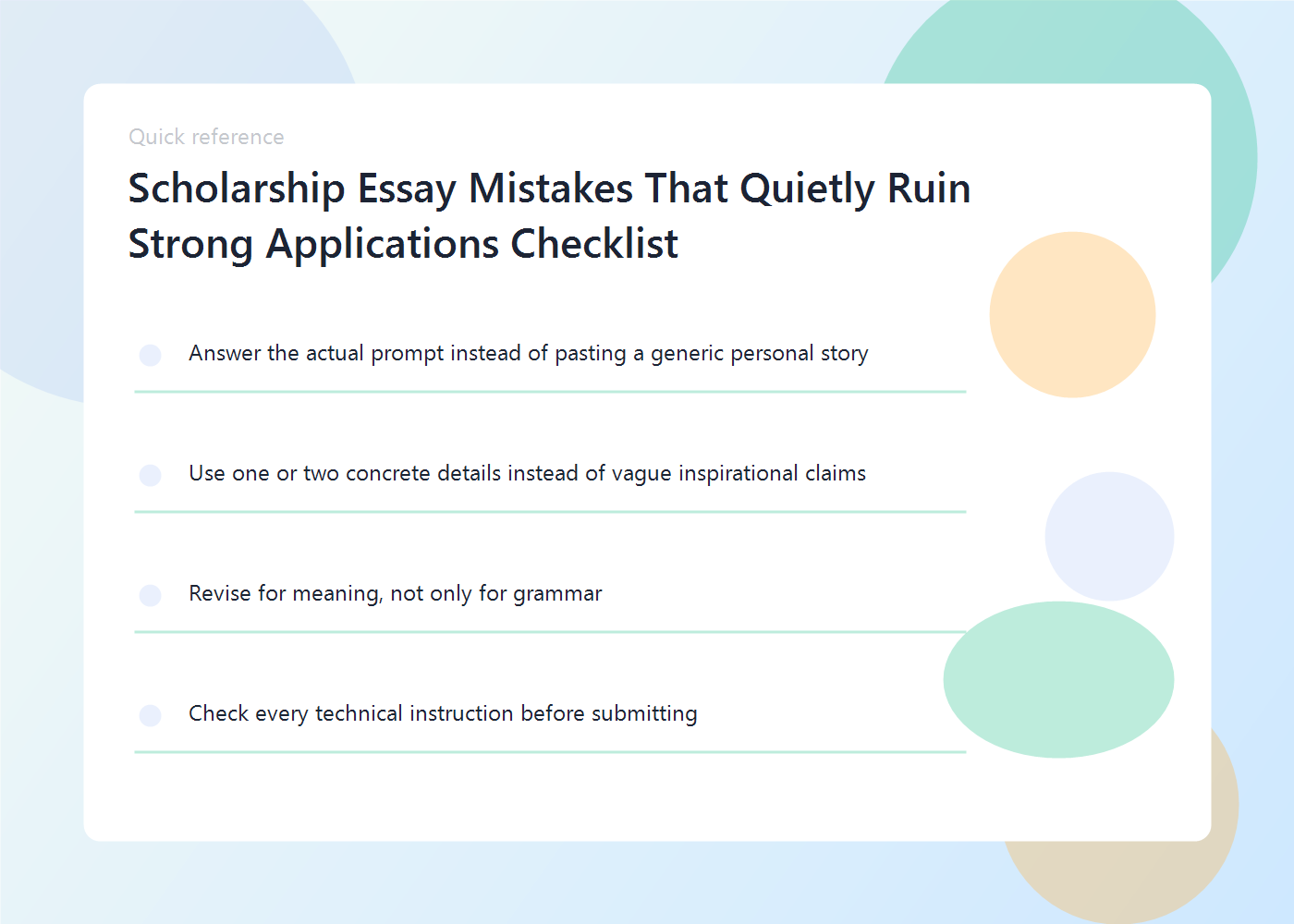
- Answer the actual prompt instead of pasting a generic personal story
- Use one or two concrete details instead of vague inspirational claims
- Revise for meaning, not only for grammar
- Check every technical instruction before submitting
FAQ
Should I write about hardship to stand out?
Only if it is genuinely relevant and you can reflect on it clearly. Hardship alone does not create a strong essay.
Is it okay to use AI to brainstorm?
Be careful. Your voice still matters most, and some scholarships now warn against AI-generated writing.
How many edits should a scholarship essay get?
Usually more than one. Aim for at least one content revision and one final clarity pass.
Related reads on Eight2Infinity
- Best AI Tools for Students Without Crossing the Line
- 10 Best Countries to Study Abroad for International Students in 2024
Why this topic matters right now
- Scholarship-writing guides and 2026 scholarship materials continue to show that prompt fit, specificity, and instruction-following matter as much as the student’s qualifications.
- Students still search heavily for essay help because weak essays often come from avoidable process mistakes, not lack of potential.