Prepare a round cake pan with a parchment circle
For a round cake recipe that calls for a lined pan, cut a parchment circle to fit the base and prepare the sides as the recipe directs. Check the paper before adding batter so it lies flat and does not leave a large uncovered edge. King Arthur Baking recommends parchment on the bottom with appropriate side preparation for cake release. This guide focuses on the preparation step; the recipe remains the authority for pan size, greasing, baking, cooling, and removal.
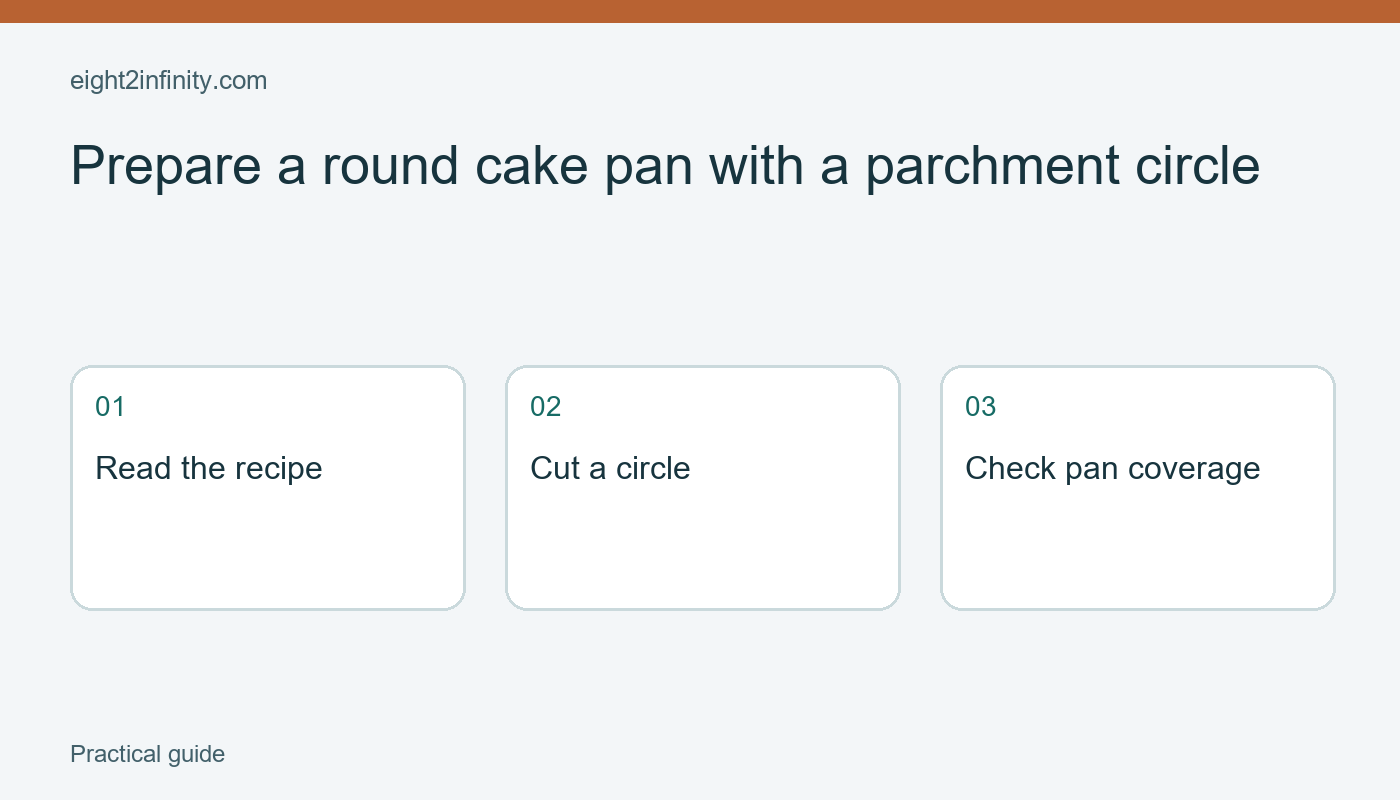
Read the recipe before cutting
Choose a recipe that explicitly uses a round pan and calls for lining or greasing it. Confirm the required diameter, depth, and number of pans. Do not assume that every cake needs the same preparation. Some recipes depend on a particular pan surface or method, so a familiar lining habit can be inappropriate. This exercise is intended for a conventional round layer-cake recipe with a parchment-lined base, not every sponge, tube cake, or specialist pan design.
Place the clean, dry pan on the counter while the oven is still safely out of the preparation area. Gather food-use baking parchment, a pencil, and scissors. Check the parchment packaging for its intended use and temperature limit, and follow those instructions. Do not substitute waxed paper or unidentified wrapping material. Keep packaging and loose paper away from heating elements. The aim is a fitted liner for a pan, not a sheet extending loosely into the oven.
Make a circle that fits the base
Set the pan on the parchment and trace around its outside base. Cut just inside the traced line, then place the circle inside the empty pan. Because the outside measurement includes the pan wall, the first circle may need a little trimming. Remove it and trim small amounts until it lies flat across the interior base. This is an ordinary fitting exercise, so work gradually rather than trying to achieve the perfect diameter in one large cut.
For a fictional practice example, imagine that a circle curls upward against the side at two points. That suggests the circle is slightly too large or not evenly cut. Trim the raised areas a little and test again. If the circle leaves a substantial strip of uncovered base, cut a new one rather than layering several scraps into an uneven patchwork. Save suitable clean offcuts only if you have a useful food-safe purpose for them; the fitted liner should remain simple.
Prepare the pan as instructed
Follow the recipe's greasing directions and the pan manufacturer's care instructions. King Arthur's cake guidance describes lining the base with parchment and treating the sides appropriately for release. Different recipes may call for different fats, sprays, or additional preparation. Do not turn one method into a universal rule. If the recipe specifies an ungreased surface or another special technique, pause and check why before applying the lining method from this article.
Put the fitted circle on the prepared base according to the chosen recipe's order. Smooth it gently so it sits flat, without folds or an obvious trapped pocket. Inspect the junction between the paper and the sidewall. A base liner does not need to rise up the walls like a sling for this task. If the recipe asks for a collar, that is a separate component with its own instructions. Keep the preparation matched to the actual cake and pan.
Check the setup before batter arrives
Read the pan size once more and compare it with the recipe. A neat parchment circle cannot compensate for a pan with the wrong capacity. If you are making two layers, prepare both pans before mixing the batter so you do not discover a missing liner at the last moment. Put the prepared pans in a stable, clean place away from the edge of the counter. Keep scissors, pencil, and paper scraps out of the mixing area.
Make a short preparation note for your own recipe file: Exact pan used, base lined, sides prepared as directed. This is more useful than writing Pan ready when you later try to reproduce the setup. If you are helping someone else, ask them to inspect the circle and read the recipe's pan-preparation sentence before you start mixing. A second reading can catch a missed instruction without requiring any claim that the method has been experimentally tested in your kitchen.
Treat baking and release as later steps
Add batter, bake, cool, and remove the cake according to the recipe. Use appropriate oven protection when handling hot pans. Do not assume that parchment makes a hot cake safe to lift by hand or that every cake should be turned out immediately. Cooling time and removal technique depend on the cake and pan. If release is difficult, consult the recipe's troubleshooting guidance rather than forcing a knife around a delicate or coated pan surface.
For a reader exercise, cut and fit a parchment circle in an empty round pan before a planned baking session. Can it lie flat without climbing the sides, and does it cover the base without a large gap? Then identify the exact recipe instructions for the sides and cooling period. Write those as separate checkpoints. This keeps three decisions distinct: fitting the paper, preparing the pan surface, and removing the finished cake at the appropriate time.